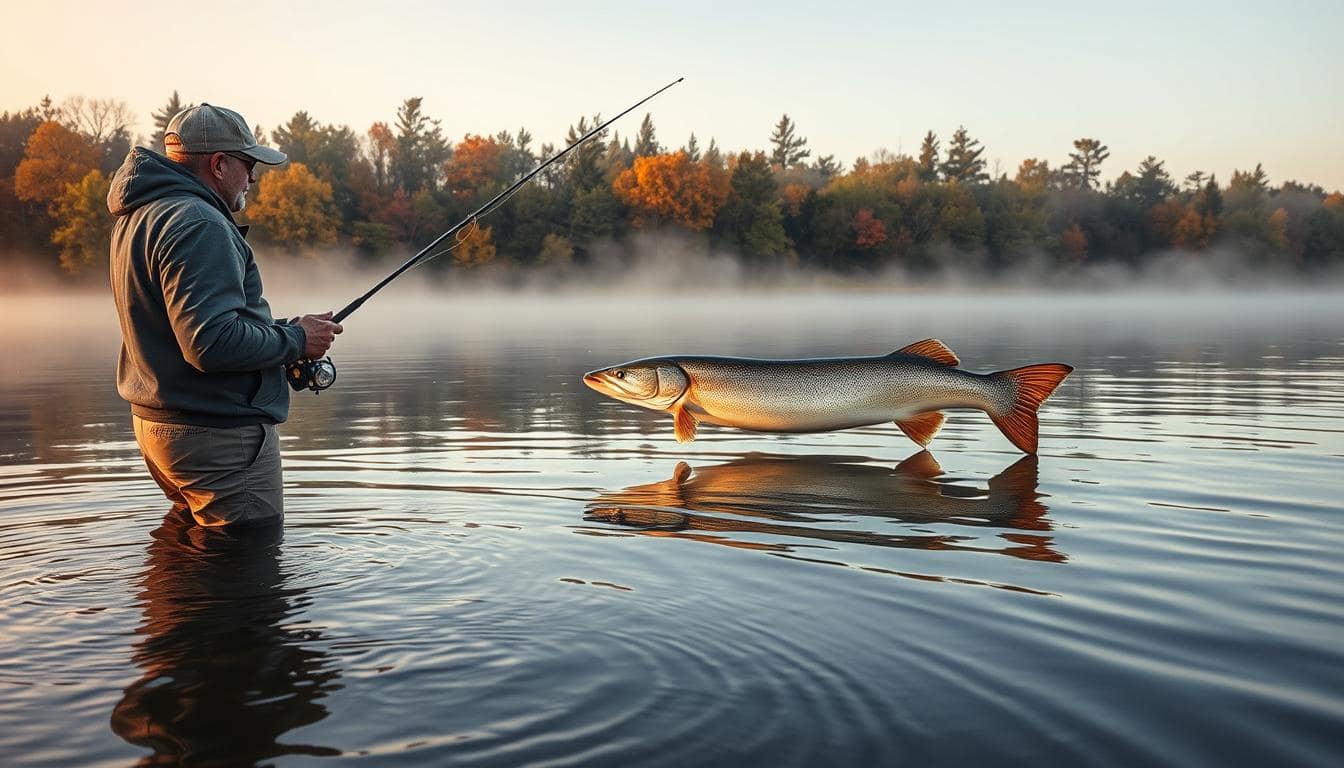

Let’s be honest about the “fish of ten thousand casts” moniker. Blindly throwing lures and hoping is like buying a lottery ticket. It’s not a skill-building strategy.
True muskie tactics focus on understanding a muskie’s mind. It’s like solving a mystery. I start by knowing the muskie’s seasonal habits.
Reading the signs is key. Look for temperature changes and baitfish activity. I think like a muskie, searching for the easiest meal.
Today’s electronics help me find muskies. I mark spots where they might ambush prey. This smart approach is the heart of the hunt, whether in late summer or fall. The cast is just the start of my plan.
Gear Setups for Power Casting
Your muskie rod should feel like a medieval siege weapon. It’s not just about casting; it’s about launching a declaration of war. Big lures need big leverage.
Your rod is like a trebuchet arm. Choose an 8-to-10-foot, extra-heavy rod. I prefer a St. Croix Big Plastics Rod, 9-foot, extra-heavy, fast-action. It’s strong enough to control and throw big lures.

The reel is like a winch on a recovery vehicle. A standard bass reel won’t do. You need a Daiwa Lexa 400 or similar. It should hold 65-80 lb test braided line and have strong drag washers.
Use braid for your line. It has little stretch, so your hookset feels direct. Mono stretches and gives fish a cushion. Braid is firmer.
Now, let’s talk about the big lures. Choose based on your strategy. A topwater “Big Makk” creates chaos on the surface. It’s like a performance art piece.
A crankbait like a “Kamakaze” sends vibrations through the water. It’s like a heavy metal concert for fish. A spinnerbait with a large blade offers a slower, wider pulse.
Soft plastic lures like Medusas and Bulldogs are the real test. They’re heavy and catch water like parachutes. Casting them all day is an athletic challenge. You need a St. Croix Big Plastics rod and a Lexa 400 reel for this.
Your gear must work together as a system. A weak rod with a strong reel is pointless. A strong rod with a weak reel is dangerous. Your gear should conquer big lures and attract big fish.
Casting big lures all day is physically demanding. Your body becomes part of the system. Proper conditioning and recovery are as important as your gear. The best gear is useless if your body can’t handle it.
So, you’ve got your gear ready. The long rod, the strong reel, the braid, and the big lures. This is your vocabulary for talking to muskies. Make sure you can speak clearly and forcefully all day long.
Technical Retrievals
Think of your retrieve as a conversation with a fish that’s not yet ready to join. A steady crank is like small talk. But you need a compelling argument with surprises. You need cadence.
Monotony is the enemy. Change your speed like a storyteller changes their pace. Use stop-and-go to mimic injured prey. This “change-up” cadence makes followers commit. It’s like a cliffhanger for fish.
For topwater lures, walk confidently and rhythmically. Wait for that heart-stopping “V-wake” behind your bait. With a deep-diving crankbait, use short, downward taps of the rod tip.
Make it dive, then pause. Let it float up erratically. That pause is where the magic happens. It’s the moment of perceived vulnerability. It’s when a curious follow becomes a violent strike.
Now, let’s talk about the grand finale. The figure-eight technique at the boat isn’t optional. It’s your closing argument. I’ve seen more giant muskies appear during this final, wide sweep than at any other moment.
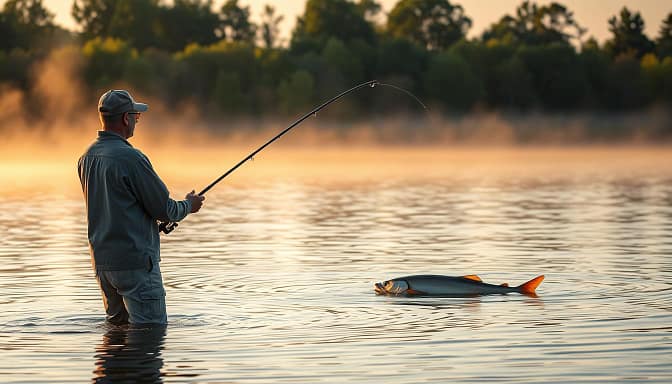
Why does it work? You’re presenting one last, irresistible opportunity right in the fish’s living room. It’s a sudden, aggressive movement that often triggers a purely reactionary bite. Execute it with purpose. Make it wide. Make it aggressive.
For some lures, like flashy spinnerbaits, a steady retrieve does the work. The vibration and flash are the attraction. But always end each cast with that forceful underwater figure-eight. It seals the deal.
Live bait fishing requires a different script. This is where precision matters. The quick-strike rig is a masterpiece of efficiency. The nose hook and trailer hook are skin-hooked lightly. This minimizes stress on the bait and allows for instant hooksets.
Watch the float. A nervous twitch becomes a submarine dive. That’s your cue. The hookset here isn’t a savage jerk. It’s a smooth, sweeping load of the rod. You’re driving the points home with controlled power.
Mastering your retrieve speed is the key to converting looks into bites. Every retrieve tells a story. Is yours a boring memo or an epic tale with a killer ending? Make sure it has a plot twist. Make sure it ends with the definitive figure-eight technique.
Musky Conditioning Exercises
Muskie fishing is like Navy SEAL training in freshwater. Your gear is ready, and you’re skilled at retrieving it. But the real challenge is the conditioning.
This isn’t about getting six-pack abs. It’s about building strength to cast a 10-ounce rod 500 times without hurting your shoulder.
The physical effort is intense. Your back and core work hard to generate power. Your forearms feel the burn from long fights. But the biggest challenge is in your mind.
It’s about patience and analyzing every detail. You learn to read a side-imaging screen like a map. This mental game sets the pros apart from beginners.
Using planer boards becomes second nature. You cover water with precision. This skill is what separates the good anglers from the great ones. Some even use pike and pickerel to prepare for muskie fights.
This practice helps build confidence for those intense muskie strikes.
It prepares you for the fast-paced action of boat-side hits. You learn to keep your fly moving in a figure-8, even when your heart is racing. This is a war of endurance, where patience is key.
There’s also an ethical side to muskie fishing. Using quick-strike rigs and rubberized nets shows respect for the fish. It’s about catching and releasing for future generations.
Catching muskies is not just about the fish. It’s about becoming a better angler. Every muscle ache and moment of focus is worth it for that perfect catch.
The real reward is the angler you become, not just the fish you catch.


