
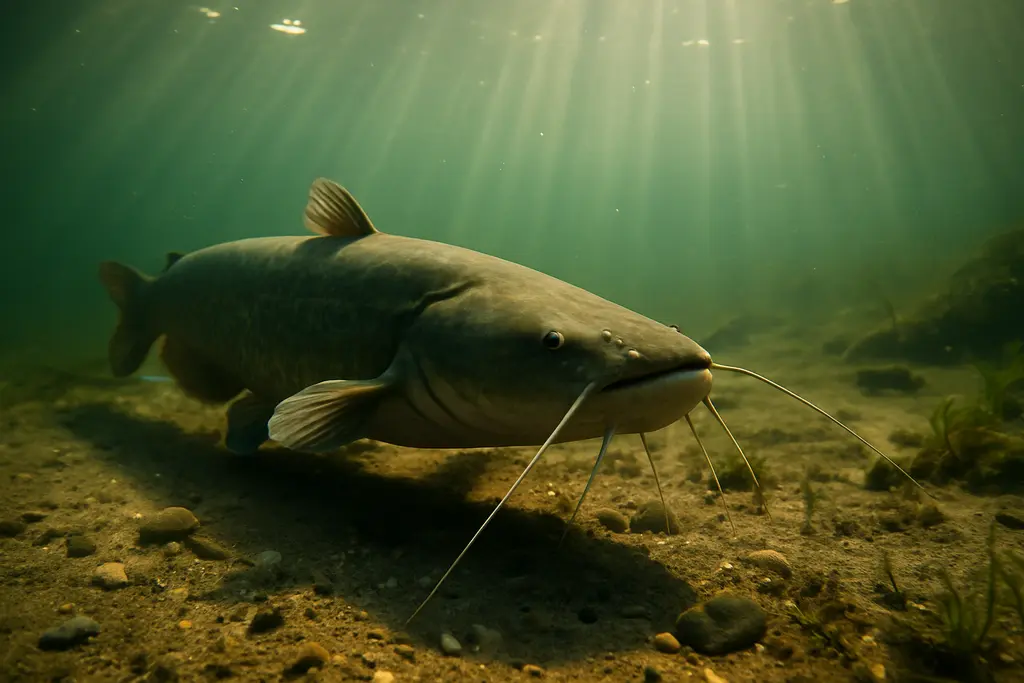

August catfish behavior can fool good anglers because “deeper” does not always mean “park a bait on the bottom and wait.” Late-summer fish may use depth as a daytime refuge, then rise through the water column as light fades and prey movement improves. The best move is to fish the clock, the depth change, and the flow change together instead of treating August like one long hot afternoon.
I’m Jasmine Pruitt, and this is the part of catfishing I love: fish are not random, even when they seem rude enough to ignore perfect bait. Research on European wels catfish gives us useful behavior clues, though we should not pretend every blue, flathead, or channel cat in a U.S. lake follows the same script. The value is in the pattern: light, temperature, depth, and flow can shift where catfish hold and when they climb to feed.
August Catfish Behavior Starts With Light
August Catfish Behavior In Daylight
In late summer, start by separating daytime holding depth from feeding depth. A fish can be deep at noon without feeding hard there. In Upper Lake Constance, researchers tracked European wels catfish for more than 85,000 hours and reported an average summer swimming depth near 4.1 meters, with fish diving deeper during summer days and rising toward the surface from dusk through dawn; thermal and light conditions were reported as primary drivers in the Movement Ecology study.
That matters on the water because your first daylight set should test where fish can rest comfortably, not where you wish they were feeding. If your electronics show fish tucked along a break, timber edge, channel lip, or submerged contour, set one bait near the holding zone and one bait slightly above it. Catfish rising to inspect bait may not want to pin themselves tight to bottom in brighter hours.
Dusk Through Dawn Is Not A Guess
The dusk-to-dawn rise is the tactical gift. Instead of anchoring once and sulking, plan a controlled shift. During the last bright stretch of the day, fish deeper structure. As light fades, move baits up the slope, onto the top edge of the break, or into the travel lane that connects deep water to shallower forage areas. If you fish from the bank, that may mean casting one bait short and one bait long rather than launching every rig to the same distant hole.
For August catfish behavior, the best “deep” plan is often a stair-step plan. One bait checks the lower edge, one checks the mid-depth lane, and one checks the upper edge if your local rules and setup allow it. The goal is to intercept movement, not just soak bait where fish spent the afternoon.
Depth Clues From Telemetry Studies
What The Constance Tracks Suggest
The Lake Constance study also reported much deeper winter use, with mean winter depth near 13.1 meters compared with the summer mean near 4.1 meters. That is a useful warning against oversimplifying late summer. Hot weather does not automatically push every tracked catfish to the deepest available water for the whole season. The sharper lesson is daily vertical movement: deeper by day, higher from dusk through dawn.
Anglers can turn that into a clean routine. On a sunny afternoon, look for the nearest comfort water beside feeding access. That might be a channel swing, a steep bank, a bridge approach, or a deeper outside bend. Then ask one practical question: “Where can this fish rise with the least effort when light drops?” Your best set is often near that path.
What The Belver Reservoir Adds
A separate acoustic telemetry study in Portugal’s Belver reservoir followed 10 invasive European catfish and found median depths near 4.8 meters in summer, 2.6 meters in spring, 9.8 meters in autumn, and 10.8 meters in winter; the same paper identified photoperiod and river flow as strong predictors of depth use in the Ecology of Freshwater Fish study.
For anglers, flow is the part to respect. If water movement increases after rain, dam generation, or reservoir management changes, do not keep fishing yesterday’s shallow pattern just because it worked once. Based on that study, stronger flow can be a signal to test deeper water. Not all deeper water is equal, though. A dead basin with no clear travel route is less attractive than a deeper edge connected to current seams, flooded cover, or bait movement.
Turn Research Into A Late-August Plan

Start Deep, Then Stair-Step Up
August catfish behavior rewards anglers who build a depth spread before they build an excuse. Pick a target area with a clear vertical route: a ledge, creek mouth, point, outside bend, or steep bank. In daylight, place your deepest bait near the holding zone. Put a second bait halfway up the break. If you have room for a third, set it near the upper travel lane as the sun drops.
- Midday: Favor deeper structure or shaded depth changes, then keep one bait slightly above the fish if they appear suspended.
- Late afternoon: Hold the deep bait, but move another bait toward the first shelf or slope above it.
- Dusk through early night: Shift effort toward routes that connect deep water to shallower feeding lanes.
- After a flow increase: Recheck deeper edges before blaming bait, moon, or boat traffic.
If you are working stratified water, pair this timing plan with your lake’s oxygen picture; our notes on summer catfish oxygen levels explain why cooler water alone is not always the answer. The practical test is simple: if marks, bites, or bait activity disappear below a certain layer, stop forcing rigs into dead water and fish the usable edge above it.
Adjust After Flow Changes
Flow changes can reset the board fast. In reservoirs and rivers, treat a noticeable increase in flow as a reason to repeat your search, not as background noise. If the bite was shallow before the change, slide one bait deeper and one bait into a protected seam. If fish were already deep, tighten your presentation near structure that breaks current without cutting fish off from food.
Boat anglers should avoid racing from spot to spot too quickly. Give each depth band enough time to show life, then move with purpose. Bank anglers can do the same by changing casting angles. Cast across a slope with one rod and along it with another. The second angle often tells you whether fish are traveling the edge or simply holding at one depth.
August Catfish Behavior For Better Late-Summer Sets
Build A Two-Window Fishing Log
The smartest teams keep two late-summer logs: daylight holding clues and low-light feeding clues. Write down depth, light level, flow condition, bait position, and whether the fish hit on bottom or above it. After a few trips, you will see whether your water rewards deep daytime soaking, dusk slope moves, or night baits set higher in the column.
Treat August catfish behavior as a timing problem first and a bait problem second. Fresh bait still matters, rig control still matters, and patience still matters. But if your bait is sitting under inactive fish at noon or below rising fish at dusk, the prettiest rig in the boat is just decoration. Fish deeper with a plan, move upward with the light, and let each bite teach you where the next bait belongs.


