
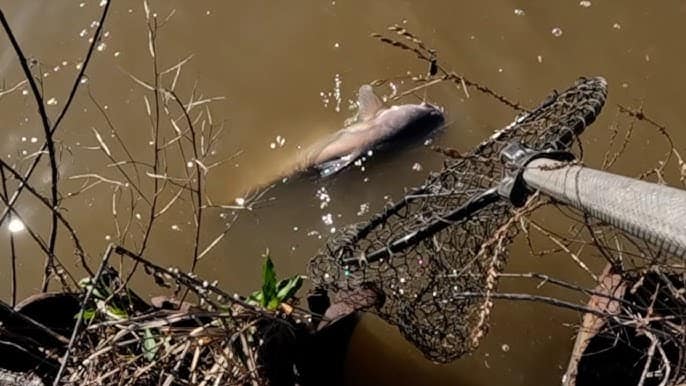
A Florida river turning brown after heavy rain looks like a problem if you judge fishing with your eyes. Anglers trying to catch catfish in muddy water should make the opposite adjustment: stop worrying about visibility and start asking where the rising current is carrying food, scent and fish.
That distinction matters in September. Current guidance for the Blackwater and Yellow rivers says high, muddy water after rain can hurt bass and bream catches while still creating good catfish conditions. The same current river forecast points channel-cat anglers toward deep outside bends during daylight and sandbars later in the day, with chicken liver and cut mullet among the recommended baits.
High Water Changes the Map Before It Changes the Bait
The first mistake after a hard rain is changing bait before changing position.
Rising water increases current, covers new shoreline and changes how food moves through a river. A hole that was comfortable holding water yesterday can become an exhausting place for a fish once flow accelerates.
Catfish still need to feed, but they do not gain anything by sitting in the hardest current all day.
That is why soft water beside hard current becomes so valuable.
Look for places where a fish can conserve energy while remaining close enough to intercept food moving downstream. A current seam beside a flooded bank, the back side of timber or the edge of a creek mouth can offer more than the deepest part of the main channel.
The important change is not that the water became dirty.
The river reorganized itself.
Catch Catfish in Muddy Water by Fishing the Boundary
The best muddy-water spots often exist where two conditions meet.
Fast water beside slow water. Main-river flow beside an eddy. A stained tributary entering water of a different color. Flooded shoreline draining toward the channel.
Those boundaries give anglers something visible to work with even when they cannot see six inches beneath the surface.
| Water Position | What the Catfish Gets | Angler Approach |
|---|---|---|
| Main heavy current | Food movement but high energy cost | Usually avoid the hardest flow |
| Current seam | Food delivery beside manageable water | Place bait just inside the softer edge |
| Behind large timber | Current protection and passing forage | Fish downstream of the obstruction |
| Creek mouth | New water, scent and drifting food | Cover the mixing zone |
| Outside-bend pocket | Depth, cover and current | Work the slower edge, not just the deepest point |
| Flooded margin | Newly available forage | Test it when current remains manageable |
The pattern is simple: fish the boundary, not the flood.
That can mean making a shorter cast than usual. Catfish pushed away from extreme current may be holding surprisingly close to shore instead of in the middle of the river where anglers instinctively throw.
Outside Bends Work Until the Current Gets Too Heavy
Outside bends deserve attention because river current naturally scours deeper water there and frequently deposits fallen timber, undercut cover and sharp depth changes.
Under normal or moderately elevated flow, that combination can be excellent.
But there is a limit.
When current through the deepest section becomes too strong, the best position may slide away from the center of the hole toward its edge, downstream pocket or adjoining seam. The fish have not necessarily abandoned the bend. They have repositioned inside it.
That is the detail that separates finding structure from actually fishing it.
Place one bait where current first meets the bend, another behind useful cover and a third toward the softer downstream edge. If only the protected rod produces, you have learned more than you would by putting three baits into the same deep slot.
A useful companion to that approach is understanding how catfish find food. Current determines where chemical signals travel, so bait placement can matter as much as bait strength.
Let Scent Ride the Current Instead of Fighting It
Muddy water makes scent presentation more important, but that does not mean adding the strongest-smelling substance imaginable and throwing it anywhere.
Current has to deliver the message.
Channel catfish feed on insects, crayfish, mollusks, crustaceans and fish, and current Florida guidance recommends odor-producing offerings such as chicken liver, shrimp, cut mullet and commercial stinkbaits. The channel catfish fishing guidance also notes that these fish are particularly active around dusk and after dark.
Fresh cut bait can be especially practical in moving water because it combines scent with natural texture and stays usable when properly hooked.
But more scent cannot fix bad placement.
Imagine the plume downstream of your bait. If that scent is being swept harmlessly through open current while the fish are holding in slack water twenty feet away, the presentation is missing them.
Move the bait before replacing it.
Use Enough Weight to Control the Rig, Not Defeat the River
Heavy water encourages anglers to solve everything with heavier sinkers.
Sometimes that is necessary. A bait rolling uncontrollably across bottom is difficult to keep in a productive lane.
But there is a point where adding more lead becomes evidence that you are fishing the wrong water.
If an extreme amount of weight is required merely to keep the rig from tumbling downstream, look nearby for a softer seam, protected pocket or current break. Catfish may be doing exactly the same thing.
Control matters more than brute force.
The rig should remain where you intend while still allowing bait to move naturally enough to send scent and vibration through the water.
Flood conditions also carry sticks, grass and larger debris. Check lines frequently. A rig buried under vegetation may remain perfectly still while becoming practically useless.
Fewer well-positioned rods can outperform a wide spread that spends the evening collecting everything coming downriver.
River Stage Is the Signal That Can End the Pattern
Muddy water can improve catfishing. Dangerous water does not.
The same current forecast that identifies productive muddy-water catfishing also warns that high water can make upper sections of the Blackwater difficult to fish and recommends checking river levels before going.
Watch the rate of rise, not merely the color.
A river climbing quickly can move debris, cover ramps, alter familiar channels and strengthen current faster than an angler expects. Heavy rainfall upstream can also change conditions even when skies at the launch are clear.
The productive window is water that concentrates food and changes fish position while remaining safely fishable.
When navigation becomes questionable, the fishing decision is already made.
Muddy Water Rewards Anglers Who Read Current First
Learning to catch catfish in muddy water is less about discovering a secret rain bait than learning to recognize where a river becomes efficient for the fish.
High water can push food into motion. Mud can reduce visibility without preventing catfish from feeding. Current seams, creek mouths, protected bends and downstream sides of cover can concentrate exactly the combination of manageable flow and available food an active catfish needs.
That makes the next move straightforward.
Do not wait automatically for the river to clear. Do not throw straight into the hardest current because it looks powerful. And do not assume a deep hole remains productive simply because it was good before the rain.
Find the boundary where fast water loses some of its force.
Put the bait where the river can carry its scent through that lane.
Then let the muddy water work for you instead of against you.


