

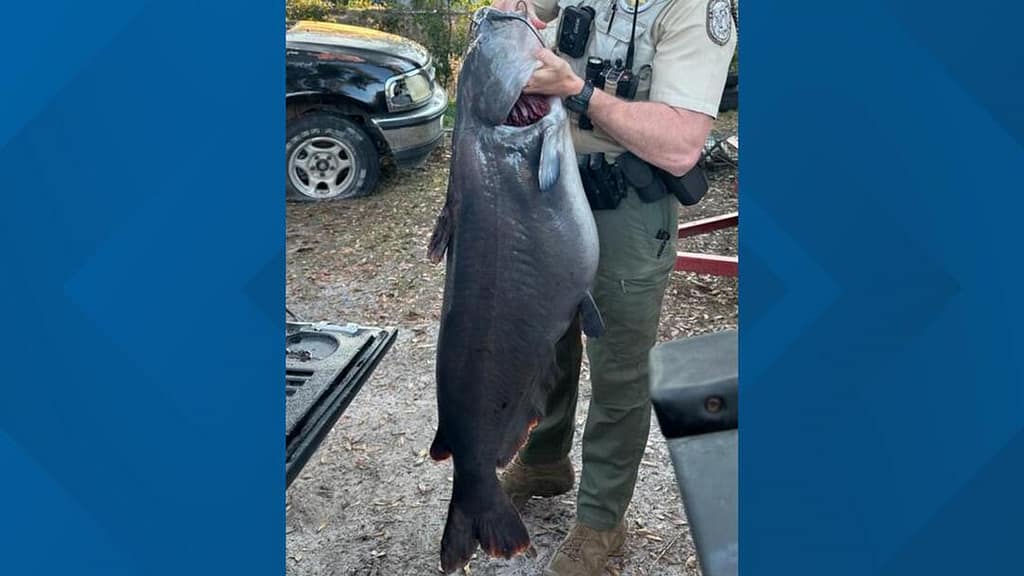
The Florida record blue catfish landed at the perfect moment for anglers already watching big-river catfish patterns tighten in late spring. A 73.6-pound blue cat from the Suwannee River does more than rewrite a state mark; it raises the better question of how many heavy fish are still using Florida’s bends, holes, ledges, and current seams without ever seeing a scale.
For a fishing story to matter beyond one photograph, it needs a larger lesson. This one has it. The record connects size with river habitat in a way that should make catfish anglers look harder at the water they already know.
Why Florida’s Record Blue Catfish Matters Now
The new attention around the Florida record blue catfish is not just another trophy-fish headline. Justin Hodge’s 73.6-pound blue catfish from the Suwannee River gives anglers a fresh reason to think seriously about river systems that may look familiar on the surface but still hold fish capable of changing local history.
The fish has the kind of numbers that sharpen interest: 73.6 pounds, 48.5 inches long, and a 36.75-inch girth. Those details matter because they make the catch more than a vague big-fish claim. They place it in the measurable world of records, verification, and fisheries credibility.
Record fish also reset public imagination. A river that produced a 73-pound blue cat starts to feel different. Anglers begin thinking about deeper bends, overlooked holes, bait movement, and whether their own rigs are strong enough if a fish like that actually eats. That is the power of a legitimate record: it changes the way people read ordinary water.
What A 73.6-Pound Blue Cat Says About The Suwannee River
The Suwannee River already carries a certain mystique. It has dark water, long bends, wooded banks, and the kind of old Florida character that makes anglers slow down and pay attention. A state-record blue catfish adds another layer to that identity.
Large catfish do not reach that size by accident. They need food, time, survivable conditions, and enough habitat complexity to avoid constant pressure. A fish that heavy suggests a system with real capacity, even if one catch alone does not define the entire population.
That is where anglers should be careful. One record does not prove that giant blue cats are everywhere in the Suwannee. It does prove that at least one extraordinary fish grew there long enough to become the official mark. That alone creates confidence for anglers willing to study the river rather than simply drift bait and hope.
The best takeaway is not that every cast might produce a state record. The better takeaway is that rivers with depth, cover, forage, and low-pressure stretches can hide fish much larger than most anglers expect. That possibility creates curiosity, but it should still be handled with discipline.
Florida Record Blue Catfish And The Big-River Pattern
The Florida record blue catfish also fits a broader big-river pattern. Trophy blue cats are often connected to channels, ledges, holes, bends, and areas where bait naturally concentrates. They may roam, but they do not move without reason. Food and efficiency still rule the day.
That is why the Suwannee angle is so useful. It reminds anglers to focus less on random shoreline and more on functional water. A deep bend with nearby current. A hole close to a feeding flat. A channel edge that guides baitfish. A hard transition where scent can move. Those are the places where big fish have a reason to stay nearby.
This is also where seasonal timing matters. Late spring can bring stronger feeding windows as catfish respond to warming water, bait movement, and pre-spawn behavior. The precise pattern varies by river, but the larger principle is consistent: big fish use structure when food becomes predictable.
Anglers who want more practical context around seasonal positioning can use low-water catfish pattern analysis to think through how changing river levels, feeding lanes, and structure affect where catfish stage. That kind of context turns a record story into useful fishing analysis.
The Record Creates A Question Anglers Love
Every record fish creates a quiet debate at boat ramps and bait shops: was it a once-in-a-generation catch, or proof that bigger fish are still out there? The honest answer is usually somewhere in the middle.
A record fish is rare by definition. If fish that size were common, the record would change constantly. Yet the existence of a verified giant means the system has already done the hardest part once. That keeps the possibility alive.
Could there be another fish in the Suwannee close to that class? Could a deeper hole, remote bend, or underfished stretch hold an even heavier blue cat? Those questions create momentum, and momentum sends anglers back to the river with better gear and sharper plans.
The risk is turning curiosity into exaggeration. Record stories can make people overstate what a fishery can produce. Serious anglers should keep their excitement grounded. The record is a signal, not a guarantee.
How Giant Blue Cats Use Habitat
Big blue catfish are often described as roaming predators, but that should not be misunderstood. Roaming does not mean wandering without purpose. Large blues move along productive routes, using depth changes, current, and forage to feed efficiently.
In a river setting, that often means bends, holes, channel swings, and edges where current carries food. In reservoirs, it may mean ledges, flats near deep water, and bait-rich channels. The best areas share one trait: they reduce the amount of energy a big fish must spend to eat.
That is why the word “habitat” matters. Habitat is not just scenery. It is the working environment that creates opportunity. A logjam may provide cover. A channel drop may provide travel. A mud flat near depth may provide feeding access. A creek mouth may deliver food.
The blue catfish species profile helps frame why the species can become such a force in large river environments. Blue cats are built for size, adaptability, and opportunistic feeding, which makes them fascinating sport fish and complicated management subjects.
What Anglers Should Learn From The Catch
A record blue catfish should make anglers audit their own approach. Not because everyone needs to chase records, but because big fish expose weak thinking. If the goal is a heavy catfish, location, bait, timing, and gear all need to line up.
| Factor | Why It Matters For Trophy Blue Cats |
|---|---|
| River structure | Gives big fish travel lanes, cover, and feeding edges |
| Fresh bait | Creates natural scent and matches local forage |
| Depth changes | Let fish move between comfort and feeding zones |
| Current seams | Carry food and scent through predictable lanes |
| Gear strength | Prevents avoidable losses when a heavy fish turns |
| Local regulations | Keeps harvest and release decisions responsible |
The table is simple, but the lesson is not. Trophy catfishing is often a game of stacking advantages. A fresh bait in a poor spot may fail. A great ledge with dead bait may underperform. Strong gear with weak knots can still lose the fish.
That is why serious catfish anglers tend to become methodical. They check leaders. They sharpen hooks. They watch river stages. They pay attention to bait movement. The record fish is exciting, but the process behind finding big cats still demands execution.
The Trade-Off Between Trophy Fishing And Regular Action
A state-record blue catfish can tempt anglers into fishing only for giants. That is understandable, but it comes with tradeoffs. Trophy setups often mean bigger baits, longer waits, heavier tackle, and fewer bites.
There is nothing wrong with that. Some anglers would rather wait all night for one serious fish than catch ten smaller ones. Others want steady action, especially when fishing with kids or newer anglers. The key is knowing which trip you are actually planning.
A trophy-minded angler may focus on deep bends, large cut bait, prime windows, and fewer rods placed with precision. A numbers angler may fish smaller bait near creek mouths, flats, and accessible feeding zones. Both approaches can be enjoyable, but they require different expectations.
This is where judgment matters. If the goal is a family outing, steady bites may create the better memory. If the goal is a personal-best blue cat, quiet hours become part of the cost. Catfishing rewards patience, but patience should be attached to a clear strategy.
Why Record Fish Raise Conservation Questions
A record catch also brings conservation into the conversation. Blue catfish are not viewed the same way in every waterbody. In some systems, they are celebrated as trophy fish. In others, they are managed as invasive predators with serious ecological consequences.
Florida’s record does not erase that complexity. It actually highlights it. Anglers need to understand where they are fishing, what regulations apply, and how local managers view the species. A fish worth celebrating in one context may require a different management approach elsewhere.
That tension is part of modern catfish fishing. The species can be thrilling, valuable, and disruptive depending on location. Mature anglers should be able to hold those ideas at once. Celebration and accountability are not enemies.
Handling decisions also matter. Some record fish are harvested, some are released, and some are verified after the fact. The ethical question depends on rules, condition, angler intent, and fishery context. The constant should be respect for the fish and the resource.
What This Means For Florida Catfish Anglers
For Florida anglers, the record should expand the map. Too many people think of Florida fishing mainly through bass, snook, tarpon, redfish, and offshore species. Catfish may not always get the same spotlight, but a 73.6-pound blue cat demands attention.
It also rewards anglers who like slower, more deliberate fishing. Catfishing is not passive when done well. It asks anglers to read current, study depth, understand scent movement, choose bait carefully, and manage gear with precision.
The Suwannee record may also encourage more interest in overlooked freshwater areas. That can be good for local fishing culture, but it carries a responsibility. More attention can mean more pressure, more harvest, and more careless behavior if anglers show up unprepared.
The best outcome is not simply more people chasing records. The best outcome is more anglers learning the water properly, following rules, and appreciating the value of big river systems.
It should also encourage local anglers to think about public access, safe fish handling, and the role river communities play in keeping freshwater fishing relevant. A record fish can bring new attention quickly; the better test is whether that attention turns into lasting stewardship.
Why The Story Travels Beyond Florida
This story travels because every serious angler understands the underlying fantasy. Somewhere under stained water, around a bend or below a ledge, there may be a fish far larger than the average catch. The Florida record gives that fantasy a real weight and measurement.
It also arrives at a useful time of year. Spring and early summer are when many catfish anglers are already thinking about movement, feeding windows, and bigger fish becoming more available. A record story adds fuel to that seasonal energy.
But the most important part is that it turns attention toward habitat. Big fish stories can easily become personality stories about the angler alone. This one is more interesting when viewed as a river story. The Suwannee produced the fish. The habitat made the moment possible.
That keeps the focus where it belongs: on water, conditions, structure, and the long chain of factors that allow a fish to become exceptional.
The Next Question Is Better Than The Record
Records are endpoints on paper, but they should be starting points for anglers. The better question is not only who caught the fish. It is what the catch teaches.
It teaches that Florida’s freshwater catfish scene deserves more respect. It teaches that big-river habitat can hide serious fish. It teaches that anglers should think carefully about bait placement, river structure, and seasonal movement. It also teaches humility. A fish can live for years in water people pass every day and remain unseen until one trip changes everything.
That is what makes the Florida record blue catfish more than a headline. It arrives while anglers are already watching the late-spring bite, and it forces a fresh look at how much potential still exists in large river systems. The opportunity is obvious: smarter anglers may find better fish by reading habitat with more care. The risk is hype without discipline. The record should inspire ambition, yes, but the anglers who benefit most will be the ones who treat it as a lesson in patience, preparation, and respect for the river.


