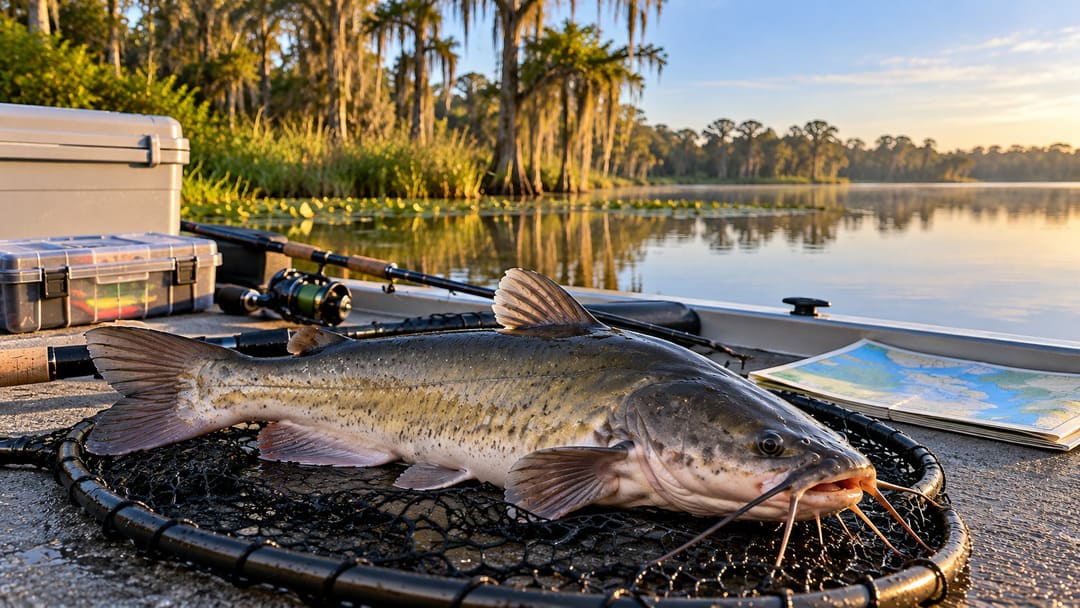
Florida anglers can legally keep channel catfish from many public waters, but the number they are allowed to harvest is not necessarily the number they should eat.
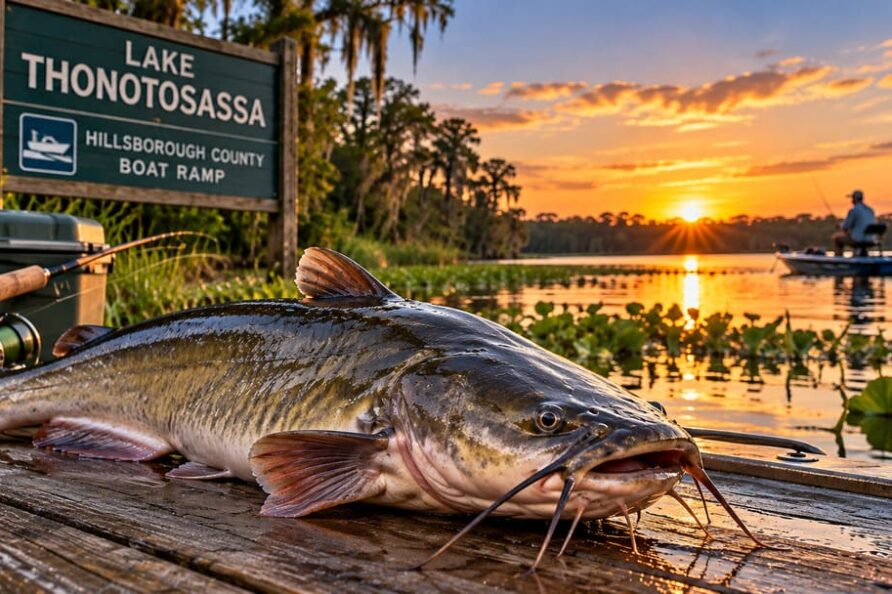
Lake Thonotosassa offers a useful example. The Florida Fish and Wildlife Conservation Commission’s Fish Management Area regulations specify no daily bag limit for channel catfish at this Hillsborough County lake. That rule governs recreational harvest. It does not establish how frequently someone should eat fish caught there.
The site’s existing guide to Lake Thonotosassa catfish fishing explains why the lake attracts anglers seeking eater-size channel cats, including productive cover and accessible fishing opportunities.
For anglers who fish to put food on the table, this is an important distinction. Florida catfish eating advisories depend on the waterbody, the species, and the person eating the fish. Checking those details before keeping a catch is a more reliable approach than assuming every legal fish is equally suitable for dinner.
A Legal Harvest Limit Is Not a Food-Safety Recommendation
Florida has two different systems that anglers need to understand.
FWC manages recreational fishing through licensing requirements, permitted methods, harvest limits and waterbody-specific regulations. Those rules determine how fish may legally be caught and possessed.
The Florida Department of Health addresses a different issue: potential exposure to contaminants through eating fish.
Its fish consumption guidance explains that mercury concentrations can vary with fish species, age and the waters in which fish live. It provides guidance for eating fish from freshwater, marine and estuarine environments.
A fish can therefore be perfectly legal to harvest while still being subject to advice about how frequently it should be eaten.
This matters particularly to anglers who regularly bring fish home rather than occasionally keeping one for a family meal.
How to Check Florida Catfish Eating Advisories
The most reliable starting point is the Florida Department of Health’s searchable fish advisory tool.
The system allows anglers to look up consumption guidance by water type, county and location.
Before keeping fish for the table, identify the exact lake, river or canal section where the catch came from. Then check whether the advisory includes the species being harvested.
A reference to channel catfish should not automatically be applied to blue or flathead catfish. Likewise, an advisory covering one portion of a river should not be assumed to describe every connected lake or tributary.
A good lookup considers four things together: where the fish was caught, which species it is, who will eat it, and how frequently fish meals are consumed.
If a location or species is not listed, that does not prove the fish was tested and found contaminant-free. Use the state’s applicable general guidance and ask the Department of Health for clarification when necessary.
Why the Species and Size of the Catfish Matter
Channel catfish, blue catfish and flatheads are all popular Florida catches, but they do not have identical feeding habits or growth patterns.
Flatheads primarily eat other fish, while channel catfish have a more varied diet. Large blue catfish can also consume substantial quantities of fish and other aquatic animals.
Those differences can affect exposure to contaminants moving through a food web.
Mercury enters aquatic ecosystems and can accumulate in fish tissue over time. Larger, older predatory fish may have had more opportunities to accumulate it through their food.
However, fish size is not a substitute for local testing. It would be inaccurate to assume that every small channel catfish is safe to eat frequently or that every large flathead has an unsafe concentration of mercury.
Waterbody-specific guidance is more useful than applying one rule to every catfish species in Florida.
A Meal Means a Portion, Not an Entire Fish
Consumption advisories usually describe how often a person can eat a defined portion of fish.
Florida’s freshwater advisory guidance uses a typical adult serving of approximately 8 ounces before cooking or 6 ounces after cooking, with portion considerations varying by body weight. Children need smaller portions.
That distinction can change how anglers interpret their catches.
A large catfish may produce several meals. Dividing it into smaller fillets does not make the contaminant exposure irrelevant, especially if those meals are consumed repeatedly.
People who eat fish from several lakes, rivers or commercial sources should also consider their combined consumption rather than treating every source as an entirely separate allowance.
Pregnant people, those who may become pregnant, breastfeeding people and young children deserve particular attention because developing nervous systems are more sensitive to mercury exposure.
Cooking Catfish Does Not Remove Mercury
There is a persistent misunderstanding about preparing fish from waters with consumption advisories.
Some anglers believe that skinning, trimming or thoroughly frying a catfish will eliminate contaminants.
The reality depends on the contaminant.
The Environmental Protection Agency’s fish preparation and contaminant guidance explains that removing skin and fatty tissue can reduce exposure to certain fat-associated chemicals.
Mercury is different.
It accumulates in muscle tissue, including the fillet people normally eat. Cooking does not remove it, and cutting away fat does not meaningfully reduce its concentration.
Proper cooking remains essential for preventing foodborne illness. But safe food preparation and controlling long-term chemical exposure are separate responsibilities.
The appropriate response to a mercury-related consumption advisory is to follow its recommended frequency and portion guidance, not to rely on a different cooking method.
What This Means for Florida Catfish Trips
Consider an angler planning a day at Lake Thonotosassa.
That information helps with catching fish.
Before deciding how many to take home, the angler should also check the applicable Department of Health eating guidance.
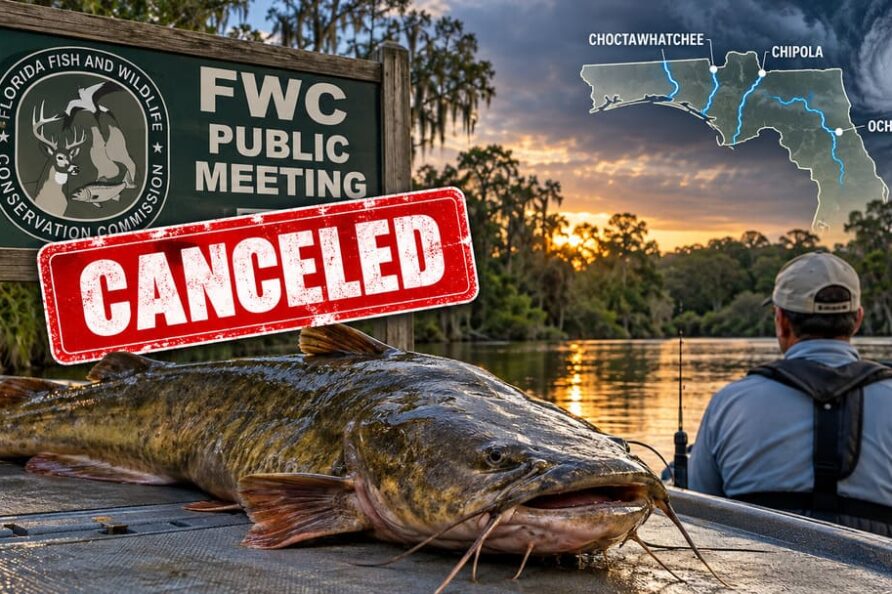
The same decision applies when targeting blue catfish on the Suwannee or flatheads in a Northwest Florida river. An impressive catch, a productive location or a generous harvest rule does not establish an appropriate meal frequency.
The best practice is to check regulations and advisories before leaving home. That gives anglers time to plan how much fish they actually intend to use and avoids making an uninformed decision after fish are already in the cooler.
Florida’s freshwater catfish can provide enjoyable fishing and worthwhile meals. The objective is not to discourage keeping fish. It is to make the decision with the same attention anglers already give to tackle, location and fishing regulations.
Know what you caught, where it came from, and how often it is recommended for the people who will eat it.