
LiveScope 2 catfish fishing sounds compelling on paper: see fish, bait and structure in real time, then decide whether a spot deserves a bait before wasting tournament time. Garmin’s July 2026 LiveScope 2 launch pushes that idea farther with the LVS44, rated to 250 feet in Forward and Down modes under suitable conditions, while the higher-detail LVS42HD targets shorter, castable ranges.
For catfish anglers, though, the real question is not whether the picture is sharper. It is whether live sonar solves a problem that side imaging, down imaging and good bottom-fishing fundamentals are not already solving.
LiveScope 2 Adds Range, but Range Is Not the Whole Upgrade
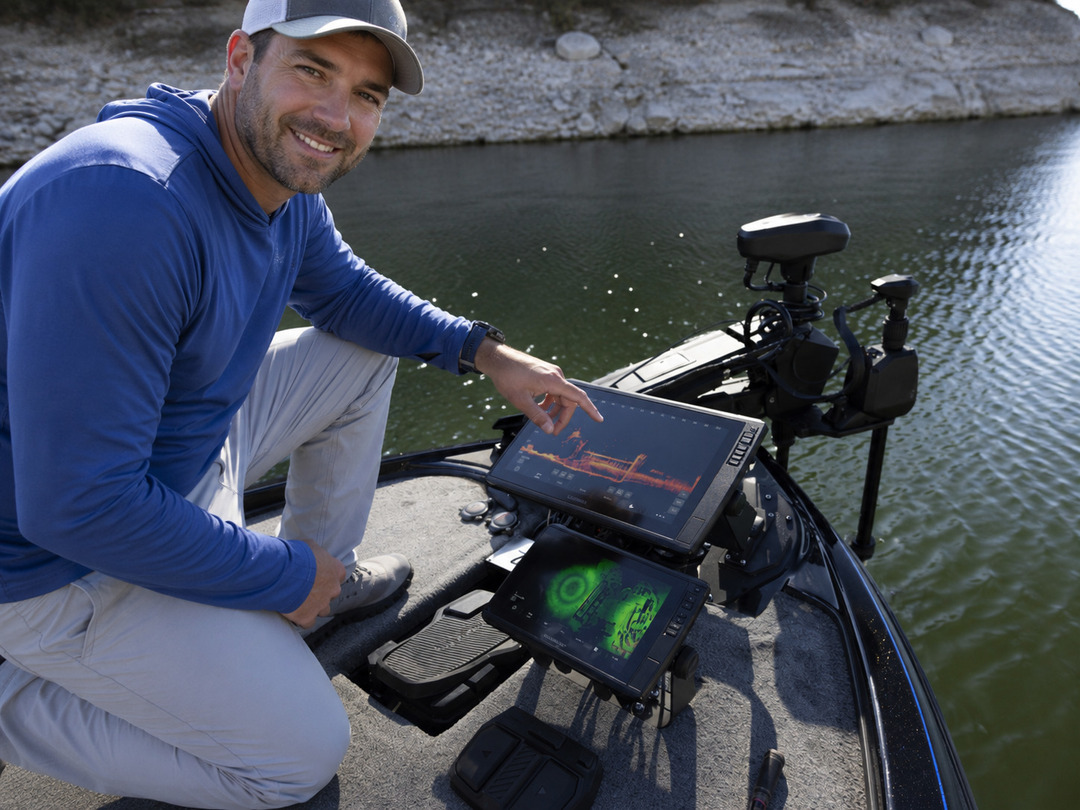
Garmin launched the LiveScope 2 series on July 7, 2026. The company says the LVS44 delivers 20% more resolution and 25% more range than LiveScope Plus, reaching up to 250 feet, while the LiveScope 2 HD LVS42HD is optimized for distances out to 125 feet with greater close-range detail. The new systems also connect directly to compatible Garmin displays, eliminating the separate black box used by earlier LiveScope setups.
More range can help catfish anglers inspect the front of a deep hole, a suspended bait school or timber ahead of the boat without driving directly over it.
But usable information matters more than maximum distance. Water conditions, bottom type, target size and transducer control still affect what an angler can interpret on screen. Garmin itself notes that maximum distance depends on factors including water conditions and bottom type.
Live Sonar Changes the Scouting Sequence
Traditional catfish electronics work best when the angler already knows the kind of structure being searched. Side imaging can reveal a ledge, creek channel, timber line or bait concentration, while down imaging helps confirm what sits beneath the boat. That workflow is efficient, but it still depends on interpreting snapshots as the boat moves.
Forward-facing sonar adds a different layer because the picture develops in real time. Instead of driving directly across every target, an angler can point the beam ahead and study how fish relate to structure before entering the zone. That can reduce unnecessary passes over water that may already be holding cautious or suspended fish.
The biggest advantage is not simply seeing more fish. It is being able to separate occupied structure from empty structure. Two deep holes can look nearly identical on mapping and conventional sonar, yet one may have active fish suspended above the break while the other shows little movement.
That distinction can matter even more during tournament fishing, when scouting time is limited. Electronics that help an angler reject unproductive water quickly can be just as valuable as electronics that reveal a promising target, because every unnecessary drift, anchor set or repositioning costs time.
Where LiveScope 2 Catfish Fishing Earns Its Keep
Forward-facing sonar is strongest when fish are not where a bottom-first approach expects them to be. Suspended blue cats, roaming fish around bait and cats holding off structure can be difficult to understand from a single conventional sonar pass.
Live imaging lets an angler watch targets ahead of the transducer and judge whether they are holding high, sliding toward cover or moving with bait.
A detailed look at modern catfish sonar tactics describes catfish anglers using forward-facing sonar to identify productive current seams, locate suspended fish while drifting and trolling, and find shad before throwing a cast net.
The benefit is faster pattern confirmation. If fish repeatedly hold several feet off bottom, anglers can adjust leader length, floats or bait depth before several dead passes reveal the same thing.
Deep Holes and Timber Still Favor a Two-Step Electronics Plan
Deep holes show why live sonar should not automatically replace conventional imaging. Side imaging can cover broad water and reveal a channel swing, timber line or hard edge. Down imaging then gives a closer vertical look beneath the boat.
LiveScope becomes more useful after that search narrows the area. Pointing the beam toward the lip of a hole, an isolated tree or the edge of a submerged pile can help determine whether fish are actually occupying the feature.
That makes search wide, inspect narrow the efficient sequence. Conventional imaging maps the larger target; live sonar helps confirm fish position before the boat anchors or begins a drift.
In timber, side imaging maps the cover field while live sonar can show movement around a specific tree or opening.
Side and Down Imaging May Still Be Enough
Not every catfish method benefits equally from a live screen. An angler anchoring on a proven hole, fishing a known ledge at night or setting baits around a repeatable current break may gain little from continuously watching individual fish.
The comparison is really about which question needs answering.
| Catfish situation | Best first tool | Where live sonar adds value |
|---|---|---|
| Broad flat or river channel | Side imaging | Confirming specific targets |
| Deep hole or ledge | Side/down imaging | Watching fish position on the edge |
| Timber or isolated cover | Side imaging | Checking movement around key pieces |
| Suspended fish | Live sonar | Tracking depth and movement |
| Drifting through bait | Side/down plus live sonar | Matching bait height to fish |
| Proven anchor spot | Conventional sonar | Often optional once the pattern is known |
For many boats, the best setup is therefore a division of labor. Side and down imaging find the neighborhood; live sonar answers what the fish are doing inside it.
Moving Blue Cats Make the Strongest Case for Live Sonar
Blue cats do not always stay on bottom. When bait suspends or current positions feeding fish above a ledge, a bottom-only assumption can leave every bait below the activity.
Live sonar can reveal that vertical separation while the boat is moving. For drifting and trolling anglers, that information can influence float placement, leader length and how high a bait travels through the water column. Catfish anglers using forward-facing sonar have already applied that information to presentation changes during moving-water and trolling situations.
The same principle applies to bait. Side and down imaging can locate a shad school broadly; live sonar can refine its position before the cast net leaves the boat. That saves time without pretending electronics make inactive fish bite.
The Upgrade Decision Should Start With Fishing Style
Garmin’s LiveScope 2 launch details also list wider sonar coverage, improved target separation, image stabilization and simplified installation alongside the LVS44’s longer range. Those upgrades still do not make it an automatic purchase for every catfish boat.
Tournament anglers who drift, track suspended blues, locate bait or dissect isolated cover have the clearest case. Anglers who mostly anchor on known holes may get more value from refining the electronics already aboard.
The pressure point is simple: would live sonar change an actual fishing decision? If it only gives a better picture of fish you already know are there, the return is limited. If it tells you where fish are positioned before you commit a drift or anchor set, the calculation changes.
LiveScope 2 Is a Patterning Tool, Not a Shortcut
LiveScope 2 catfish fishing is most valuable when it reduces uncertainty. The LVS44’s extended range can help anglers look farther ahead, but the real advantage comes from seeing whether fish are suspended, moving with bait or using cover before committing time to that water.
Side and down imaging still handle much of the heavy scouting work. Live sonar adds another layer when real-time movement changes how the bait should be presented.
For catfish anglers, that is the useful line: buy the technology for the decisions it improves, not for the distance printed on the specification sheet.
Frequently asked questions
How far can Garmin LiveScope 2 see?
Garmin rates the LVS44 for Forward and Down viewing out to 250 feet under suitable conditions. Actual usable range can vary with bottom composition, water conditions and other environmental factors.
Is LiveScope 2 useful for catfish fishing?
Yes, particularly for suspended fish, drifting or trolling, bait location and checking specific cover. Its value is lower when anglers already know the exact structure and plan to anchor there.
Is side imaging or LiveScope better for finding catfish?
They perform different jobs. Side imaging is generally better for quickly searching broad areas and structure, while LiveScope becomes valuable for examining individual targets and watching fish movement in real time.
Can LiveScope help anglers find catfish bait?
Yes. Forward-facing sonar can help refine the location of bait schools such as shad after broader sonar has identified the general area, making cast-net placement more deliberate and efficient.
Should catfish tournament anglers upgrade to LiveScope 2?
It depends on fishing style. Anglers who frequently chase suspended fish, drift large areas or analyze isolated structure have a stronger case than anglers who mainly fish familiar holes from anchor.