

Catfish fishing is having a quiet resurgence because it rewards something many modern anglers have forgotten: restraint. In an era of fast retrieves, high-tech lures, and constant movement, some of the most effective catfish bottom fishing techniques still depend on patience, scent, water reading, and the discipline to let the fish come to you.
Why Catfish Fishing Rewards Patience
I have always found catfish fishing to be less about chasing fish and more about understanding how they behave. Unlike many game fish that respond aggressively to flashing lures or fast presentations, catfish often feed by investigating scent trails, bottom structure, current seams, and easy meals.
That changes the entire strategy. The most common mistake I see beginners make is casting too often. They throw the bait, wait a few minutes, reel it in, check it, cast again, and repeat the cycle until they have disturbed the very area they are trying to fish. Catfish do not always strike immediately. They may approach slowly, circle the bait, test it, or follow the scent from a distance before committing.
The better approach is simple but difficult for impatient anglers: cast accurately, keep the bait on the bottom, and give the setup time to work.
Understanding Catfish Bottom Fishing Techniques
At the center of effective catfish fishing is one principle: catfish are built to locate food near the bottom. Their whisker-like barbels, strong sense of smell, and bottom-oriented feeding habits make them especially responsive to baits that stay in place and release scent over time.
That is why catfish bottom fishing techniques remain so effective across rivers, lakes, reservoirs, ponds, and backwaters. Whether fishing from a bank, dock, boat, or bridge, the goal is usually the same: place a strong-smelling bait where catfish naturally travel and avoid moving it unnecessarily.
A proper bottom presentation allows scent to spread through the water. In current, that scent moves downstream and creates a feeding trail. In still water, it forms a localized attraction zone. Either way, the bait needs time to announce itself.
Letting The Bait Work
The phrase “let the fish come to you” sounds passive, but it is actually a disciplined tactic. Once the bait is positioned, the angler’s job shifts from action to observation.
A good catfish bait does not need constant animation. Cut bait, chicken liver, shrimp, worms, stink bait, and other scent-heavy options are most effective when left alone long enough to release odor into the water. Reeling in too often interrupts that process. It also risks dragging the bait away from the scent trail that is beginning to build.
I prefer to think of each cast as setting a trap rather than making a presentation. The bait should land near structure, a current edge, a drop-off, or a muddy flat where catfish are likely to move. Once it settles, patience becomes part of the rig.
Reading The Bite Correctly
Catfish bites are not always dramatic. Some fish slam the bait and bend the rod hard, but many strikes begin as subtle taps, slow pulls, or steady pressure. This is especially true with larger catfish, which may pick up bait and move with surprising calm.
That is why rod position matters. A rod placed too loosely may miss a slow take. A rod held too aggressively may cause the angler to set the hook too soon. I watch for rhythm. Random taps can mean small fish, turtles, current, or bait movement. A slow, deliberate pull often deserves more attention.
With circle hooks, the response should be controlled rather than violent. The hook is designed to rotate into the corner of the fish’s mouth as pressure increases. A hard, early hookset can pull the bait away. A steady reel-down is often more effective.
Choosing The Right Bottom Rig
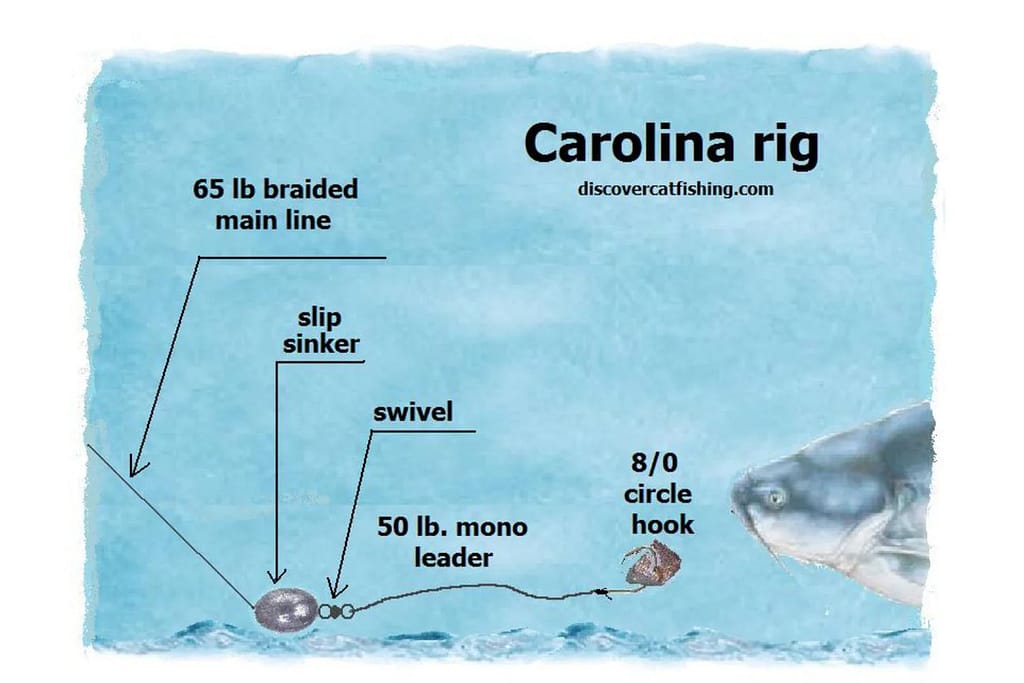
A bottom rig does not need to be complicated. In fact, simplicity is often an advantage. The classic slip-sinker rig remains one of the best all-around choices because it allows the catfish to pick up the bait with less resistance.
The basic setup is straightforward: main line, sliding sinker, swivel, leader, and hook. The sinker holds the bait near the bottom while the leader gives it natural movement. In rivers, heavier sinkers may be necessary to prevent the bait from rolling. In lakes or ponds, lighter weights can be enough.
The key is matching the rig to conditions. Too little weight allows the bait to drift out of position. Too much weight can make the setup feel unnatural. The right rig holds the bait in the strike zone without making the fish suspicious.
Where To Cast For Catfish
Good catfish fishing starts before the cast. Location matters more than distance. Many anglers cast as far as possible when the better target may be a channel edge, submerged log, bridge piling, undercut bank, or shallow flat near deeper water.
In rivers, I look for slower water adjacent to current. Catfish often hold where food naturally collects, especially behind obstructions or along seams where fast and slow water meet. In lakes, I focus on drop-offs, points, creek channels, and muddy bottoms where catfish can cruise comfortably.
Night fishing adds another layer. Catfish often move shallower after dark, especially in warm weather. A spot that seems too close to shore during the day can become productive at night.
Why Scent Is The Real Attractor
Catfish are among the most scent-oriented fish commonly targeted by anglers. That does not mean they ignore movement or vibration, but smell is central to how they find food. This is why bait freshness, oil content, and scent dispersion matter.
Cut bait works well because it releases natural oils and blood into the water. Worms attract through both scent and movement. Chicken liver produces a strong odor but can be difficult to keep on the hook. Prepared stink baits can be useful when targeting channel catfish, especially in warm water.
The best bait is not always the strongest-smelling bait. It is the bait that matches the fish, location, and conditions. In many waters, local forage is hard to beat. If catfish are feeding on shad, bluegill, tilapia, or small baitfish, using cut pieces of similar prey can be highly effective.
Timing The Waiting Game
Patience does not mean waiting forever in the wrong place. Productive catfish anglers know when to stay and when to adjust. I usually give a promising spot enough time for the scent trail to develop, especially if the bait is fresh and the location has structure or current.
However, if there is no sign of life after a reasonable period, the problem may be location rather than bait. A small move can make a large difference. Shifting from the middle of a flat to the edge of a channel, or from fast current to a current break, can put the bait directly in a travel lane.
The best windows are often early morning, evening, night, and periods after rain when food is washed into the system. Rising or stained water can improve catfish activity, provided the current is not too strong or unsafe.
The Discipline Of Doing Less
Modern fishing culture often celebrates constant adjustment: new lures, new retrieves, new colors, new casts. Catfish fishing teaches a different discipline. Sometimes the winning move is to stop interfering.
That does not mean being careless. The angler still needs sharp hooks, secure knots, fresh bait, suitable tackle, and good placement. But once those elements are right, the bait needs time to perform.
This is where experience shows. A beginner may mistake inactivity for failure. A seasoned catfish angler understands that the quiet period is part of the process. Under the surface, scent is spreading, fish are moving, and the odds are building.
Common Mistakes That Cost Fish
The most damaging mistake is reeling in too often. Every unnecessary retrieve breaks the scent pattern and removes the bait from the feeding zone. Another common error is fishing with bait that has been washed out, stripped by small fish, or poorly secured.
Hook size also matters. A hook that is too small may miss larger fish. A hook that is too large may reduce bites from average-sized catfish. Line strength should match the water. Heavy cover, rocks, timber, and strong current require more durable gear.
Noise and vibration can also matter in shallow water. Slamming coolers, stomping on docks, or shining lights directly into the water may reduce activity near the bank.
Why This Technique Still Matters
The enduring value of catfish bottom fishing techniques is that they align with how catfish actually feed. Rather than forcing a reaction, the angler creates an opportunity. The bait sits where the fish expects food to be. The scent moves naturally. The strike develops on the fish’s terms.
That approach is not flashy, but it is effective. It also scales well. A beginner can use it with basic tackle from the bank, while an experienced angler can refine it with precise rigging, current analysis, seasonal patterns, and bait selection.
Catfish fishing remains one of the most accessible yet misunderstood forms of freshwater angling. The core lesson is deceptively simple: cast with intention, let the bait settle, watch carefully, and resist the urge to overwork the setup.
Conclusion
The reason catfish bottom fishing techniques matter right now is that they offer a practical antidote to overcomplicated fishing advice. As more anglers look for reliable, low-barrier ways to catch quality fish, bottom fishing for catfish remains one of the most dependable methods available.
The opportunity is clear: anglers who understand scent, patience, bait placement, and subtle strikes will consistently outperform those who simply cast and retrieve without strategy. Catfish fishing is a waiting game, but it is not a guessing game. Done correctly, it is a deliberate system built around one powerful idea: let the fish come to you.


