

Side imaging for catfish is most valuable before a rod ever leaves the holder. The screen is not there to decorate the console or prove that fish exist; it is there to show where a catfish can rest, feed, and move without your boat passing directly over it.
That shift matters in shallow, pressured, or clear water, where one careless pass can turn a promising target into a silent patch of bottom. The broader catfish fishing techniques still matter, but side imaging gives those tactics an address instead of leaving bait placement to instinct.
Side Imaging for Catfish Starts With Cover, Not Fish
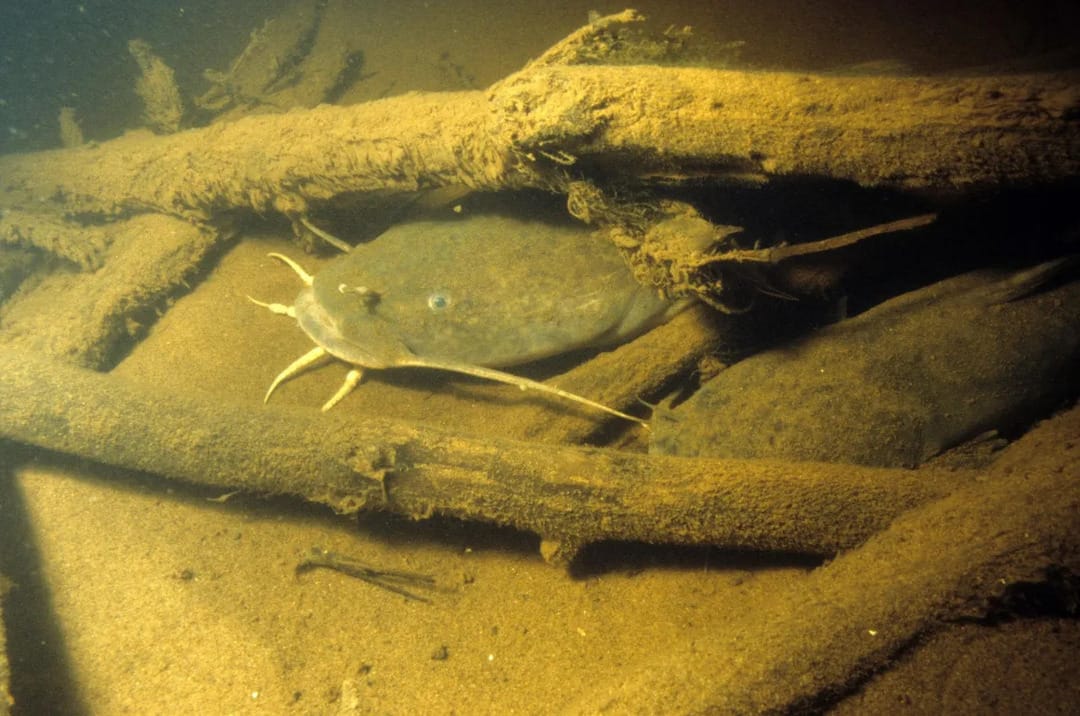
The biggest mistake is searching only for bright dots that look like fish. Catfish often sit so close to timber, rock, bridge debris, depressions, or channel edges that the cover is easier to identify than the fish itself.
Think cover first, fish second. Find the object or bottom change that creates an advantage, then study the water around it. A lone tree on a clean flat, a hard patch beside soft bottom, or a small ditch through featureless water may be more useful than a scattered group of uncertain returns.
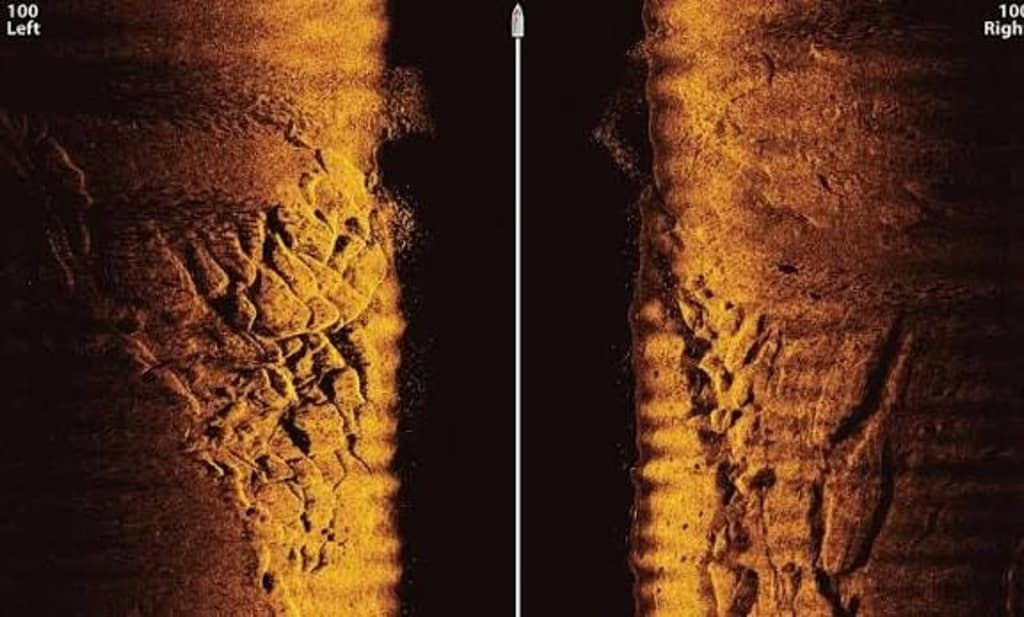
Side imaging scans away from the boat and builds a picture from successive sonar slices. The center shows the water beneath the boat, while the bottom spreads outward to the left and right. Understanding how side imaging builds the picture keeps anglers from confusing the water column, bottom, and off-to-the-side targets.
Read Shadows Before Bright Returns
Bright returns attract the eye, but shadows often explain the target. A log, piling, stump, rock pile, or chunk of concrete blocks the sonar beam and leaves a dark area behind it. The longer the shadow, the more relief the object usually has from the bottom.
That makes shadow the height clue. A bright streak with almost no shadow may be a low object or hard patch. A compact return throwing a long, clean shadow may be a standing trunk, bridge support, or tall piece of debris worth a closer pass.
Shadow shape also helps separate cover types. Crisp edges often point toward hard material. Softer, uneven shadows can suggest brush or vegetation. The goal is not to name every object perfectly. It is to decide whether it creates shade, current protection, an ambush edge, or a clean bait position.
Build a Two-Pass Scan Instead of One Long Guess
One pass shows a target. Two passes explain it.
Start with a wider search range and travel on a straight, steady line. Mark anything that breaks the surrounding pattern: isolated timber, a rock transition, a ditch, a sharp channel lip, scattered bridge rubble, or a depression with a hard edge.
Then return on a different heading with a tighter range. Crossing the target from another angle can reveal cavities, branches, overhangs, and the true orientation of the cover. A practical wide-scan and confirmation workflow also recommends refining the range, checking another direction, and confirming the target with down imaging when needed.
This is where waypoint discipline matters. Do not simply mark the brightest object. Mark the edge, not the icon: the upstream corner, outside face, shadow tip, channel-side drop, or opening where a bait can sit without burying itself in the snag.
Match Range and Boat Control to the Water
More range does not automatically produce more information. Stretch the screen too far and small targets shrink into crumbs. Set it too tight during the first pass and you waste time covering water in narrow strips.
A better approach is to match the scan to the job.
| Screen clue | Likely meaning | Best next move |
|---|---|---|
| Long dark shadow | Tall timber, piling, or raised debris | Mark the near edge and shadow tip |
| Bright patch with little shadow | Hard bottom or low rock | Cross from another angle |
| Broken, fuzzy texture | Brush or vegetation | Study the outside edge |
| Clean line beside deeper water | Channel lip or drop-off | Mark points along the break |
| Small bright returns near cover | Possible fish holding off structure | Verify without driving over them |
Boat control is just as important as range. Scan slow and straight enough to keep objects from stretching, compressing, or bending across the display. Avoid sharp turns while interpreting a target. If wind or current makes the boat wander, correct gently and make another clean pass.
The Signals That Separate Productive Cover From Dead Clutter
Not every log deserves a bait. The strongest targets combine cover with another reason for catfish to use it.
Look for nearby depth, a current break, a travel edge, hard-bottom contact, bait activity, or an opening that lets a large fish move in and out. A brush pile isolated on a bare flat may be valuable because it is the only shelter available. The same brush inside acres of identical cover is harder to fish efficiently.
Position matters too. Fish returns suspended just off the cover can suggest active movement. Returns buried tightly inside the shadow may be difficult to separate from structure and harder to reach without snagging. When the screen is unclear, let the geometry decide: fish the clean lane beside the cover rather than throwing into its center.
Pressure changes the calculation. Obvious bridge pilings and large laydowns receive repeated attention. Side imaging earns its keep by finding the smaller object 40 feet away, the secondary depression behind the rubble, or the isolated trunk other boats never cross.
The Real Advantage Is Distance
The point of side imaging for catfish is not to turn fishing into screen watching. It is to approach with more control, place baits with more purpose, and avoid disturbing the water you intend to fish.
The best anglers identify the cover, read its shadow, confirm its shape, mark the fishable edge, and set up far enough away to make a clean presentation. That sequence turns side imaging from an expensive picture maker into a practical catfish tool—and in pressured water, the distance it creates may be the most valuable information on the boat.


