
Trophy catfish bank fishing gear should do two jobs that often fight each other: handle a violent fish and remain mobile enough to reach the best water. The winning setup is not the biggest pile of equipment on the bank. It is a compact system that can be carried, deployed, controlled, and packed before fatigue or weather takes over.
That distinction matters because bank anglers cannot simply reposition with a trolling motor. They walk around fences, down riprap, across sand, and through vegetation, often after dark. The broader library of Florida catfish tactics reinforces the same principle: access and execution shape the opportunity before the first bait settles.
Trophy Catfish Bank Fishing Gear Starts With Mobility
A heavy-duty setup becomes useless when it takes three trips to unload. Every return to the vehicle burns fishing time, separates the angler from unattended equipment, and encourages bringing items that never earn their space.
Build around one cart, one large pack, or a paired cart-and-bucket system. Rods, holders, landing gear, bait, terminal tackle, lighting, and water should move together. Loose grocery bags, separate tackle trays, and uncontained tools turn a clean arrival into a yard sale.
The key idea is simple: mobility is part of strength. A system that reaches a better point, sets faster, and leaves cleanly will outperform a stronger but clumsier loadout on many nights.
Match the Power Chain Instead of Buying Isolated Parts
Trophy tackle should operate as one chain. The rod must cast the combined sinker-and-bait load without feeling overloaded. The reel must hold enough appropriate line, apply smooth drag, and remain comfortable during repeated casts. The main line, leader, swivel, hook, and knot must all suit the same level of pressure.
This is where many “heavy” setups become surprisingly weak. An angler buys a powerful rod, then connects it to an aging reel, a damaged leader, or terminal hardware chosen from a mixed box. The system is only as reliable as the first compromised part.
Choose two matched outfits rather than a collection of unrelated rods. Mark their drag settings, keep replacement leaders ready, and inspect the final few feet of line after contact with rock, shell, concrete, or timber. A balanced power chain is easier to troubleshoot and faster to rebuild in darkness.
Secure the Spread Before the First Cast
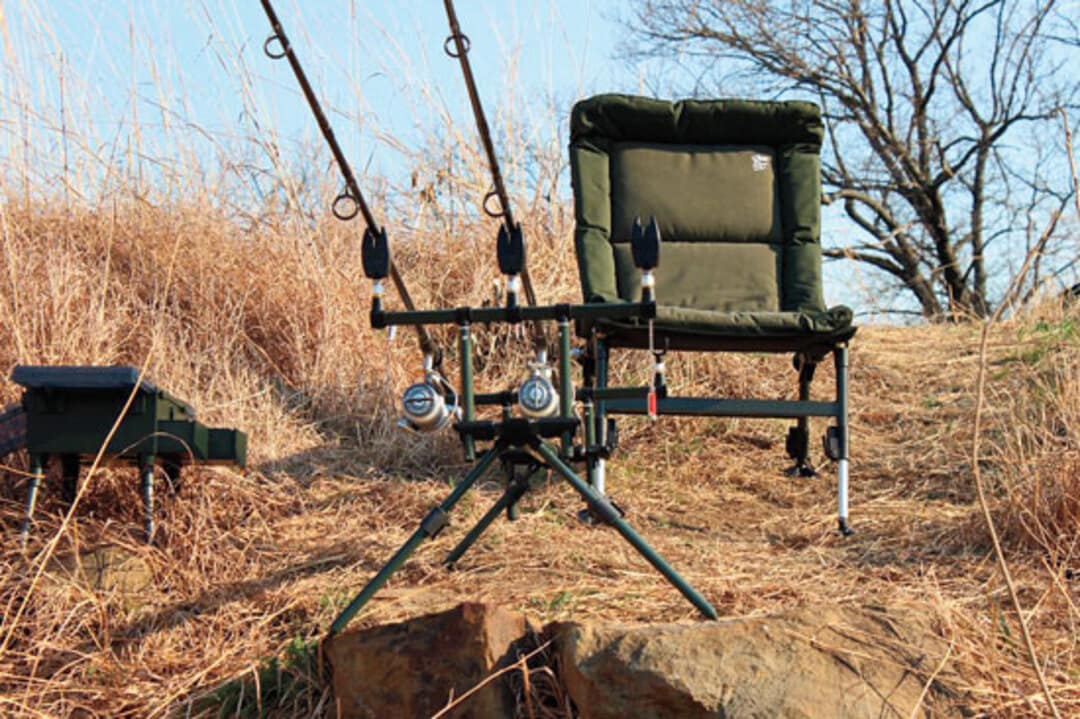
Rod holders are not accessories when large catfish are the target. They are anchors, bite indicators, and traffic-control devices. A holder must penetrate the bank deeply enough to resist a hard strike while keeping the rod angle compatible with the current, line path, and chosen rig.
Florida’s freshwater gear rules state that there is no statewide limit on the number of rods an angler may use. That legal freedom does not make an oversized spread smart. Two rods that can be reached immediately are usually safer and more efficient than five rods scattered across a dark shoreline.
Set holders before baiting hooks. Space them so lines do not cross during a run, and keep the route from chair to rod free of coolers, carts, and open tackle boxes. Secure the spread first; fishing comes second.
Build a Landing Lane, Not Just a Fishing Spot
A productive casting position can still be a terrible landing position. High banks, submerged brush, loose rock, steep mud, and concrete edges become serious problems when a heavy fish reaches shallow water.
Before casting, identify where the fish can be guided, where the netter can stand, and where the catch can be handled without rolling in dirt or sliding back into the water. The net should be assembled and open, not buried beneath bait containers. Pliers, gloves, measuring tools, and a camera should be reachable with one hand.
For large fish, landing is a planned operation. The fight is not finished when the fish appears. It is finished when the fish is controlled, the hook is removed, and the angler can release or retain it legally without improvising at the water’s edge.
The One-Trip System Has Six Working Modules
The easiest way to cut clutter is to assign every item to a module. If something does not support transport, fishing, anchoring, rigging, landing, or safety, it needs a strong reason to make the trip.
| Module | Core equipment | Design standard | Common failure |
|---|---|---|---|
| Transport | Cart, pack, buckets, rod straps | Moves in one controlled trip | Too many loose bags |
| Fishing | Two matched rod-and-reel outfits | Same operating logic and spare parts | Mismatched line and drag |
| Anchoring | Heavy holders and driving tool | Stable in the actual bank material | Shallow or poorly angled holders |
| Rigging | Compact labeled terminal box | Rebuilds a rig without searching | Oversized mixed tackle collection |
| Landing | Large net, pliers, gloves, measuring gear | Staged before the first cast | Net and tools buried in the load |
| Safety | Headlamp, backup light, water, first aid | Reachable without unloading everything | Essentials packed at the bottom |
This table is not a shopping list. It is a test. A mobile system works when each module is complete, compact, and positioned in the order it will be used.
Pressure Points That Expose Weak Bank Systems
The first pressure point is terrain. Narrow paths and soft sand punish small cart wheels, while riprap punishes top-heavy loads. Test the packed system near home before trusting it on a long approach.
The second is darkness. Reflective rod tape, labeled compartments, and a backup light reduce fumbling, but lighting should never become an excuse to stay through dangerous weather. Official lightning safety guidance warns that no place outside is safe during a thunderstorm; the best bank system is one that can be abandoned and packed quickly when conditions turn.
The third is the fish itself. A trophy exposes tangled line, weak knots, unstable holders, buried nets, and blocked footing in seconds. That is why trophy catfish bank fishing gear should be judged as a complete field system, not a stack of individual products. Build for the walk, the cast, the strike, and the landing, and heavy-duty equipment finally becomes an advantage instead of extra weight.


