
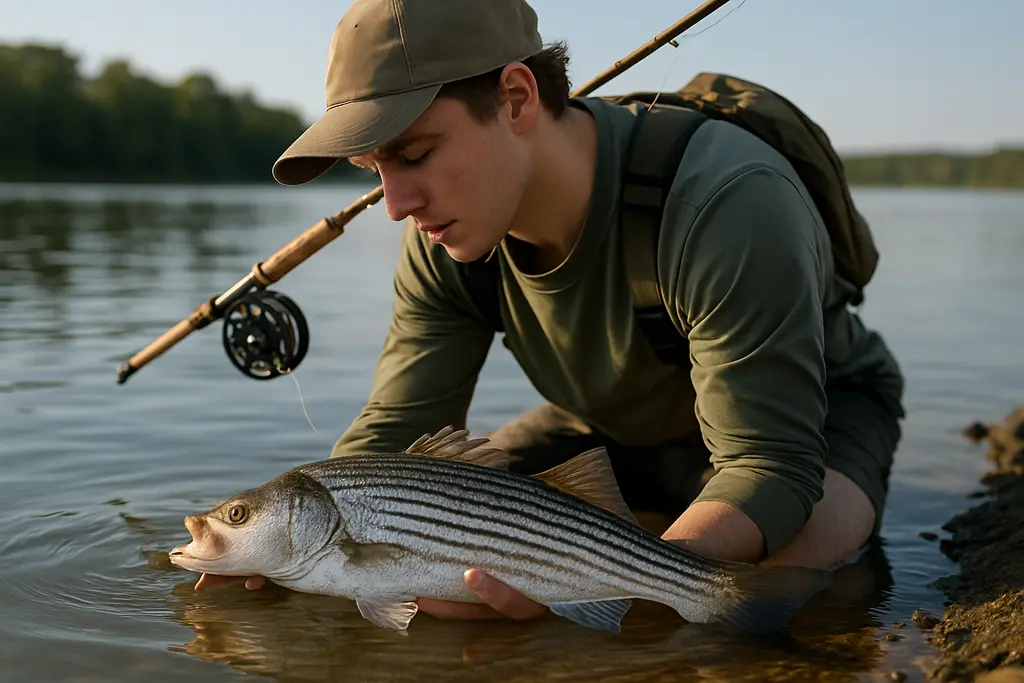
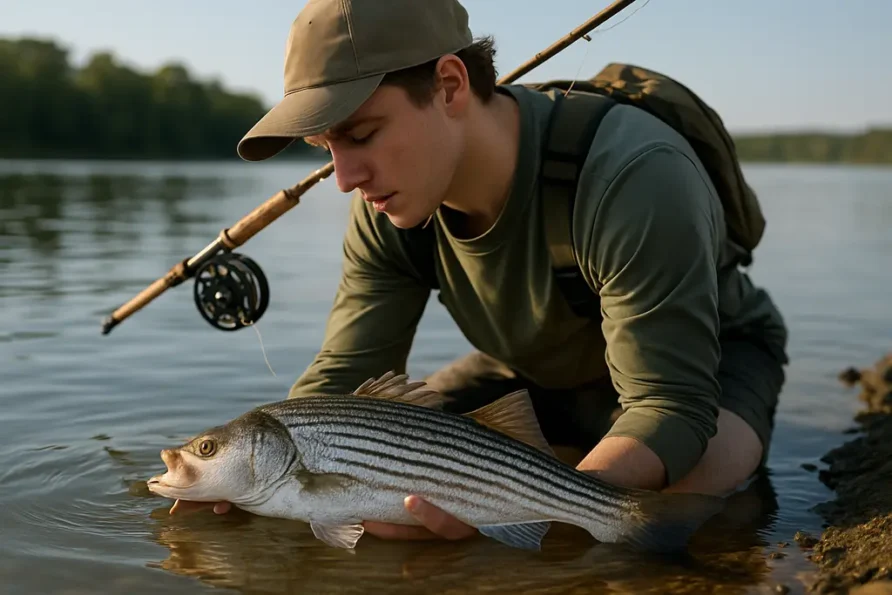
Striped bass conservation starts before a fish ever comes tight. The right release plan is not a guilt trip; it is a practical fishing skill, just like reading current seams or setting drag. If you want more stripers around for future trips, build your routine around cooler water, fast hook removal, wet hands, safer hooks, and a release that happens before the fish is worn down.
Why Striped Bass Conservation Starts At Release
A released striper still pays for every choice we make: the length of the fight, where the hook lands, how long the fish is out of water, and whether we handle it like a living fish or a wet trophy. Maryland Department of Natural Resources advised on March 9, 2026, that anglers should limit air exposure to the time needed for a photo or hook removal, ideally less than one minute, and avoid catch-and-release fishing when water is warmer than about 80 degrees Fahrenheit or air temperature is above about 95 degrees Fahrenheit Maryland DNR striped bass release guidance.
That advice changes how I plan a trip. If the forecast screams heat and the shallow flats are bathwater, I do not treat catch-and-release as harmless entertainment. I shift earlier, fish shorter, target moving water, or stand down. Striped bass conservation is not about fishing less forever; it is about fishing smarter on the days when released fish face the hardest recovery.
Read The Day Before You Cast
Start with temperature and timing. Dawn and night sessions usually give you the best shot at cooler water, while bright afternoon heat can stack stress on top of the fight. If you carry a thermometer, use it before you start casting, not after you have already caught fish. If the water is pushing into the high-risk range described by Maryland, change the plan before the stripers become your experiment.
Current matters, too. A fish released into oxygenated moving water has a cleaner chance to regain balance than one dropped into a slack, hot back pocket. Position the boat or your feet so the release can happen near clean flow. That small setup choice can save fumbling time after the catch.
Heat, Fight Time, And Handling Choices
Fight time is where many anglers lose the plot. A striper is built to surge, but that does not mean we should play it to exhaustion on light tackle for style points. Use tackle heavy enough to turn the fish, keep the rod loaded, and gain line when the fish gives it. The goal is not brute force; it is steady pressure that shortens the battle without tearing hooks free.
Handling time starts the second the fish reaches the boat, sand, or rocks. Have pliers ready. Have the camera ready if a photo is legal and necessary. Have your measuring board wet and flat. The worst release routine is the one where the angler lands the fish first, then starts looking for tools like a raccoon in a tackle bag.
Build A Two-Minute Landing Drill
Practice a simple drill with your fishing partner. One person controls the rod and fish. The other wets the net, opens the pliers, clears loose hooks, and prepares the measuring board. If you fish solo, lay out the same station before the first cast. You should be able to move from landing to unhooking to release without stepping around coolers, bags, or loose plugs.
Think of it like a fire drill, only wetter and with more gill plates. Your job is to remove delays before adrenaline enters the picture. Calm hands release fish faster.
Keep Air Time Honest
Maine Department of Marine Resources recommends minimizing air exposure to 10 seconds total, just enough to unhook, take a quick photo, and release, while using two wet hands, barbless hooks or flattened barbs, and a soft rubber landing net when needed Maine striped bass release tips. That 10-second target is strict, and it is a useful reset for anglers who think a minute-long photo session is quick.
Here is my rule: if the camera is not ready before the fish is lifted, skip the photo. A strong kick-away is better proof of a good catch than five nearly identical grip-and-grin shots.
Gear Choices That Protect Released Fish
Gear does not make an angler ethical by itself, but it can remove common sources of damage. Maryland’s 2026 guidance states that non-offset circle hooks are required when fishing with bait for striped bass, and that lures with single hooks are preferred to reduce damage. That means your tackle box should match your release goals before you leave the driveway.
If you bait fish, non-offset circle hooks help reduce deep hooking because they are designed to catch in the mouth rather than down in the throat. If you throw lures, consider swapping some trebles for single hooks where practical. You may miss the occasional swipe, but you can often unhook fish faster and with less wrestling.
Striped Bass Conservation Hook Setup
For striped bass conservation, hook setup should match both the lure and the landing environment. On plugs, test single-hook orientation so the lure still swims correctly. On bucktails, keep hook points sharp so you do not need a violent hookset. On bait rigs, avoid offset circle hooks where non-offset circle hooks are required, and resist the urge to swing hard like you are bass fishing a jig. Let the fish come tight and let the hook do its work.
Barbs are another speed factor. Maine recommends barbless hooks or flattened barbs for striped bass release. A flattened barb can turn a messy unhooking into a clean twist with pliers. If you are worried about losing fish, improve line control and rod angle before blaming the barb.
Landing Nets And Grip Control
A rubber or soft mesh landing net is easier on fins, slime, and hooks than rougher netting. Wet the net before use, keep the fish in the water when you can, and avoid letting extra lure hooks tangle in the mesh. If the fish is too green and thrashing, give it a moment alongside the boat rather than hoisting it into chaos.
Grip tools and dehookers can help, but they are not a license to hang a large fish vertically. Maryland encourages holding large striped bass horizontally and avoiding lifting by the jaw or gills. Support the belly with a wet hand, keep fingers out of the gill plates, and work low over the water or a wet surface. Gravity is not your fishing buddy.
- Before the cast: check temperature, rig safer hooks, and set tools within reach.
- During the fight: use steady pressure and tackle strong enough to shorten the battle.
- At landing: keep the fish wet, control loose hooks, and avoid dry decks or sand.
- For photos: lift only when ready, shoot fast, and skip the pose if the fish is stressed.
- At release: face the fish into clean water and wait for balance and a firm kick.
Boat-Side Routine For Cleaner Releases
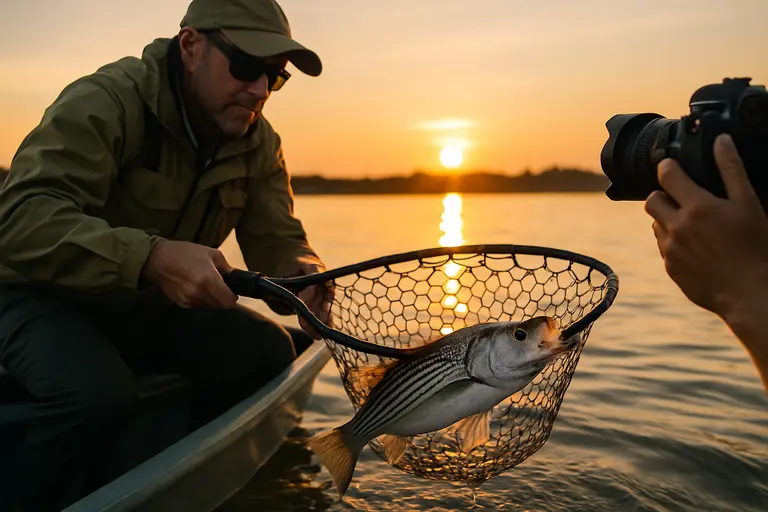
A clean release is a sequence, not a scramble. I like to rehearse it in my head before the first fish: net, unhook, measure if needed, photo if ready, revive, release. That order keeps everyone from shouting different instructions while the striper is burning energy out of water.
Shore anglers need the same plan. Keep fish out of dry sand and away from rocks. If you fish from a jetty, think hard about whether you can safely land and release a striper from that height. A long drop back into the water is not a release plan. Sometimes the best move is changing position before casting.
Measure, Photo, And Let Go
Measuring should be fast and calm. Wet the board, close the fish’s mouth, control the tail, and avoid repeated attempts for a perfect number unless a regulation requires confirmation. If the fish is clearly not being harvested, there is no need to keep it out longer for extra measurements.
Photos should be treated like a pit stop. The angler kneels or stays low, the fish is supported horizontally, and the camera operator is ready before the lift. Count it down: lift, shoot, back in. If the fish clamps, rolls, or loses balance, end the photo plan and focus on release.
Release Readiness Checks
Do not shove a tired fish away like you are launching a paper boat. Hold it facing into current or move it gently forward in clean water so water passes across the gills. Watch for balance. A ready fish will hold itself upright and kick with purpose. If it rolls, keep supporting it in the water until it regains control, as long as conditions are safe for you.
This is where patience matters, but not photo-session patience. It is recovery patience. Your attention belongs on the fish, the current, your footing, and any other anglers casting nearby.
Striped Bass Conservation On Every Trip
Make striped bass conservation part of your normal trip rhythm, not a special rule saved for hot days. Pack pliers, flatten barbs where legal and sensible, use soft nets, plan around heat, and talk through release jobs with your crew before lines go out. Good release work is not fancy. It is fast, calm, and repeatable.
The best striper anglers I know are not just good at finding fish; they are good at letting them go in fighting shape. That takes discipline when the bite is wild and the camera is calling. Keep the fish wet, keep the fight short, keep the air time honest, and let that striped bass kick away like it has somewhere better to be. That is the kind of catch-and-release habit worth passing down.


