
Let’s face a harsh truth: all the fancy lures in your box won’t help if you’re in the wrong place.
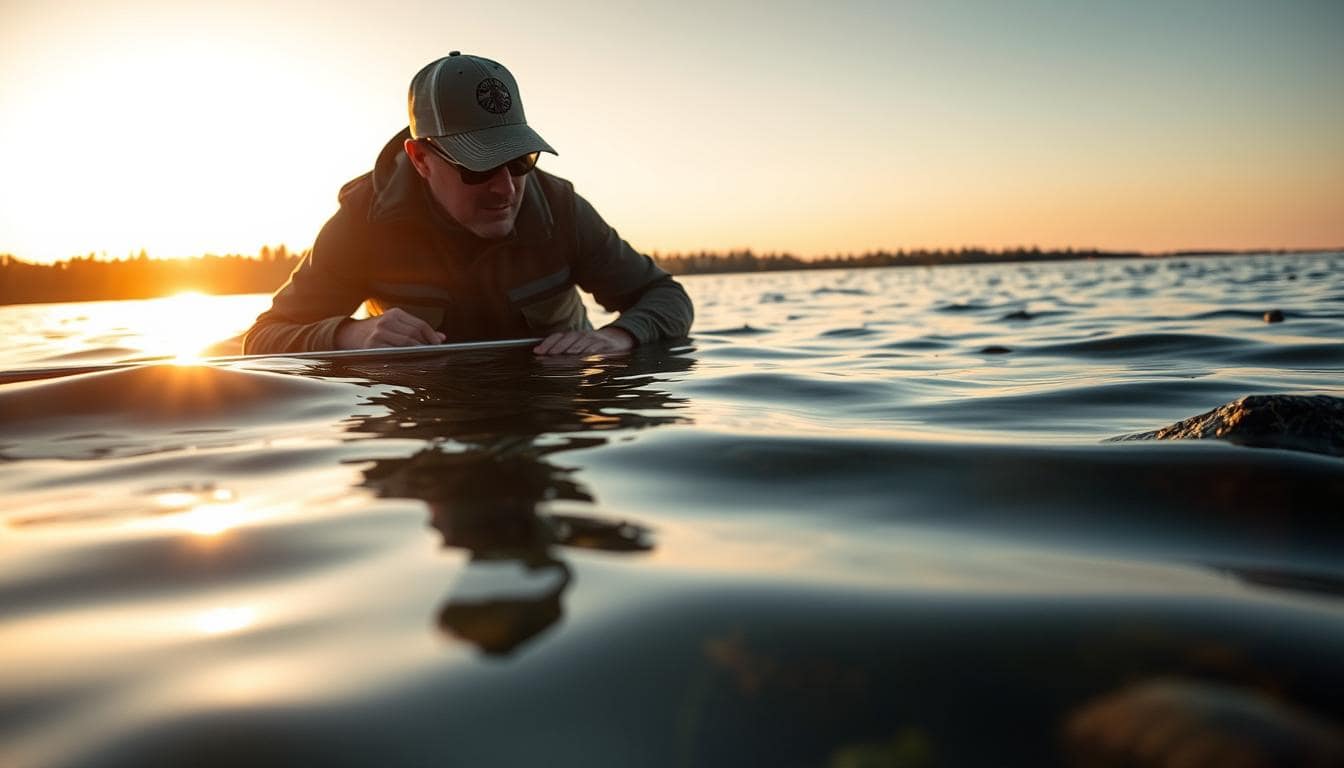
This isn’t about the gear. It’s about decoding a liquid landscape. You’re like a detective, studying why walleyes prefer certain spots.
Their world is full of current seams, wind-blown lines, and small details. Knowing this is key to understanding their habitat.
We’re moving away from the myth that the latest gear is everything. The truth is, the best technology is useless without knowing how to position yourself. Guides on Mille Lacs know this well.
It’s about reading the structure of the water—like flats, reefs, and breaks. This skill is as important as mastering water temperature tactics. It makes you a local, not just a visitor.
Fine-Tuning Drift & Trolling Rigs
Walleye fishing is like a political campaign. Boat control is the key to success. It’s the hard work that fills your cooler.
It’s about using physics to present your bait. This is the art of fishing.
Your boat is like a drafting table. Your rigs are your tools. The driftsock is not just a piece of cloth, but a precise tool.
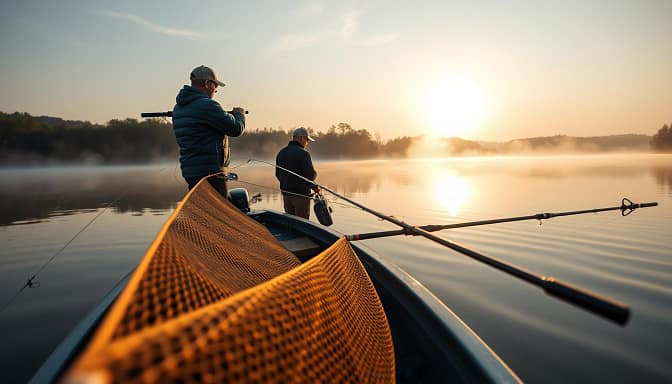
Imagine a sock off the bow like a parachute. It creates drag and makes your presentation predictable. This is the heart of trolling optimization.
For tricky maneuvers, use a dual-sock system. It’s like a steady anchor in the lake. This setup lets you fish at the right depth without moving the motor.
Pair this control with the right tackle. Each rig is designed for a specific fishing need. Let’s look at the options.
| Rig | Best For | Key Advantage | The Vibe |
|---|---|---|---|
| Bottom Bouncer | Clean, snaggy bottoms; precise depth control | Snag-resistant engineering; keeps bait in zone | The seasoned bureaucrat. Gets the job done without drama. |
| Lindy Rig | Finesse presentations; neutral or negative fish | Minimalist elegance; natural bait movement | The grassroots activist. Pure, simple, and often devastatingly effective. |
| Nightcrawler Spinner | Active fish; dirty water; triggering reaction strikes | Provocative flash and vibration | The attack ad. Loud, flashy, designed to provoke an immediate response. |
Choosing the right tool is key to trolling optimization. A Bottom Bouncer is great for rocky areas. The Lindy Rig is perfect for finicky bites in spring. And the spinner rig is for making a big splash.
For more on live bait rigs, check out Realtree’s guide.
In chaotic waters, the three-way crankbait rig is your best bet. It allows you to fish deep while avoiding snags. It’s a specialized tool for tough conditions.
This section is about building a versatile fishing arsenal. Don’t focus on just one thing. Master the driftsock and each rig’s unique role. True trolling optimization is about precision, not speed.
Electronics Mastery
If you’re just watching fish finders like a psychedelic screensaver, we need to talk. Modern walleye electronics are a big deal, but only if you use them right. It’s not just for fun; it’s for finding fish.
Your sonar unit should be like a map and a lab. We’re not just looking for fish arches anymore. The real skill in Walleye Precision Fishing is reading the small signs: the texture of the bottom, the currents, and where fish might be hiding.
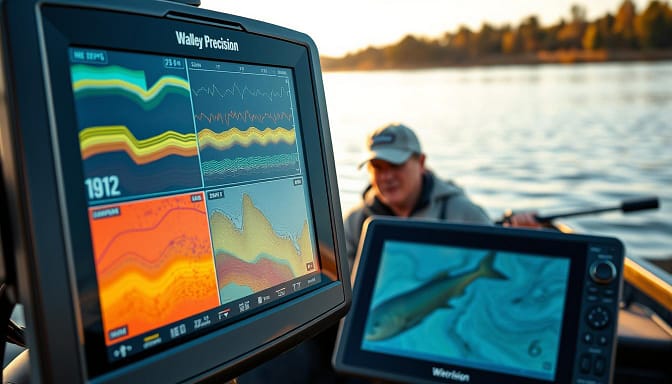
Think about the bottom hardness. Soft bottoms give wide sonar returns, while hard bottoms show up as thin lines. Walleye like these spots, where they can find food easily.
Waypoint technology and GPS make fishing more scientific. Tools like Minn Kota’s i-Pilot Link help you follow exact paths. This makes finding fish in tough conditions easier.
When you see a good spot on your downscan, mark it. Then, use your trolling motor to go back to that spot. This makes your fishing more precise.
Don’t just look at the marks; understand what they mean. Are the fish close to the bottom or up high? Are they near certain parts of the structure? This deep dive into walleye electronics shows how to go from finding fish to knowing why they’re there.
The goal is not to let the machine do all the work. That’s like using a calculator without knowing math. The goal is to use tech to carry out your fishing plan well. It’s like the difference between astrology and astronomy in finding fish.
Learning to use these tools well makes your fishing more focused. You start fishing specific spots, not just anywhere. This is the heart of Walleye Precision Fishing—turning data into a plan to catch dinner.
Speed Control Workout
Speed is the final test. Your plan is ready, and your gear is set. Now, it’s time to put it all into action. This is where thinking meets feeling.
Mastering jigging is like dancing with the bottom. Each move, like The Hop or The Rip, talks to walleye in its own way. A small change in weight or a slight wrist movement can make a big difference. It’s a form of tactile art.
When trolling, precision is everything. Traditional speeds are around 2.0 mph. But a refined snap-weight system works best at 1.5 mph. This method lets lures follow the bottom, speeding up and slowing down to get bites.
Your boat’s throttle is like a brush. Use a bow-mounted trolling motor for quick turns. Driftsocks help fight wind. In big waves, a kicker motor with electric steering keeps speed steady.
Depth and speed go hand in hand. Adjust your lead-core line and snap weight’s distance from the lure. In clear water, a longer monofilament leader works better. On Mille Lacs, this simple change leads to more bites.
This workout isn’t about strength. It’s about finesse. The difference between a follow and a hookset often comes down to 0.2 mph. Your foot on the pedal and your finger on the spool are the final judges. Now, go feel the water.


