
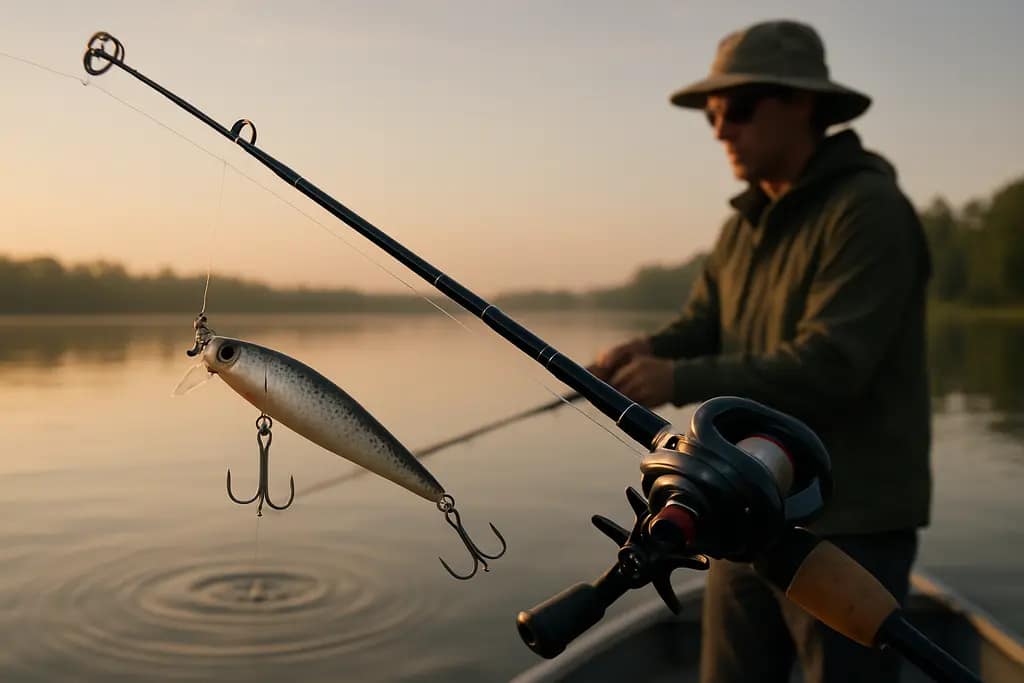

The Berkley Doom Stroller arrived with a very specific job: give bass anglers a hard-bait option for targeting roaming or suspended fish around baitfish schools. Berkley announced the bait on September 16, 2026, with a September 2026 launch, a $16.99 MSRP, three sizes, and a design aimed especially at anglers using forward-facing sonar Berkley announcement. That is a narrow target, and I like that. A lure built for everything often teaches you nothing. A lure built for suspended bass forces you to think about depth, pace, bait size, and how long your presentation stays in front of fish.
What The Berkley Doom Stroller Is Built To Do
Berkley Doom Stroller Design Notes
The Berkley Doom Stroller is positioned as a hard-bait alternative to the jighead-and-minnow technique. That matters because many anglers already understand the suspended-fish problem: bass may be visible on electronics, but they are not glued to the bottom, and they may track baitfish in open water. A soft minnow on a jighead can be effective in that role, but this bait gives anglers a different hard-bodied profile and action to test when fish are following but not committing.
Its defining feature is a precision internal weighting system, described by Berkley as producing consistent rolling action at any retrieve speed. From a practical casting deck view, that means your job is not to overpower the lure. Let the bait work. If you constantly snap, rip, or race it without a reason, you may be adding noise to a presentation designed to stay controlled. Start with a steady retrieve, then make one change at a time: a pause, a short pull, or a slower handle turn.
Why The Hard-Bait Format Matters
Hard baits give clear feedback. You can feel whether a bait is tracking cleanly, whether slack is killing contact, and whether your retrieve is speeding up because you got excited after seeing a fish follow. That feedback is useful around suspended bass because the strike window can be small. If a fish rises two feet and trails the lure, the wrong move can pull the bait out of range.
The bait also features a strategically positioned treble hook, which Berkley says is intended to improve hookup ratios during strikes. Do not treat that as permission to swing wildly. With trebles, steady pressure after the bite is often the cleaner choice than a full-power hookset. The smarter habit is to keep your rod loaded and avoid giving a fish slack after it pins the bait.
Choosing Size, Sink Rate, And Color
Match Size To The Fish You See
The bait comes in sizes 70, 90, and 110. Tackle Warehouse lists the 70 at 2.75 inches, the 90 at 3.5 inches, and the 110 at 4.33 inches; it also lists sink rates of about 1.8 to 2.2 feet per second for the 70 and about 2.5 to 2.8 feet per second for the 90 and 110 retailer specs. Those numbers should guide your first decision before you make the first cast.
| Model | Length | Listed Sink Rate | Practical Starting Point |
|---|---|---|---|
| 70 | 2.75 inches | About 1.8-2.2 fps | Smaller baitfish profile or shallower suspended targets |
| 90 | 3.5 inches | About 2.5-2.8 fps | Middle-size bait profile and faster depth control |
| 110 | 4.33 inches | About 2.5-2.8 fps | Larger baitfish profile with the same listed sink range as the 90 |
If you fish the Berkley Doom Stroller by guessing, you give up the best part of the design. Use the sink rate as a countdown tool. If the 70 falls about two feet per second, a three-count gets it near a six-foot drop before the retrieve begins. If the 90 or 110 falls closer to the upper listed range, that same count puts the bait deeper. These are starting estimates, not magic math, because line angle, cast distance, and retrieve speed all affect the running path.
Use Sink Rate Like A Countdown
A clean routine helps. Cast past the fish or bait school, count the bait down, begin the retrieve before the lure sinks below the target, and watch how fish respond. If fish follow and fade, change one variable. Shorten the countdown. Slow the handle. Pause once. Do not change size, color, retrieve, and cast angle all at once unless you enjoy confusing yourself.
Berkley lists 15 hand-selected color patterns, including Vapor Herring, French Pearl, Blue Shimmer, Shad, Blue Smelt, HF Flashback, Misty Minnow, Perch, Wakasagi, Chrome, MF Minnow, Broken Glass, Stealth Shad, Summer Shandy, and Silver Citrus. The practical move is to pick colors by water clarity and baitfish appearance, then let the fish grade your paper. If they follow but do not bite, a color shift can be worth testing before abandoning the depth or retrieve.
Retrieve Control For Suspended Bass

Keep The Bait In The Strike Window
Suspended bass fishing punishes sloppy timing. The cast is only the first step. Your countdown sets the lane, and your retrieve decides whether the bait stays in that lane long enough to get eaten. Since this bait is designed to roll consistently at different retrieve speeds, begin with the slowest retrieve that keeps contact. Then build speed only if the fish show interest without closing the gap.
Forward-facing sonar users may be tempted to chase every fish on the screen. Resist that. Make the lure path easy for a bass to intercept. Cast beyond the fish rather than directly on top of it, count down with discipline, and retrieve through the same depth band. If the fish is moving with bait, lead it like you would lead a bird with a shotgun: not frantic, just ahead of the target.
Read Baitfish Before Color
Color matters, but bait behavior matters first. If baitfish are high, do not let a faster-sinking model fall out of the zone before the retrieve starts. If baitfish are deeper, use the listed sink rate to get down without wasting half the cast. Anglers who want to sharpen the hand movements behind this style can pair this bait practice with advanced retrieve patterns, then bring only the cleanest motions back to suspended bass.
- Start with a steady retrieve before adding pauses or pulls.
- Use the listed sink rate to estimate depth before the bait moves forward.
- Change one variable at a time so each fish response teaches you something.
- Keep rod pressure steady after a treble-hook bite instead of overreacting.
The Berkley Doom Stroller is not a shortcut around practice. It is a tool that rewards anglers who can repeat a cast, count down honestly, and control retrieve speed under pressure. That is where the fun starts. The lure gives you a defined system; your job is to make that system repeatable.
Why Berkley Doom Stroller Tactics Matter
Practice Before Tournament Pressure
The best time to learn this bait is not five minutes after you spot suspended fish during a money event. Take it to open water, make long casts, count it down at different intervals, and watch how retrieve speed changes the feel. Build your own reference points for the 70, 90, and 110. A bait with application-specific sink rates only helps if you have trained your thumb, eyes, and reel handle to work together.
The Berkley Doom Stroller gives sport fishing anglers a focused way to attack a common modern bass problem: fish that are visible, catchable, and still hard to fool. Treat it as a depth-control bait first and a color-choice bait second. Pick the size that fits the baitfish, count it down with intent, and make every retrieve teach you something about how suspended bass react.


