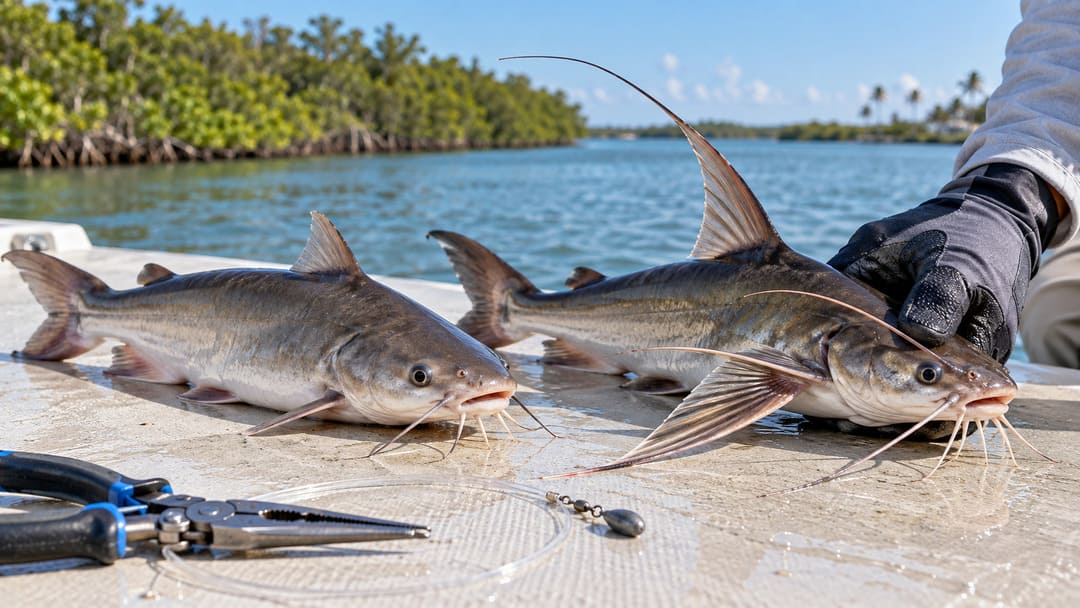
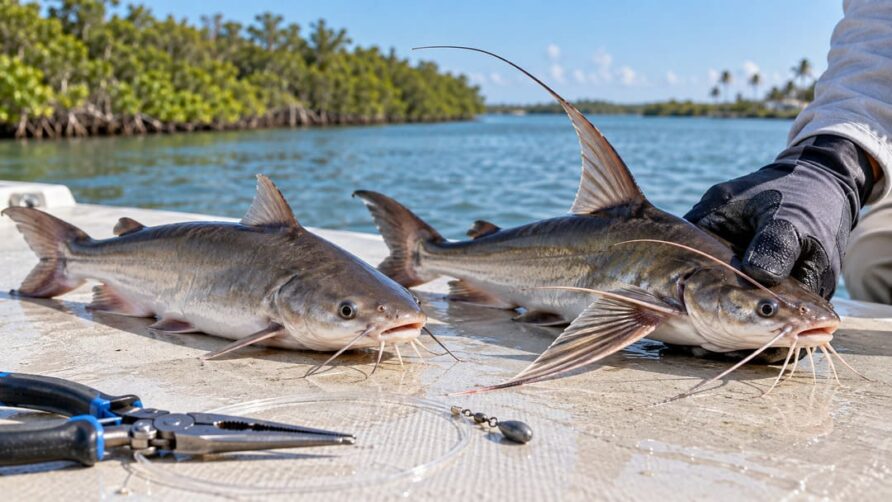
A whiskered fish comes over the rail at a Florida pier, bridge or inshore boat, and plenty of anglers immediately call it a hardhead.
Sometimes it is. Sometimes it is a gafftopsail catfish, or “sailcat,” a different native species with an easy-to-see identification feature, better food reputation and a substantially larger Florida state record. More importantly, both fish carry sharp dorsal and pectoral spines that deserve attention before an angler reaches for the hook.
For Florida anglers, the useful skill is not memorizing scientific names. It is being able to make a fast Florida saltwater catfish identification from several visible features, control the fish without putting a hand into its spine path, and understand that “unregulated” does not mean there are no harvest rules.
For broader precautions involving fish, hooks and on-water injuries, the site’s guide to common fishing hazards provides useful additional context.
Hardhead vs. Gafftopsail: Look at the Fins First
The fastest field mark is on the fins.
FWC describes the gafftopsail catfish as having long, fleshy filaments extending from its prominent dorsal and pectoral spines. The hardhead has the same basic arrangement of three prominent spines—one dorsal and two pectoral—but does not have those long fleshy filaments.
That makes the “sail” in sailcat more than a nickname.
If a catfish comes aboard with an exaggerated, streamer-like dorsal fin and long extensions on the pectoral spines, gafftopsail should be your first thought. FWC’s gafftopsail catfish identification profile also notes another useful difference: gafftopsails have two chin barbels, while hardheads have four.
| Feature | Hardhead catfish | Gafftopsail catfish |
|---|---|---|
| Dorsal/pectoral spine filaments | Absent | Long, fleshy filaments |
| Chin barbels | Four | Two |
| Side-of-mouth barbels | Shorter, not flattened | Long, flattened |
| General color | Brownish to gray-green | Bluish-green to silver |
| Florida state record listed by FWC | 4 lb, 8 oz | 8 lb, 14 oz |
| Food value described by FWC | Not specifically promoted | Described as a good food fish |
FWC lists both species as native to Florida. Hardheads are common around bridges, piers, passes and inland waterways, while gafftopsails inhabit coastal water and can move into brackish areas.
Why the Distinction Matters Beyond Curiosity
Correct identification changes what an angler may decide to do with the fish.
FWC explicitly describes gafftopsail catfish as a good food fish, despite the tendency of some anglers to dismiss every saltwater catfish as an unwanted bycatch. The agency lists the species at up to 27 inches and 10 pounds, with an 8-pound, 14-ounce state record.
Hardheads are generally smaller in Florida’s record book, although FWC notes they can reach considerably larger maximum sizes than the state-record fish.
The point is not that every sailcat should go into the cooler. It is that an angler who automatically treats a gafftopsail as a hardhead may be throwing back a fish he or she would otherwise consider keeping.
Identification also matters for record recognition and basic catch documentation. A clear photograph should show the entire fish and, for these two species, the fins and chin area provide especially useful evidence.
“Unregulated” Does Not Mean Unlimited
There is another Florida-specific wrinkle.
FWC currently includes both gafftopsail and hardhead catfish among saltwater species without species-specific recreational regulations. But the agency warns that the term “unregulated” can be misleading.
Florida’s default harvest rule for unregulated saltwater species is two fish or 100 pounds per person per day, whichever is more. Standard recreational gear rules also continue to apply.
That is an important distinction for anglers accustomed to reading species pages where a familiar minimum size and daily bag number are printed prominently.
No species-specific bag limit does not mean an unlimited harvest.
And because fishing regulations can change, anglers intending to keep a significant catch should check FWC’s current regulations rather than relying on an old screenshot or memory from a previous season.
The Dangerous Part Is Not the Whiskers
Catfish barbels may look threatening, but they are sensory structures.
The parts an angler needs to control are the rigid spines at the front of the dorsal and pectoral fins.
Both Florida saltwater species have three prominent sharp spines. A hooked catfish can flare them while twisting, which means the dangerous moment often comes when an angler grabs a fish casually while it is still thrashing beside a kayak, pier rail or boat deck.
A better routine is to slow the situation down. Use suitable pliers or a dehooking tool where practical, maintain control of the fish, keep hands out of the direct path of the dorsal and pectoral spines, and avoid pinning a violently moving fish against your body.
Gloves may improve grip, but they should not create false confidence around a rigid spine.
A Catfish Spine Puncture Deserves More Respect Than a Hook Scratch
The reason for careful handling is not merely that a spine puncture hurts.
Medical literature describes catfish-spine injuries as capable of causing mechanical damage, venom-associated inflammation, retained spine fragments and bacterial infection.
A 2026 retrospective study of 155 patients with catfish-related injuries in a Gulf South health system found that 59 patients, or 38%, experienced a complicated clinical course. The researchers found delayed presentation was associated with significantly higher complication risk compared with patients presenting within six hours.
That percentage should not be misunderstood. The study was not a survey of all Florida hardhead or gafftopsail punctures, so 38% is not the probability that any Florida angler stuck by a catfish will have a complication.
The useful finding is the relationship with delay.
The study’s authors reported that patients presenting 24 to 72 hours after injury had a higher complication risk than those presenting within six hours, and cultured infections included organisms such as Aeromonas and Vibrio. Anglers can review the 2026 catfish-spine injury study for the full medical findings.
A deep puncture, possible retained spine, worsening swelling or redness, severe persistent pain, numbness, drainage, fever or other concerning symptoms are reasons not to treat the injury as a trivial fishing cut. Medical professionals can determine whether imaging, wound care or other treatment is needed.
The Best Identification Habit Takes About Five Seconds
Florida anglers do not need a complicated identification key every time a saltwater catfish hits the deck.
Start with three observations:
Look at the fin spines. Long fleshy extensions strongly indicate a gafftopsail.
Look under the chin. Two chin barbels support gafftopsail identification; four point toward hardhead.
Look at the overall build and color. The bluish-green, more dramatic sailcat generally looks different from the brownish or gray-green hardhead once you know what features to notice.
And make those observations without putting your hand where the spines can reach it.
Florida’s two common saltwater catfish are easy to lump together because they often arrive on the same kinds of bottom-fishing trips. But they are not interchangeable fish. One quick look at the fins and barbels can tell you what you caught; one care.