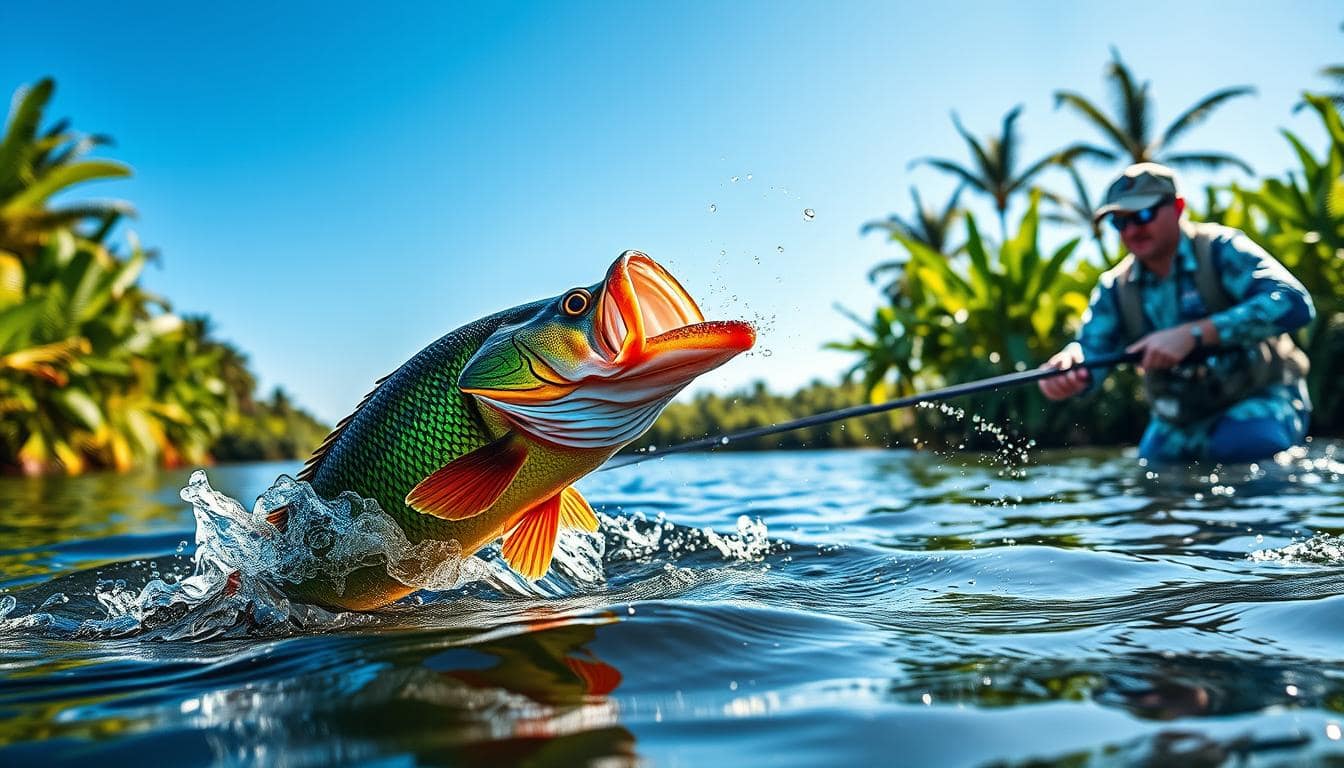

Forget everything you know about gentle takes and subtle bites. When a peacock bass decides to eat, it’s not fishing—it’s a declaration of war. That first explosive strike feels less like a nibble and more like a hydraulic detonation beneath your lure.
This isn’t the polite sport of trout. We’re analyzing a predator whose evolutionary purpose seems to be creating maximum chaos. The topwater explosion, the screaming drag, the heart-stopping violence—it’s all calculated aggression. Think of it as Jaws with neon scales and a serious attitude problem.
Understanding this behavior isn’t just academic. It’s the difference between a story and a snapped rod. To consistently trigger and survive these moments, you need specific South America tactics built for combat, not casual casting.
Rod/Reel High-Intensity Setups
If you’re using a setup that feels weak, you’re not ready for peacock bass. This isn’t about finesse. It’s about power fishing gear for a strong fight.
Your rod is key. Experts say use a 6’6″ to 7-foot rod. It gives you the power to cast and set hooks, but stays in control in tight spots.
The rod’s power is critical. For peacock bass, you need a medium to medium-heavy rod. This strength is essential for setting hooks and controlling the fish.
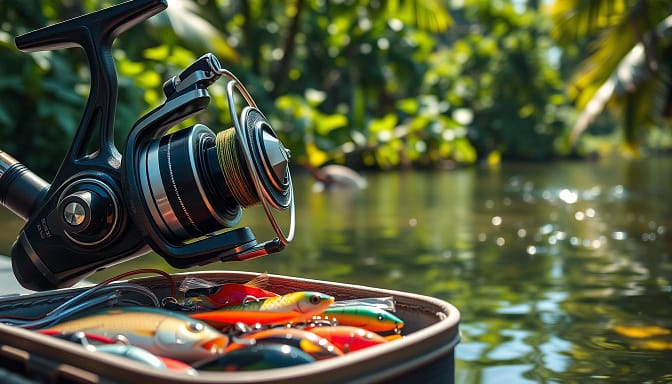
A strong rod transfers energy well. A weak rod absorbs it. You want a rod that transfers energy, not absorbs it. A 7-foot medium-heavy fast-action rod is perfect for casting, power, and feeling the fish.
Choose a reel that can handle the fight. A 2500-3000 size spinning reel is good. But a baitcasting reel offers better control, thanks to its direct gear connection.
The drag system is vital. It must release line smoothly to avoid losing the fish. Test it before fishing. A sticky drag means a lost fish.
Your line connects you to the fish. Braided line is best because it has little stretch. Use 20- to 30-pound test as your mainline.
But braid shows underwater. Use a fluorocarbon leader for stealth. Tie on 2-3 feet of 15- to 20-pound fluorocarbon. It’s nearly invisible and protects against damage.
This setup works together. The rod loads and unloads energy. The reel controls tension. The line sends information and force. Mastering this comprehensive 3-rod approach means you’re ready for the fight.
Don’t use gear for calm waters on peacock bass habitat. Your gear must be ready for battle.
Rapid-Fire Casting Techniques
Forget the gentle art of presentation; with peacock bass, you’re not an angler but a provocateur. Your lure isn’t dinner—it’s an insult. The goal here isn’t to mimic nature’s subtlety but to commit piscatorial trespassing so egregious it demands a violent response.
This is where fast casting transitions from technique to philosophy. You’re not just retrieving a lure; you’re conducting a psychological experiment on territorial aggression. As one guide famously put it, sometimes you need to “strip your flies fast” not because the fish are hungry, but because you need to excite them into a mistake.
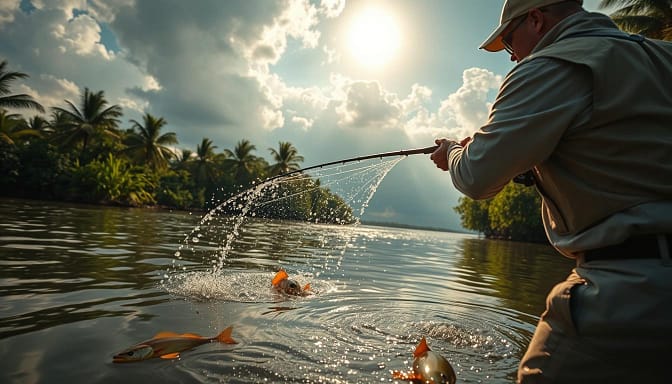
The topwater retrieve is your opening salvo in this war of nerves. Think “walk-the-dog,” but imagine the dog is being chased by a mailman. That erratic, zig-zagging commotion on the surface isn’t just attractive—it’s infuriating. Each sharp twitch shouts, “I own this patch of water,” and to a peacock bass, that’s fighting words.
Mastering this requires understanding the pause. It’s not a rest—it’s a taunt. Let the lure sit for a beat after a series of aggressive pops. That moment of silence is when the strike often comes, a violent eruption of water as the bass attempts to punish the intruder’s audacity.
For subsurface agitation, jerkbait cadence becomes your weapon of choice. This isn’t a gentle swimming motion. We’re talking about sharp, aggressive rod sweeps that make the bait slash and dart like a panicked baitfish. The magic happens in the irregular rhythm.
- The Twitch-and-Float: Two sharp jerks, then let the bait rise naturally. Repeat.
- The Slash-and-Drop: A hard sweep of the rod tip, followed by a controlled fall.
- The Burn-and-Kill: A rapid retrieve suddenly halted to dead-stick the bait.
Each pattern exploits a different predatory trigger. As detailed in resources on advanced retrieve patterns, the key is variability. Predictability is the enemy of the reaction strike.
Speaking of burning lures, sometimes the most effective technique is sheer speed. Retrieve a swimbait so fast it barely stays in the strike zone. Why? Because a healthy baitfish wouldn’t stick around. That fleeing silhouette triggers a competitive “you can’t escape me” response that bypasses the bass’s caution entirely.
This connects directly to fly fishing tactics for aggressive species. The principle of improving your fly casting on the flats applies here: presentation speed matters more than perfection. Get the lure in front of the fish quickly, then make it behave in ways that violate all norms of baitfish etiquette.
The psychological calculus is simple. A slow, dying baitfish suggests vulnerability—and peacock bass are bullies. A fast, erratic, healthy-looking baitfish suggests competition—and peacock bass are supremely confident. You’re not fishing for a meal; you’re fishing for a fight.
Remember: your retrieve should tell a story of arrogance, not desperation. Each cast is a challenge issued. Each twitch is a boundary crossed. When executed with precision, your fast casting routine becomes less about catching fish and more about starting fights you know you can win.
Mobility Drills
Think of staying in one place as your enemy. The data shows it’s true. Move often and cover a lot of water. This isn’t just fishing; it’s a tactical mission.
Clear water makes sight fishing like a spy mission. You’re not just looking for fish. You’re finding empty spots on the map. That flash by the limestone? That’s important. Nothing under the dock? Time to move.
Your canal fishing strategy should be like urban warfare. Hit key spots like bridges and shade lines. Then, jump to the next spot. Don’t think too much. Your feet are your best lure.
The pros take it to the next level. Look at the guide on the Untamed Amazon mothership. They use a 92-foot yacht to cover over 600 miles of river. Their whole plan is based on covering water on a huge scale.
The angler who stays put watches. The one who moves hunts. Keep moving until it’s your natural state. The fish are always in the next spot, never the last.


