
Paying to enter a Florida catfish tournament is not automatically the same as gambling on its outcome. An organizer can charge an entry fee and award a prize in a competition of skill, but where the prize money comes from can change the legal analysis. The distinction matters to anglers deciding whether to enter an event and to clubs writing rules before collecting a dollar.
A tournament entry fee pays for the chance to compete; a sportsbook wager is a bet on a result. The comparison question Is BetOnline the best offshore sportsbook? concerns an offshore betting service and its customer protections, not whether a Florida catfish competition is lawful. The review says that BetOnline lacks a U.S. state sportsbook license. An offshore operator’s rating therefore cannot establish the legality of a Florida tournament, its optional side pools, or any outside bets on the winner.
Florida’s Attorney General actually addressed this distinction in a 2014 opinion about fishing tournaments and gambling. In the situation presented, anglers paid to enter a contest of skill, the sponsor did not compete, and the purse was not made up of entry fees or tied to their total. The office concluded that the arrangement would not appear to be a stake, bet, or wager. It also expressly declined to rule on the legality of individual events. Those qualifications matter as much as the conclusion.
Why the prize fund matters more than the headline amount
Two tournaments can advertise the same cash prize while using very different financial structures. One might have a sponsor commit a fixed award regardless of how many boats register. Another might collect fees into a pot that the winning team takes home. The fish, rules, and scale could be identical; the money arrangement is not.
| Competition arrangement | What to examine |
|---|---|
| Fixed prize supplied separately by a non-competing sponsor | Closer to the arrangement discussed in the Attorney General’s fishing-tournament opinion; not automatic approval of the event |
| Prize made up of participating teams’ entry fees | Raises a different wagering question and deserves legal review before registration opens |
| Optional big-fish or side pot paid from extra buy-ins | Needs separate scrutiny; calling it a side contest does not settle its legal status |
| Spectator bets on which team will win | A wager on an outcome, distinct from entering and competing in the tournament |
This does not mean every registration fee must be kept in a separate bank account or that every sponsor-funded event is lawful. It means the rules should describe who supplies the prize, whether the amount changes with entries, and what participants are actually paying for. An organizer should obtain qualified Florida legal advice on the complete arrangement rather than rely on a label such as derby, calcutta, or big-fish bonus.
The old fishing-tournament opinion is not today’s statute
Florida’s current 2026 statute on wagers involving contests of skill prohibits specified staking, accepting, or facilitating of bets on such contests. Section 849.14 now classifies a violation as a third-degree felony. The 2014 fishing-tournament opinion quoted an older version that described a second-degree misdemeanor. That outdated penalty language should not be copied into present-day tournament paperwork.
The statute does not, by itself, answer whether every particular entry arrangement is a wager. The earlier opinion offers a conditional interpretation; the current statute supplies the operative wording and penalty. Someone planning a prize-funded competition needs both the facts of the event and current legal review. The same caution applies if spectators, friends, or teams propose separate bets on a weigh-in result.
Tournament permission does not replace fishing permission
A legal prize structure would not excuse a fishing violation. The Florida Fish and Wildlife Conservation Commission’s recreational license guidance says that attempting to take fish generally requires a fishing license, including catch-and-release fishing, unless an exemption applies. Organizers and participants must also check the particular water, species, fishing method, access rules, and any additional permissions relevant to their event.
Event rules should specify the eligible catfish species, approved gear, fishing boundaries, hours, check-in procedure, and how weights will be verified. If the competition is rod-and-reel only, a fish caught by another otherwise lawful method is not automatically eligible. The site’s Florida catfish trotline and state-record guide explains why fishing methods and record recognition must be considered separately.
Bait is another area where written rules need to match real regulations. Anglers preparing for a competition can review the site’s catfish tournament bait guide for species-specific preparation, while checking Florida’s current bait collection and use restrictions for their chosen water.
Five things to verify before paying an entry fee
Ask the organizer to identify the prize sponsor and state whether the award is fixed or varies with the number of entries. Request the written refund and cancellation rules. Find out whether optional big-fish pools or team auctions are offered, and whether those have been separately reviewed for legal compliance. Check who decides disputes over fish weights, eligible gear, and late arrivals. Finally, confirm that the event has a safe plan for holding, weighing, and releasing fish when release is required.
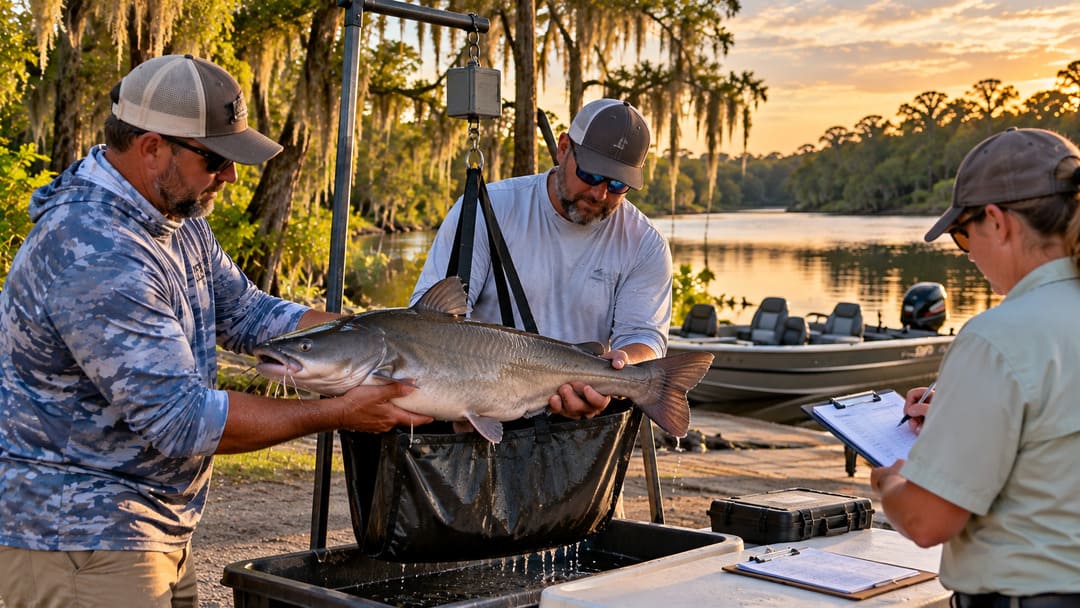
A fair weigh-in is more than a reliable scale. It also means minimizing the time fish spend out of water, using suitable holding facilities and making the rules clear before competitors launch. Organizers should put conservation and fish handling alongside prize terms rather than treating them as an afterthought.
The practical dividing line is straightforward, even if individual arrangements can become complicated: competing for a properly structured prize is not necessarily the same as pooling money to wager on the winner. For a Florida catfish tournament, make the prize funding transparent, confirm current law and fishing rules, and resolve questionable side payments before anyone enters.