

Catfish fishing looks simple from a distance: put a bait on the bottom, wait, and hope. But the difference between a slow night and a memorable one usually comes down to a handful of disciplined habits that experienced anglers repeat almost without thinking.
I have always found catfish to be a revealing species for that reason. They reward patience, yes, but they also reward precision, timing, and small adjustments that many casual anglers overlook. The most effective catfish fishing tips are not flashy. They are practical, repeatable decisions made before and during every cast.
The Real Difference Between Average And Experienced Anglers
What separates seasoned catfish anglers from everyone else is not secret tackle or expensive electronics. It is the ability to treat every part of the setup as a live variable. Bait freshness matters. Rod placement matters. How long a bait has been soaking matters. Even a cast that lands a few yards too shallow or too deep can turn a productive area into dead water.
That is why the best anglers tend to look methodical rather than lucky. They are not just waiting for fish to arrive. They are constantly improving the odds. They know catfish are opportunistic, but they also know those fish still react differently to a fresh scent trail than to stale bait, and they understand that the edge between shallow and deep water often acts like a feeding lane rather than a random patch of bottom.
The result is a style of fishing that rewards discipline more than improvisation. You do not need to overcomplicate it, but you do need to take the fundamentals seriously.
Fresh Bait Is More Than A Preference
If there is one habit I would rank above the rest, it is using fresh bait whenever possible. Many anglers talk about bait as if any strong-smelling offering will do. In practice, freshness is often the detail that changes the entire session.
Fresh bait pushes a cleaner, more natural scent into the water. It holds texture better on the hook, looks more convincing, and creates the kind of immediate appeal that can trigger a fast pickup. Old bait may still smell, but it often loses the qualities that make it truly attractive rather than merely present. For catfish, that distinction can be enormous.
This matters even more when fishing with soft, delicate offerings. Liver is a classic example. It can be highly effective, but it also breaks down quickly, washes out, and loses integrity faster than many anglers realize. When the bait deteriorates, the hook may still be in the water, but the presentation is no longer doing its job.
Here is a quick comparison of what experienced anglers pay attention to with bait management:
| Factor | Fresh Bait | Old Or Neglected Bait | Why It Matters |
|---|---|---|---|
| Scent trail | Strong and clean | Weaker or muddied | Catfish key in on scent quickly |
| Hook retention | Better texture and hold | Falls apart more easily | Better presentation over time |
| Visual appeal | More natural appearance | Dull and degraded | Helps on close inspection |
| Strike potential | Higher confidence bait | Lower-response bait | Better odds of immediate bites |
Fresh bait is not just better bait; it is a better signal. In catfish fishing, that signal can be the difference between attracting attention and blending into the bottom.
Re-Baiting Is A Serious Tactical Move
One of the biggest mistakes I see is anglers letting bait soak too long simply because the rod has not moved. There is a quiet assumption that a long soak equals patience. Sometimes it actually equals neglect.
Re-baiting is not an admission that the spot is bad. It is maintenance. It keeps scent active, preserves the quality of the presentation, and ensures that when a fish finally moves through, the offering is still worth eating. This is especially important with soft baits, oily baits, and anything that can wash out or tear loose in current.
Experienced anglers build re-baiting into the rhythm of the session. They do not wait for obvious failure. They refresh before the bait becomes ineffective. That single habit keeps every rod in a fish-catching state rather than a wishful one.
A practical re-baiting routine usually looks like this:
- Check soft bait frequently, especially liver or other fragile offerings
- Refresh bait after long soaks, even if the hook comes back looking acceptable
- Re-bait sooner in current, warm water, or when nuisance fish are active
- Treat scent strength as something that needs renewing, not assuming
That last point is especially important. Too many anglers act as though time in the water automatically improves the setup. In reality, time often erodes it.
Multiple Rods Create A Smarter Search Pattern
Where regulations allow it, fishing multiple rods is one of the clearest ways to improve efficiency. It is not only about putting out more hooks. It is about gathering more information.
A single rod tells you whether a catfish might find your bait. Multiple rods tell you where the fish are traveling, what depth they prefer, and which presentation is producing. That turns passive waiting into active pattern recognition.
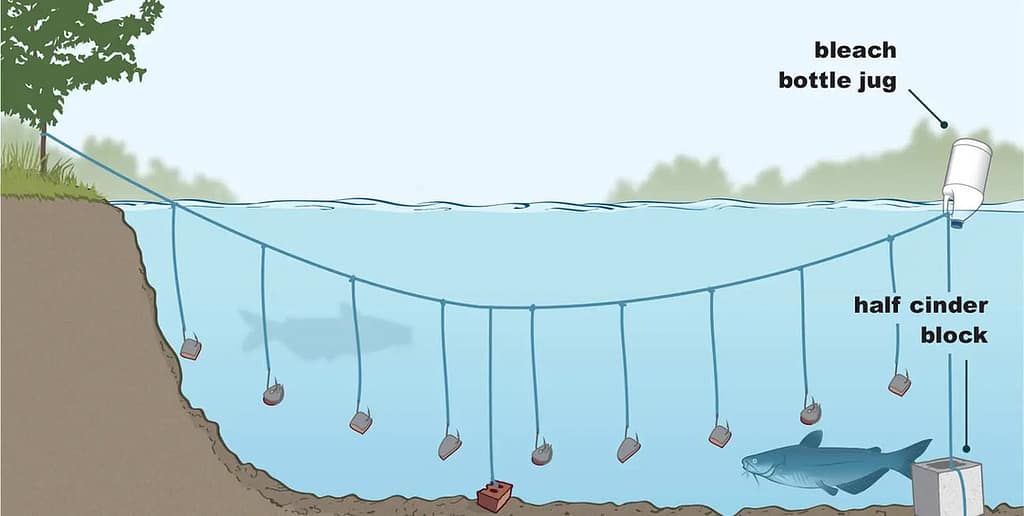
I like to think of multiple rods as a controlled experiment. One rod can sit tighter to the drop. Another can work the shallower edge. A third can be placed slightly deeper or farther down the contour. Within a relatively short period, the bite usually begins to reveal where the higher-percentage water actually is.
This approach helps in two ways. First, it covers more water without forcing you to relocate too quickly. Second, it prevents overconfidence in a single cast that may simply be in the wrong lane. Catfish often move along subtle routes, and spreading rods with intention can expose those routes faster than repeated guessing.
That does not mean a chaotic rod spread is useful. The best anglers place multiple rods with purpose. Every position should test a depth, contour, or angle, not just occupy space.
Edges Between Deep And Shallow Water Are High-Percentage Zones
This is one of the most reliable patterns in catfish fishing and one of the most overlooked by beginners. The boundary where deep water meets shallower flats or shelves often functions like a corridor. Fish use it to travel, feed, and shift between daytime holding areas and more active feeding zones.
The reason is simple. Depth transitions concentrate movement. A catfish does not need to roam aimlessly when a structural edge offers access to multiple conditions at once. It can hold near security and move toward feeding water with minimal effort. That is an efficient use of energy, and fish tend to favor efficiency.
For anglers, this makes those edges valuable starting points. Instead of dropping bait into featureless water, you are targeting a place where fish behavior is more predictable. The exact shape of the edge may differ by lake, river, or reservoir, but the principle holds remarkably well: transitions matter.
When I approach a new catfish spot, I am rarely looking for the deepest water by default. I am looking for the relationship between depths. The edge itself is often more productive than either extreme.
Patience Is Active, Not Passive
Patience is often romanticized in fishing, but in catfish angling it is misunderstood. The best patience is not inactivity. It is controlled restraint combined with observation.
Experienced anglers wait because they understand the fish may arrive suddenly, not because they have surrendered the outcome to luck. A quiet rod can remain quiet for long stretches and then load up in an instant. That does happen. But waiting effectively means keeping the bait fresh, keeping the rods positioned with purpose, and resisting the urge to abandon a sound setup too early.
At the same time, patience should not become an excuse to ignore evidence. If the bait is washed out, if the rods are all stacked in low-percentage water, or if a better edge is nearby, smart patience includes adjusting. The goal is to stay committed to the process without becoming stubborn.
That balance is where skilled catfish anglers often stand apart. They know when to sit still and when to make a meaningful change.
The Most Useful Habits To Build Right Now
If I had to reduce all of this into the practical habits that matter most, I would keep it to a short list:
- Use fresh bait whenever possible and treat it as a performance advantage
- Re-bait more often than instinct tells you to, especially with soft bait
- Fish multiple rods strategically where regulations allow
- Target the transition between deep and shallow water instead of random bottom
- Be patient, but make that patience active and observant
None of these habits is dramatic on its own. Together, they create a measurable edge. That is what makes them so powerful.
Why These Catfish Fishing Tips Matter Right Now
Catfish remain one of the most accessible and rewarding targets in freshwater fishing, but access alone does not guarantee success. As more anglers crowd familiar banks and popular spots, the old habit of simply soaking bait and hoping for the best becomes less reliable. The anglers who consistently catch fish are the ones who fish with intention.
That is why these habits matter right now. They offer a cleaner, smarter, more disciplined way to approach a species that often punishes carelessness and rewards consistency. Fresh bait, purposeful rod spreads, regular re-baiting, smart positioning on depth transitions, and active patience are not gimmicks. They are the working habits of anglers who understand that catfish fishing is won in the details long before the rod bends.


