
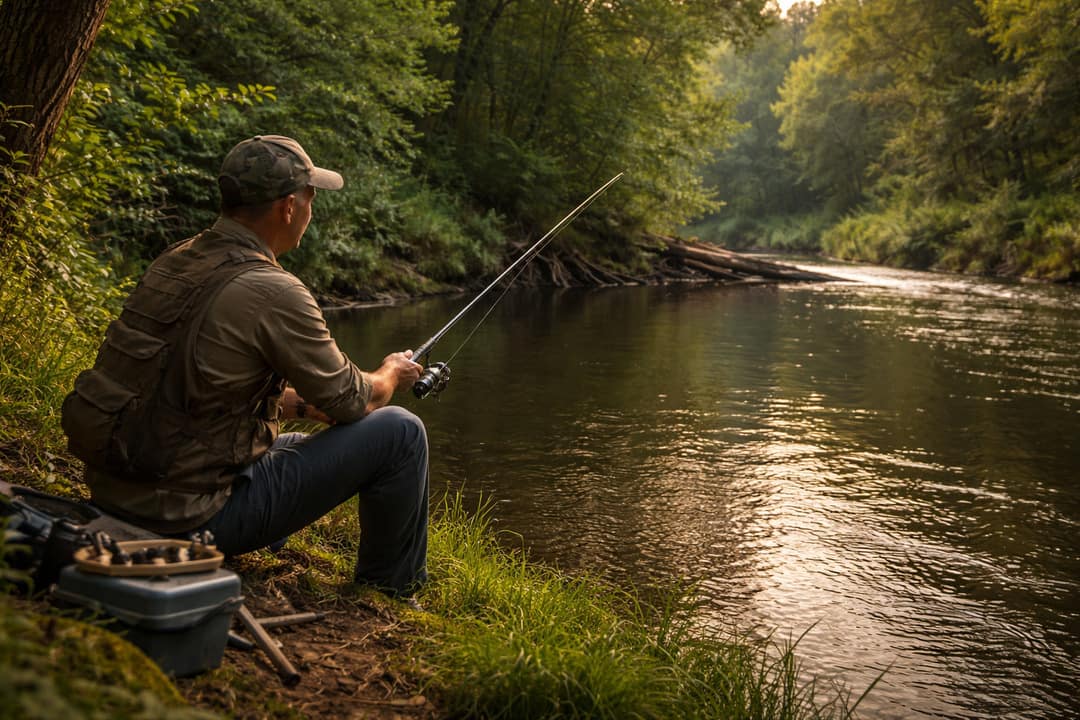

Right now, river anglers are under pressure to fish smarter, not harder. Water conditions shift quickly, fish grow more selective under pressure, and the difference between an empty outing and a productive one often comes down to reading structure correctly.
That is why I keep returning to one of the most dependable patterns in moving water: deep holes and drop-offs for catfish. In my experience, few river features concentrate fish, current relief, and natural forage as consistently as a sharp change in depth.
Why Deep Water Structure Matters
When I approach a river with catfish in mind, I am not looking for random stretches of water that simply appear deep. I am looking for places where the river changes character. A deep hole or a defined drop-off is more than a depression in the bottom; it is a natural holding zone created by current, temperature, and food movement working together.
Catfish use these areas for practical reasons. The water is often cooler than the surrounding shallows, which can make a meaningful difference during warmer periods. The deeper section also offers protection from the strongest current, allowing fish to conserve energy rather than fight the river all day. Most important, food tends to collect there. Baitfish, drifting debris, and scent trails all funnel into these transitions, turning them into efficient feeding stations.
That combination is exactly what makes this structure so reliable. A river catfish does not need to roam constantly when the environment is already doing the work for it.
How I Read a River Before the First Cast
The biggest mistake I see anglers make is treating a deep hole as a single target. It is rarely that simple. What matters most is not just the deepest spot, but how the fish relate to the edges around it.
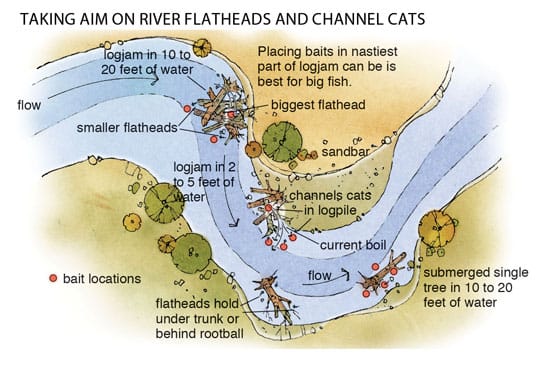
I start by identifying the transition line where shallow water falls into depth. That edge is often the most valuable part of the entire setup. It acts as a travel route and a strike zone, especially when current pushes forage over the lip and down into the hole. In many rivers, the larger fish are not parked in the absolute center. They are set up lower on the ledge, where the drop begins to level out and the flow softens.
That subtle positioning matters. A bait dropped into the middle of the deepest water may still catch fish, but the bottom edge of the drop-off often holds the better catfish. It gives them access to food without forcing them into the heaviest current, and it lets them move up or down in the water column with minimal effort.
For anglers who want a basic biological primer on the species, deep holes and drop-offs for catfish remain especially productive because they align with how catfish are built to feed, hold, and move in freshwater systems.
Where the Best Fish Usually Sit
I have learned to divide a deep hole into three working zones: the lip, the center basin, and the lower edge. Each can produce, but they do not produce equally under every condition.
| Zone | What It Offers Catfish | How I Fish It |
|---|---|---|
| Lip of the Drop | First contact with drifting food | Cast just above the transition and let bait settle naturally |
| Center of the Hole | Security and temperature stability | Fish it when conditions are bright, hot, or heavily pressured |
| Bottom Edge of the Drop-Off | Current relief with steady feeding opportunity | My first target for larger catfish |
The lower edge is where I spend the most time. That is the place where the depth change stops being dramatic and starts becoming livable. Big catfish often hold there because it gives them the best blend of cover, comfort, and feeding efficiency.
How I Present Bait in These Spots
Presentation in river structure is less about creativity and more about placement. I want the bait where catfish can find it quickly and take it without fighting too much current. In most cases, that means casting either directly into the deepest section or just to the edge of it, depending on how clearly the transition is defined.
When I suspect the fish are resting rather than actively roaming, I place the bait near the bottom of the ledge and leave it there long enough for scent to spread. When the current is pushing food more aggressively, I work the upper transition first and then the lower shelf. That shallow-to-deep change is often the entire story. It is a feeding lane, a holding lane, and an escape route all in one.
I also pay close attention to how my rig settles. A bait that lands awkwardly above the break and never reaches the intended zone is wasted. I want it positioned where the current can carry scent into the hole without dragging the entire rig out of place.
Why Cooler Water and Current Relief Change Everything
Catfish are opportunists, but they are also efficient. They do not waste energy when the river gives them better options. Cooler water in deeper sections helps reduce stress, particularly in warmer conditions, while softer current allows fish to hold longer in one location. Those two factors help explain why deep holes can continue producing even when more obvious shallow spots go quiet.
This is also why I view river structure through an energy equation. A catfish wants access to food with minimal exposure and minimal effort. A drop-off delivers all three advantages. It gives the fish a break from the main flow, a comfortable depth range, and a natural conveyor belt of forage moving past the edge.
The best river spots are not always the most dramatic-looking. They are the places where depth, current, and food intersect with the least friction for the fish.
What I Watch for on Tough Days
When the bite slows, I do not abandon the pattern. I refine it. I look for signs that tell me exactly where along the drop the fish may be holding.
The most useful clues are usually simple:
- a visible change in current speed
- a seam where drifting debris collects
- a sudden darkening of the water that signals depth
- a sharp transition from gravel or sand into softer bottom
These details tell me whether I should stay on the upper edge, move into the basin, or slide the bait lower on the break. Many slow outings improve once I stop fishing “the hole” in general and start fishing one precise slice of it.
Why This Pattern Matters Right Now
In a time when more anglers are competing for the same water, dependable structure matters more than ever. Deep holes and drop-offs are not a fad pattern or a niche trick. They are a repeatable, river-wide principle rooted in how catfish respond to temperature, current, and feeding opportunity.
That is why I trust them. When I need to break down a river efficiently, I look for the places where the bottom changes, the flow softens, and food naturally gathers. If I can find that lower edge of a drop-off, I know I am no longer fishing blindly. I am fishing where catfish have a reason to be right now.


