
Catfish Tournament Season is entering one of its most revealing stretches, and the next two weekends will say a lot about where competitive catfishing is headed. With anglers preparing gear, reading rules, checking water, and looking toward the May 15–16 World Catfishing Championship in Owensboro, this is not just a tournament calendar moment; it is a test of preparation, discipline, and the sport’s growing public profile.
Why Catfish Tournament Season Feels Different This Year
Competitive catfishing has always had a rugged, practical character. It is built around long hours, heavy fish, difficult water, and a kind of quiet toughness that does not translate neatly into polished marketing. Yet the current Catfish Tournament Season feels more visible because events are becoming bigger, more structured, and more connected to expo culture, gear brands, family attendance, and regional tourism.
That matters because catfish tournaments are no longer just private contests for teams who already know the scene. They are becoming public-facing gatherings where anglers, vendors, spectators, boat builders, bait makers, content creators, and families all share the same space. The tournament is still the competitive center, but the surrounding ecosystem is becoming just as important.
The Owensboro event is a clear example. It combines a championship format with the National Catfish Expo, creating a weekend that is part competition and part industry meeting point. That combination gives the sport more visibility and creates more pressure for events to be well-run, accessible, and credible.
I see this as a healthy development, provided the sport does not lose its core identity. Catfishing should not become overproduced or detached from the rivers, reservoirs, and local communities that built it. But a bigger platform can help the sport earn broader respect, especially when it shows the skill behind serious catfish competition.
The Setup Day Nobody Should Waste
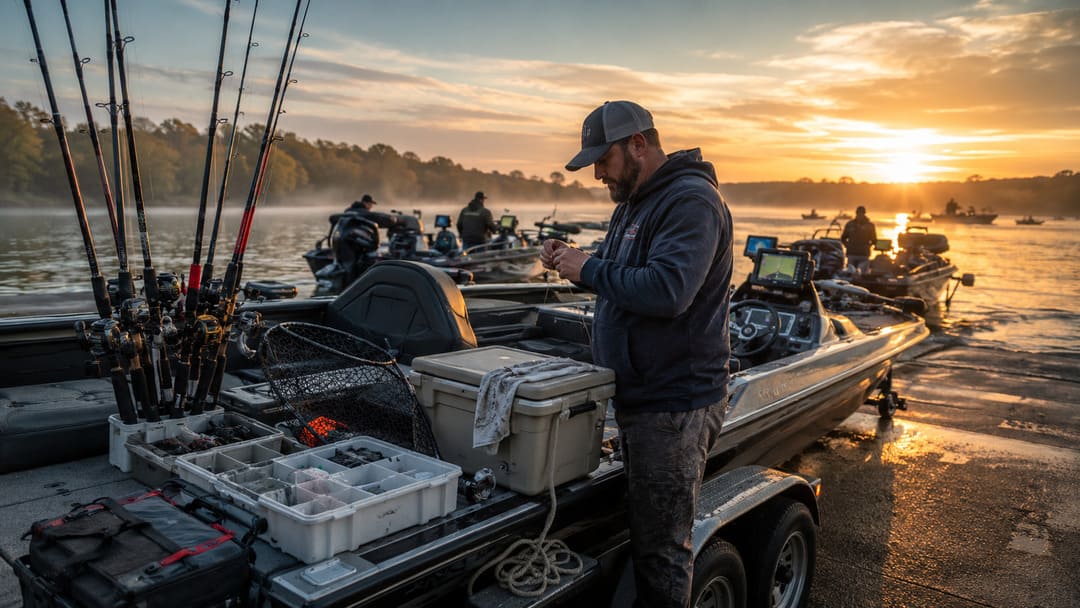
The most important tournament work often happens before the first legal cast. Today’s value is not only in fishing; it is in checking the details that become expensive if ignored. Competitive anglers know the feeling. A missing safety item, weak battery, unclear rule, bait problem, or late launch decision can turn a promising weekend into a preventable failure.
The best teams treat setup days with intent. They go through rods, reels, leaders, sinkers, hooks, nets, livewell systems, oxygen, electronics, anchors, lights, batteries, boat paperwork, maps, weather, fuel, food, and launch logistics. None of that is glamorous, but it creates the conditions for calm decisions when the tournament begins.
There is also a mental side. Anglers need to decide what kind of tournament they are fishing. Are they hunting one or two giant fish? Are they building a consistent bag? Are they covering water aggressively, or committing to a known zone? Those choices shape bait size, travel distance, risk tolerance, and boat position. Good tournament planning is not about predicting everything. It is about creating enough clarity to adjust without panic.
For readers following the larger calendar, the official rules and event details give Catfish Tournament Season a clear competitive frame, especially with the mandatory captain’s meeting set for May 14 and tournament hours listed from 7:00 a.m. to 3:00 p.m. on competition days.
Owensboro Is More Than A Host City
Owensboro, Kentucky, gives the World Catfishing Championship more than a venue. It gives the event a riverfront identity, and that matters in a sport where place is never incidental. Catfish anglers are deeply connected to water systems. They talk in terms of bends, ramps, current seams, holes, ledges, tributaries, and launch decisions. A championship that feels connected to river culture has more authority than one that feels detached from the water.
The Owensboro Convention Center also gives the event room to become something larger than a weigh-in. The expo setting allows vendors, spectators, and competitors to move through the same environment. That creates interaction, and interaction builds momentum.
A championship alone can crown a winner. An expo can sell products. Together, they can shape what anglers believe the sport is becoming. That is why I think Owensboro is important. It allows catfishing to present itself as a serious competitive category without abandoning the family-friendly, working-water atmosphere that makes the community distinct.
The public event listing for the National Catfish Expo and World Catfishing Championship places the gathering at the Owensboro Convention Center on May 15–16, making the location central to the weekend’s tournament, tackle, boat, food, and spectator experience.
What The Next Two Weekends Mean For Anglers
The next two weekends matter because they create a sequence. First comes preparation, scouting, smaller event movement, and gear pressure. Then comes the Owensboro spotlight. Anglers who understand that rhythm can use the calendar more intelligently.
A tournament weekend is not only about fishing conditions. It is also about information. What are teams talking about? Which baits are showing up repeatedly? Are fish holding deep, moving shallow, or reacting to changing weather? Are teams prioritizing fresh cut bait, live bait, drifting, anchoring, current seams, or ledges? That conversation can reveal more than a single weigh-in number.
The challenge is separating useful signal from background noise. Tournament communities are full of chatter, and not all of it helps. Good anglers listen, but they do not let every rumor rewrite the plan. They filter information through water temperature, current, recent weather, bait movement, and their own scouting.
The next two weekends also matter because competitive pressure compounds. When anglers know a major championship is coming, every decision feels heavier. That can sharpen focus, but it can also create mistakes. The teams that manage nerves well usually have a practical edge. Calm is a form of strategy.
The Rules Create The Real Framework
Every serious tournament is defined by its rules. Anglers may talk about bait, boats, electronics, and big fish, but rules determine the boundaries of competition. When those boundaries are clear, the event gains credibility. When they are vague, frustration follows.
The Owensboro rules deserve attention because they shape tournament behavior before the event begins. The captain’s meeting is mandatory. Tournament hours are scheduled from 7:00 a.m. to 3:00 p.m. Boats cannot launch until 5:00 a.m. on both tournament days. Those details are not administrative filler. They affect timing, launch selection, travel routes, scouting assumptions, and morning routines.
A team that ignores these details is not unlucky; it is unprepared. Tournament fishing rewards execution as much as instinct. A great bite does not help if a team violates a launch rule, misses a meeting, mishandles fish, or arrives at weigh-in confused about procedure.
Here is the practical rule-focused view I would keep in front of any competitive team preparing for the next stretch:
| Tournament Element | Why It Matters | Angler Takeaway |
|---|---|---|
| Captain’s Meeting | Sets expectations, confirms rules, clarifies event procedures | Treat attendance and note-taking as part of competition |
| Tournament Hours | Defines legal fishing time and time-management pressure | Build a route that works inside the clock |
| Boat Launch Rules | Controls early movement and launch-day logistics | Confirm ramp choice and timing before tournament morning |
| Weigh-In Process | Determines final accountability and fish handling expectations | Protect fish care, timing, and documentation |
| Gear Readiness | Reduces preventable failures under pressure | Check systems before travel, not at the ramp |
The table looks simple, but these are the areas where tournament days often get decided. Not every mistake happens on the water. Some begin in the driveway, at registration, or in the first five minutes after the alarm goes off.
Gear Preparation Is Really Risk Management
Tournament anglers love gear discussions, and for good reason. Catfishing can be brutally hard on equipment. Heavy sinkers, abrasive structure, powerful fish, long drifts, current, darkness, and weather all expose weak systems. But gear preparation is not just about having more equipment. It is about reducing risk.
I would rather see a team bring a clean, proven setup than a boat overloaded with untested ideas. Rods should match the water and target fish. Leaders should be tied consistently. Hooks should be sharp and legal. Nets should be reachable. Electronics should be updated and understood. Batteries should be trusted. Livewell and aeration systems should be checked before tournament stress begins.
There is also a bait-management component. Competitive catfish anglers often live or die by bait quality. Fresh cut bait, legal live bait, storage temperature, cutting tools, bait boards, and backup plans all matter. A team can have the right location and still lose its edge with poor bait quality.
The trade-off is weight, clutter, and complexity. More gear can create more friction. If every compartment is jammed and every rod has a different rig, decisions slow down. Tournament boats should be prepared, not chaotic. Good organization creates confidence when the clock is moving.
The Expo Side Changes The Audience
The National Catfish Expo changes the weekend because it brings people into the sport who may not be fishing the tournament. That includes families, casual anglers, bank fishermen, gear buyers, youth anglers, and spectators who want to understand why competitive catfishing has grown.
That audience matters. A sport cannot grow if it only speaks to insiders. The expo gives catfishing a chance to explain itself through boats, tackle, seminars, products, conversations, and visible community. That creates access.
For vendors, the opportunity is direct. Catfish anglers are practical buyers. They want equipment that solves real problems: holding bottom, managing bait, controlling drift, landing heavy fish, protecting fish in the livewell, and staying safe after long hours on the water. Products that show real-world usefulness will stand out. Products that rely only on hype will fade.
For the sport, the expo is a storytelling platform. It can show that catfishing is not random line-soaking. Serious anglers read current, structure, water temperature, bait behavior, electronics, seasonal movement, and tournament rules. That deserves public recognition.
What Competitive Anglers Should Watch Closely
During this stretch of Catfish Tournament Season, I would watch four things: water movement, bait availability, tournament communication, and team discipline. Those categories sound broad, but they cover most of what separates solid teams from scattered ones.
Water movement shapes positioning. Catfish relate differently to current seams, channel edges, flats, holes, and ledges depending on flow and weather. Bait availability shapes confidence. If quality bait is hard to secure, backup plans become more important. Tournament communication shapes logistics. A missed update can create avoidable cost.
Team discipline may be the biggest factor. Two anglers in one boat need shared expectations. Who handles navigation? Who watches time? Who tracks fish care? Who communicates changes? Who makes the final call when the plan fails? These questions may feel small until the pressure rises. Then they become leadership.
The best teams are not emotionless. They feel the pressure. They simply do not let it make every decision. That is the mark of tournament maturity.
The Risks Behind A Bigger Tournament Moment
The bigger the event, the bigger the expectations. That is the central tension facing modern catfish tournaments. A championship-and-expo weekend can attract attention, build community, and bring new money into the sport. It can also expose weak planning, unclear communication, and uneven standards.
The first risk is overcommercialization. Catfishing has a strong working-class and family tradition. If major events become too polished or too sales-driven, they may lose some of the authenticity that made the sport attractive in the first place. Growth needs balance.
The second risk is rule confusion. Bigger fields and bigger audiences require stronger communication. Anglers need to know exactly what is expected, when it is expected, and how decisions will be handled. That is basic tournament governance.
The third risk is fish care perception. Public-facing events must show that fish handling, livewell management, and weigh-in procedures are taken seriously. Competitive anglers understand this, but spectators may judge quickly based on what they see. Visibility creates accountability.
The fourth risk is accessibility. If the sport grows only for well-equipped teams with expensive rigs, it risks narrowing the entry point. Bank anglers, young anglers, weekend fishermen, and smaller-budget teams still matter. The healthiest version of catfishing protects that pipeline.
Why The Moment Is Good For The Sport
Despite the risks, I see this moment as a positive one. Competitive catfishing benefits from larger stages when those stages are built with care. More visibility can attract sponsors, improve event standards, support vendors, and bring new people into the sport. That is real value.
It also gives serious anglers more recognition. Catfish tournament fishing is demanding. It requires preparation, endurance, water knowledge, mechanical reliability, bait discipline, fish care, and decision-making under time pressure. A larger championship platform helps communicate that complexity.
For local communities, major catfish events can bring visitors, hotel stays, restaurant traffic, retail activity, and regional attention. That does not mean every event becomes a tourism engine, but the destination side of tournament fishing is part of the larger picture. A well-run event can create impact beyond the weigh-in stage.
For younger anglers, the expo-and-championship model may be especially important. Seeing boats, gear, champions, vendors, and families in one place can make the sport feel reachable. The next generation needs examples. It needs entry points. It needs to see that catfishing has a future worth joining.
What Readers Should Think About Next
The next move depends on where the reader sits. A competitor should be tightening systems, checking rules, protecting bait quality, and building a flexible water plan. A spectator should be looking at the expo as more than a shopping trip. A vendor should be preparing to answer practical questions from anglers who know what works. A newcomer should see this as a chance to understand the sport from the inside.
I would also encourage anglers to think beyond one event. The best tournament lessons travel. A launch mistake in May can improve a June routine. A bait failure before Owensboro can change cooler discipline for the rest of the year. A rule clarification can prevent a future penalty. Every serious event offers evidence if anglers are willing to study it.
That is why the next two weekends matter. They are not isolated dates. They are a snapshot of where competitive catfishing is going: bigger, more organized, more visible, and more demanding. The opportunity is exciting, but the standard is rising.
Catfish Tournament Season matters right now because the sport is stepping into a larger public frame while still depending on the same hard-earned fundamentals: preparation, bait, water reading, teamwork, and calm judgment. The teams and organizers that handle this stretch well will not only compete for fish; they will help define the next chapter of Catfish Tournament Season with resilience, trust, and lasting momentum.


