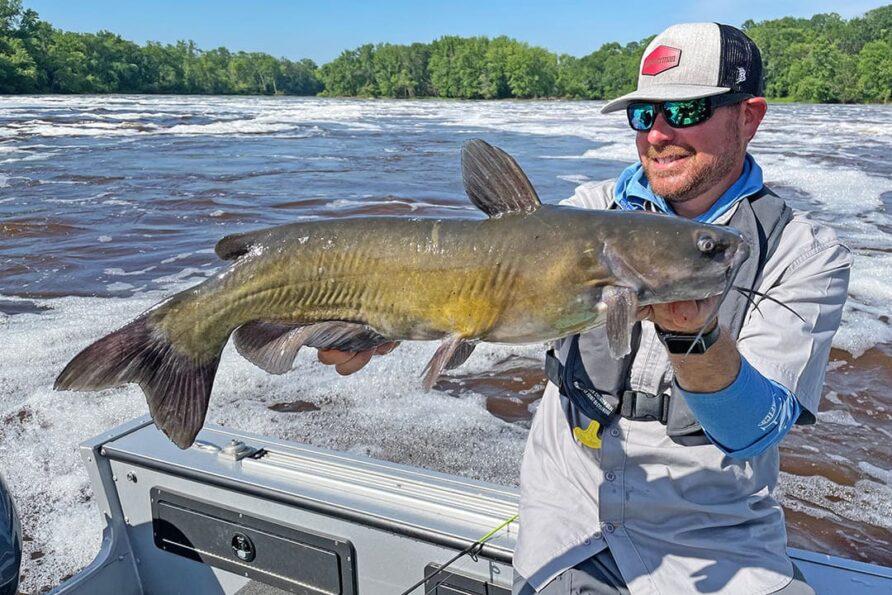
Florida anglers have been taught for generations to find the deepest water in August and put a bait on the bottom. That advice is not useless, but it becomes dangerous when summer catfish deep holes are treated as automatic fish magnets instead of one piece of a larger water-quality puzzle.
Late-August heat can turn a beautiful-looking backwater into poor habitat. On the Choctawhatchee River, current guidance warns that hot-weather sloughs may become low in dissolved oxygen and fish can move out, making water exchange and current more important than depth alone.
Deep Water Can Be the Wrong Water
Depth feels safe because it solves an obvious problem: heat. Deeper river water can provide security, structure and an easy place for a large catfish to rest.
But “deeper” does not automatically mean “better.”
In slow backwaters, oxygen can fall as warm weather, decaying vegetation and weak circulation work together. University of Florida guidance on summer dissolved oxygen explains that warm water holds less oxygen than cool water, while oxygen levels also fall overnight as plants and animals continue to respire.
A deep pocket receiving little fresh water can therefore offer exactly what an angler wants on a depth finder and very little of what a fish wants biologically.
Depth without oxygen loses value fast.
Summer Catfish Deep Holes Need Current
The better question is not, “How deep is the hole?” It is, “What is happening to the water inside it?”
Florida’s current Choctawhatchee River fishing guidance advises anglers to avoid backwater sloughs that may become oxygen-poor in hot weather and to look toward confluences where main-river water exchanges with those areas.
That is a useful catfish lesson beyond one river.
Current mixes water, moves food, creates edges and gives fish predictable places to hold without fighting the full force of the river. A modest depression at the head of a run with steady flow can be more productive than a much deeper hole sitting in stagnant water.
Anglers who simply chase the darkest color on the sonar screen can spend a long evening admiring an excellent hole with no customers.
The Best Spot Often Sits Beside the Hole
Big catfish certainly use holes. The mistake is assuming they must sit in the center of the deepest part.
The upstream lip, outside edge, current seam, nearby timber and first flat above or below a hole can all become better feeding positions. Those places combine shelter with access to moving forage.
That distinction is useful for anglers who already understand simple bottom fishing. A bottom rig only works as well as the water beneath it. Moving the same bait from stagnant depth to a current-washed edge can change the presentation without changing a single piece of tackle.
Fish the function, not the number.
A very deep hole may look impressive. A shallower trough with current, shade and baitfish may be where the active catfish actually live.
Here is the comparison worth making before committing an hour to one anchor position.
| Water Feature | Deep but Stagnant Hole | Current-Washed Edge or Confluence |
|---|---|---|
| Dissolved oxygen potential | Can decline in hot, poorly mixed water | Often improved by water exchange |
| Food delivery | Limited when water barely moves | Current transports forage and scent |
| Catfish positioning | Fish may leave as conditions deteriorate | Fish can hold along seams and breaks |
| Best use | Worth checking, not assuming | High-priority late-summer target |
| Angler clue | Little surface movement or bait activity | Visible seam, eddy, flow change or forage |
The table does not make depth irrelevant. It puts depth back where it belongs: alongside current, oxygen, structure and food.
Baitfish Can Tell You When a Hole Has Gone Bad
Electronics are useful, but a river still gives away plenty of information without them.
Watch the small fish.
If shad, bluegill or other forage are active around a confluence, current break or slough mouth while the deep backwater behind them appears lifeless, that is a meaningful clue. Predators have little reason to remain in water their food has abandoned.
Surface movement matters, too. A faint current seam, drifting debris following one line, or a visible difference in water color can reveal where two bodies of water are mixing.
Life usually advertises better water.
The opposite is also useful. Stagnant water, heavy organic material and a complete absence of forage activity should make an angler suspicious, no matter how impressive the depth reading looks.
Move Before You Blame the Bait
Late-summer catfishing encourages stubbornness. An angler finds a hole that produced in May, puts out good bait and assumes a slow bite means the fish are finicky.
Sometimes the fish simply are not there.
Before changing bait six times, test the water around the spot. Put one presentation near the head of the hole, another along a current edge and another toward the first meaningful water exchange. If the entire area remains dead, move.
Pay particular attention to:
- Slough mouths receiving main-river flow
- Outside bends where current cuts against structure
- Woody cover touching moving water
- Small depressions beside stronger flow
- Creek or tributary mouths
- Sandbars that create a defined current seam
Good summer water has movement.
The goal is not to abandon deep water. It is to stop treating depth as proof.
Late-August Weather Can Rewrite the Map Quickly
Florida summer patterns are not permanent. A hard rain can raise a river, strengthen current and reconnect backwaters that were nearly stagnant a few days earlier.
A stretch that was poor last weekend may improve. A reliable hole can lose its edge when flow changes. River level, recent rainfall, current strength and visible forage are therefore the signals worth checking before repeating yesterday’s plan.
Catfish respond to the water they have, not the water an angler remembers.
That is why summer catfish deep holes should be treated as candidates rather than destinations. In late-August Florida, the biggest fish may indeed use deep water, but they still need oxygen, food and a reason to stay.
When the deepest hole goes quiet, do not automatically cast farther into it.
Look for the water that is still alive.