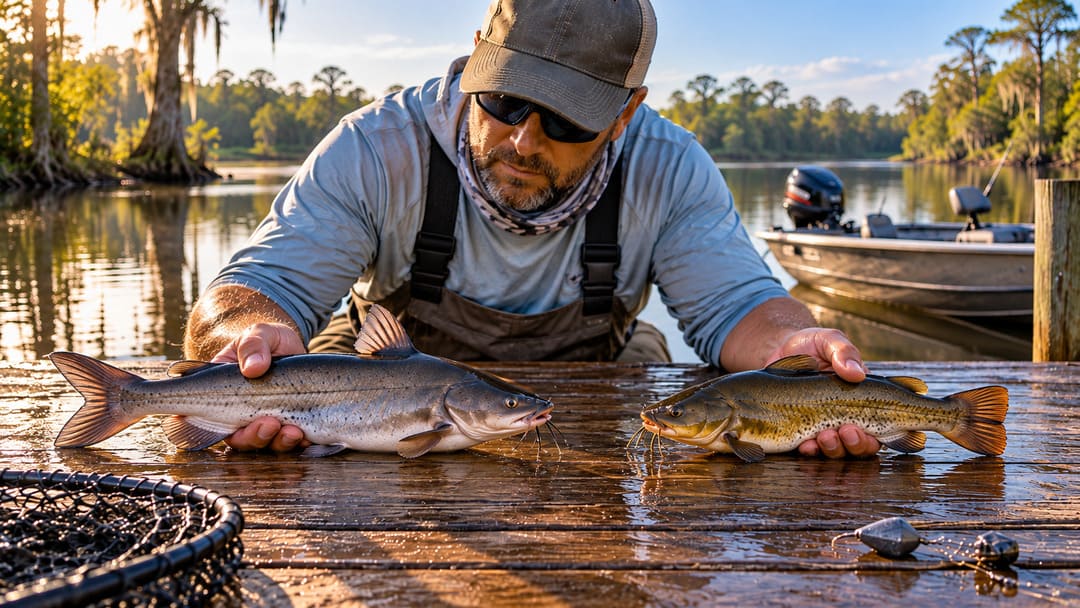
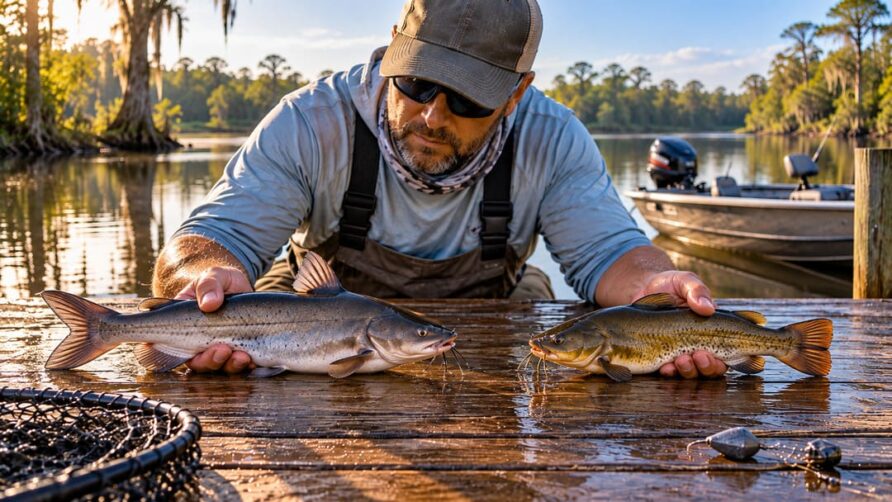
A whiskered fish from a Florida lake or river is not automatically a channel catfish. The quickest useful check is the tail: a deep fork suggests channel or blue catfish; a more modest fork can point toward a white catfish; and a nearly square tail calls for a closer look at bullheads or flatheads. Then examine the anal fin beneath the fish and, for bullheads, the short whisker-like barbels under its chin. Color alone is a poor final answer.
This distinction matters beyond naming a catch. In FWC’s research on North Florida catfish, the agency identifies six commonly recognized freshwater game-fish catfishes: channel, white, brown bullhead, yellow bullhead, flathead and blue. Smaller species, including spotted bullheads, snail bullheads and madtoms, also occur in some rivers. FWC considers blue and flathead catfish nonnative in Florida, even though both are familiar sport fish. A useful field guide therefore needs more than a choice between “channel” and “blue.”
Florida freshwater catfish identification starts with the tail
The tail is a sorting tool, not a complete species diagnosis. A second clue is the anal fin, the fin running along the belly behind the vent. In the Indiana Department of Natural Resources’ illustrated catfish identification guide, channel catfish have a rounded outer anal-fin edge, usually with 24–29 fin rays. Blue catfish have a longer, straighter, comb-like edge, usually with 30–35 rays. Those anatomical differences are more dependable than whether a large fish looks blue or gray.
| Possible species | First clues to examine | Common identification trap |
|---|---|---|
| Channel catfish | Deeply forked tail; rounded anal-fin edge; spots often present on younger fish | Older fish may have few or no spots |
| Blue catfish | Deeply forked tail; longer, relatively straight anal-fin edge | A large, unspotted channel catfish can look similar |
| White catfish | Moderately forked tail; stocky body; short, rounded anal fin | Mistaken for a small channel catfish |
| Flathead catfish | Broad, flattened head; projecting lower jaw; largely square tail | A square tail alone can suggest a bullhead |
| Yellow or brown bullhead | Tail square, rounded or only slightly notched; inspect chin barbels and body markings | Whisker color is not equally dependable across Florida |
You do not need to count every fin ray on a lively fish. Look first at the outline and record a clear photograph if the fish is difficult to identify. Fin-ray counts become useful when comparing photographs or seeking expert confirmation.
Two shortcuts that often mislead anglers
“No spots means blue catfish” is unreliable. Channel catfish commonly show dark side spots when young, but the marks can disappear as fish mature. Large males may also darken during spawning season. A deeply forked tail gets you into the channel-versus-blue comparison; the anal fin is the next check.
“White chin whiskers mean yellow bullhead” needs a Florida exception. Brown bullheads often show dark chin barbels and irregular mottling, while yellow bullheads usually have pale barbels. But the Florida Museum’s yellow bullhead description notes that yellow bullheads in peninsular Florida may have dusky-brown chin barbels. It also describes a relatively long anal fin with 24–27 rays; brown bullheads generally have fewer. That makes the combination of tail shape, mottling, fin shape and location more useful than one whisker-color rule.
The goal is a supported identification, not a rushed guess. When features conflict, record the river or lake, a side view, and a clear view of the tail and anal fin. Leave unusual small catfish as “unconfirmed” until a suitable reference or fisheries expert resolves the identification.
Why getting the species right matters
For everyday fishing, species identification can sharpen expectations: the water likely to produce a big-river blue catfish is not automatically the best place to target small bullheads. The site’s Florida catfish top-spots scouting guide provides a next step for matching a target species to the type of water anglers plan to fish.
It also matters when reporting an exceptional catch. Under FWC’s freshwater angler-recognition information, Big Catch recognizes qualifying fish by species and by length or weight, while certification of a new state record requires an FWC biologist to identify the species and an FWC employee to witness the certified weighing. A photograph and a guessed name are not enough to establish a state record. Check the latest program requirements before making a claim.
For a routine catch, plan the photo before lifting the fish from the water. Wet your hands, support the body, avoid the rigid dorsal and pectoral spines, and minimize air exposure. Photograph the features that actually distinguish the species rather than taking only a trophy pose. A fish that cannot be identified confidently from a quick, safe inspection is better logged as uncertain than held out of water for a lengthy examination.
The practical habit is simple: tail first, anal fin second, chin barbels and markings third. Use more than one feature, especially for old channel catfish and Florida bullheads. That produces better catch notes, more meaningful comparisons between fisheries and fewer misidentified fish in the camera roll.