
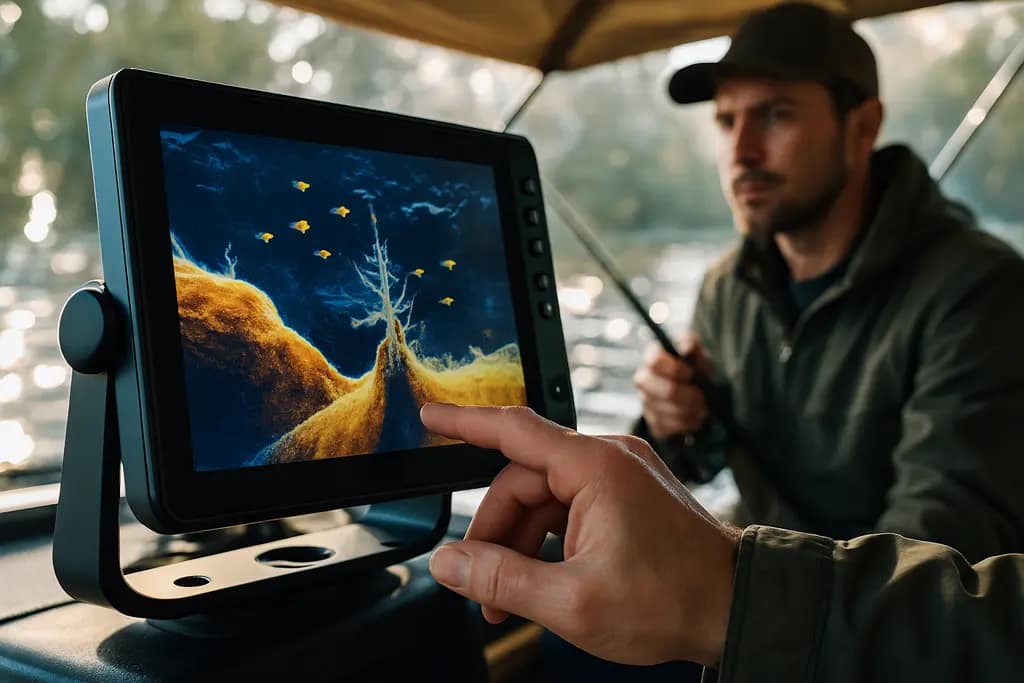

Live imaging sonar has become one of the loudest gear conversations in catfish angling, and for good reason: seeing movement in real time changes how anglers spend boat time. But the best lesson from recent Blue Catfish research is not “buy the screen and catch more fish.” It is sharper than that. The tool can change search behavior, confidence, and setup discipline, yet one controlled catfish study did not show a simple catch-weight advantage.
That should get every tournament angler’s attention. Gear decisions are not just shopping decisions; they are time-management decisions. If a unit causes you to scan for four hours and soak baits for one, you have not upgraded your program—you have moved the bottleneck. The winning mindset is to treat real-time sonar like a scouting assistant, not a captain.
What Live Imaging Sonar Actually Changes
In a controlled experiment at Milford Reservoir in Kansas during 2022–23, 16 angler teams using live-imaging sonar averaged 14.57 kg of Blue Catfish per 5-hour period, while teams without it averaged 16.97 kg, with no significant difference in catch mass reported by the study authors Blue Catfish sonar study. That result is refreshing because it cuts through dock-talk fog. The screen did not magically put bigger fish in the boat during that case study.
The same research direction still matters because anglers with access to the technology spent significantly more time searching for promising fishing locations. That is the real shift: behavior. The screen can make you more selective, more mobile, and more tempted to keep hunting for the perfect mark. Used well, that selectivity helps you avoid dead water. Used poorly, it turns a fishing day into a sightseeing tour with expensive electronics.
Live Imaging Sonar Search Habits
The practical move is to set a search limit before you ever idle away from the ramp. For example, give yourself a defined scan window on a ledge, channel edge, or open-water zone, then commit to fishing or leaving. Do not let the unit talk you into “one more pass” forever. In tournament conditions, every minute spent scanning has to earn its place against bait time, rig checks, net readiness, and safe boat positioning.
The Milford Reservoir creel work from March through October 2022 recorded about 220,000 angler-hours of effort, with about 20% aimed at Blue Catfish; the reported catch rate was 0.38 Blue Catfish per hour, or 1.15 kg per hour Milford Reservoir effort data. Those numbers remind us that catfish success is still built from repeated decisions, not one magic screen shot.
Where The Screen Helps Less
Recent fishery-management discussions have raised a useful caution: the benefit of real-time sonar can be limited in shallow, highly structured habitat, while the tool may offer more efficiency in deeper, open-water situations. That distinction matters for gear planning. If your local water is shallow, cluttered, and full of tight cover, your best investment may still be boat control, side-view scouting, mapping discipline, and bait placement. If you spend more time on open basins or suspended targets, real-time viewing can carry more scouting value.
Gear Setup Choices That Matter
Newer live-view systems have been promoted with clearer returns, noise reduction, wider coverage, and simpler installation options. That sounds exciting, but the catfish question is simpler: can your setup help you make faster, cleaner decisions? Your best use of live imaging sonar is not staring at every flicker. It is building a repeatable process for finding fish, reading their position, and deciding whether to fish the spot.
Start with mounting and viewing comfort. If the transducer points one way and your boat drifts another, you will blame the fish while your gear lies to you. If the screen is mounted where you have to twist your neck all day, fatigue will creep into your decisions. If the unit is not powered cleanly, weak voltage or clutter can make interpretation harder. None of that is glamorous, but it is where good electronics programs are built.
Build A Catfish Electronics Checklist
Before you add another accessory, run a simple boat-side audit. Catfish anglers love heavy gear, big bait, and long soaks, but electronics reward neat systems. A loose cable, sloppy transducer angle, or screen you cannot read in glare can cost more fish than a missing feature.
- Transducer aim: Check that the beam direction matches how you fish, whether you are scanning ahead, below, or around the boat.
- Screen placement: Put the display where the angler making boat-control decisions can read it without leaving the helm or rod station confused.
- Power health: Use a clean power setup so the unit runs consistently through a full session.
- Waypoint discipline: Mark useful observations, then leave notes that mean something later, such as “moving fish near break” rather than random icons.
Match The Tool To The Water
If you fish open water, give the technology a clear job: locate moving targets, define depth bands, and help you decide whether to set baits. If you fish tight structure, do not force the unit to solve every problem. Use it to confirm openings, edges, or fish movement, then rely on careful anchoring, controlled drifting, or spot-lock positioning to present baits without dragging rigs through clutter.
This is where many anglers overspend and under-practice. A pricier transducer does not fix poor screen interpretation. Treat live imaging sonar like a new rod blank: it only performs after you learn its load, limits, and timing.
Boat-Time Drills For Better Readings
The fastest way to learn real-time electronics is to drill with a purpose. Do not wait until tournament morning to decide what a fish return, bait cloud, or moving target looks like on your unit. Pick a practice day, leave the ego at the ramp, and make the screen teach you one skill at a time.
The Ten-Minute Scan Rule
Choose a likely zone and scan for ten minutes. If you see no reason to fish, leave. If you see enough activity to test, set baits for a defined window. This drill trains discipline. It also protects you from the most common electronics trap: scanning until your confidence falls apart. Catfish angling still requires putting bait in water, watching rods, and adjusting to conditions.
For anglers comparing forward-facing systems, it may help to read a focused breakdown of LiveScope 2 catfish fishing before deciding how much range, coverage, and installation simplicity matter for your style.
The Mark-And-Return Drill
Find a target or activity zone, mark it, leave for several minutes, then return and try to reacquire it. This drill teaches you whether you are actually reading the same area or just reacting to screen movement. It also sharpens boat handling. If you cannot return to a spot cleanly, the best electronics in the world will only show you what you almost fished.
Run the drill in calm conditions first. Then repeat it with wind, current, or boat traffic. The point is not to look fancy. The point is to build a system you can trust when tournament pressure, fading light, or crowded water starts squeezing your decisions.
Live Imaging Sonar For Catfish Decisions
Live imaging sonar is most valuable when it helps you answer practical questions: Are fish present? Are they positioned where I can present a bait? Is this area worth more time? Should I move now? The screen should shorten bad guesses, not replace fishing judgment.
Use It Without Overharvest Mindset
Fishery managers have raised concerns that wider use of real-time sonar could increase efficiency in some fisheries, especially where habitat and angler effort line up in ways that make fish easier to target. Catfish anglers should take that seriously. If technology helps you locate fish faster, pair that skill with restraint, legal harvest, careful handling, and respect for local regulations.
That is not anti-technology. It is smart sport fishing. The best anglers I know want strong fisheries next month, next tournament, and years down the road. A clear screen is exciting; a healthy fishery is better.
The Practical Takeaway For Your Boat
Buy the unit that fits your water, your boat, and your decision-making style. Practice before you compete. Set scan limits. Keep bait time honest. Compare what the screen shows against what your rods prove. If the technology helps you make faster decisions, it earns its space. If it only keeps you staring at pixels, simplify your approach.
Catfish angling has always rewarded patience, position, and confidence. Real-time imaging adds another layer, but it does not cancel the basics. Let the screen inform your plan, let your rigs test the plan, and let results—not hype—decide how much boat time the tool deserves.


