
The Twisted Cat Outdoors Fort Madison stop is not just another date on a catfish tournament calendar; it is a pressure point where preparation, judgment, and river discipline start showing before a line ever hits the water. With registration closing Saturday night and the captain’s meeting setting the tone for Sunday’s competition, this is the kind of event where the serious teams separate themselves early.
Why Twisted Cat Outdoors Fort Madison Deserves Attention
I look at the Twisted Cat Outdoors Fort Madison event as more than a local tournament stop because Fort Madison is the kind of river town that changes the character of a competition. The Mississippi River does not reward casual assumptions. It rewards anglers who read current, respect timing, manage bait, understand boat position, and know when to abandon a plan that looked brilliant the night before.
That is why the pre-event meeting on Saturday, May 2, matters. The actual tournament runs Sunday, May 3, but the competitive rhythm begins the evening before. Registration closes at 9:00 PM. The captain’s meeting runs from 5:00 PM to 8:00 PM at Eagles, located at 4821 Avenue O in Fort Madison, Iowa. The formal rules discussion is scheduled for 6:30 PM. Those details may sound administrative, but in tournament catfishing, administrative details often become competitive details.
A well-run catfish tournament depends on clarity. Anglers need to know where to be, when to be there, how launch order will work, what technologies are restricted, what fish count, what handling standards apply, and how the weigh-in will be controlled. When those expectations are understood before takeoff, the event becomes less about confusion and more about execution.
For anyone following the tournament trail, planning to fish the event, or simply watching the growth of competitive catfishing, this Fort Madison stop deserves a closer look. It sits at the intersection of river culture, modern tournament management, conservation ethics, and a sport that has become far more sophisticated than many casual observers realize.
The Pre-Event Meeting Is Where Tournament Discipline Begins
The captain’s meeting is listed as non-mandatory, but I would not treat it as optional in any serious sense. Tournament anglers know the difference between attending because rules require it and attending because intelligence requires it. The latter is often more important.
A pre-event meeting is where small uncertainties get resolved. It is where teams can confirm how check-in will work, how livewell checks will be handled, how boat staging will proceed, and how officials intend to enforce the rules. It is also where the tone of the tournament becomes visible. A well-organized meeting tells anglers that the event will be run tightly. A loose meeting tells them something else.
For the Fort Madison event, the Saturday schedule is compact but meaningful.
| Item | Detail |
|---|---|
| Pre-Event Meeting Date | Saturday, May 2, 2026 |
| Meeting Time | 5:00 PM–8:00 PM |
| Rules Discussion | 6:30 PM |
| Location | Eagles, 4821 Avenue O, Fort Madison, Iowa |
| Registration Deadline | 9:00 PM Saturday |
| Tournament Date | Sunday, May 3, 2026 |
| Tournament Hours | 7:00 AM–4:00 PM |
| Check-In Begins | 5:00 AM at Turnwater Bar & Grill Marina |
| Fish Limit | Maximum of 5 fish per boat |
| Eligible Species | Blue catfish, channel catfish, flathead catfish |
That schedule does not leave much room for indecision. A team that arrives uncertain, underprepared, or late to the process is already burning mental energy that should be reserved for the river.
The rules discussion at 6:30 PM is particularly important because this event includes details that directly affect strategy. Boat number order matters. Livewell checks begin early. Tournament waters are defined by what is accessible by boat on tournament day. Pre-fishing stops at 6:00 PM the day before the event. Forward-facing and live sonar are prohibited on tournament day. Those are not background details. They shape how teams prepare and compete.
Registration Timing Creates Real Competitive Pressure
Registration closing at 9:00 PM on Saturday may sound like a simple deadline, but deadlines create pressure. Anglers who wait until the last window often do so for practical reasons: travel, weather, work schedules, partner coordination, or late equipment decisions. Still, last-minute registration has consequences. It compresses the margin for solving problems.
Tournament catfishing already involves a lot of moving parts. A team needs bait, fuel, tackle, safety gear, functioning electronics, a reliable livewell system, a working plan for fish care, and a launch routine that does not unravel in the dark. Add registration uncertainty to that list and the risk increases.
The stronger teams tend to control what can be controlled. They settle entry details early. They review rules before arrival. They know where the meeting is. They understand where check-in begins. They arrive with enough time to observe the mood, ask a question, and listen.
There is a quiet competitive value in being calm. On tournament morning, calm does not come from personality; it comes from preparation. The angler who is not wondering about paperwork, rules, boat order, or launch protocol can focus on water temperature, river level, current seams, bait condition, and the first decision after takeoff.
That is one reason the pre-event meeting matters. It moves uncertainty from Sunday morning to Saturday evening, where it belongs.
What The Fort Madison Riverfront Adds To The Event
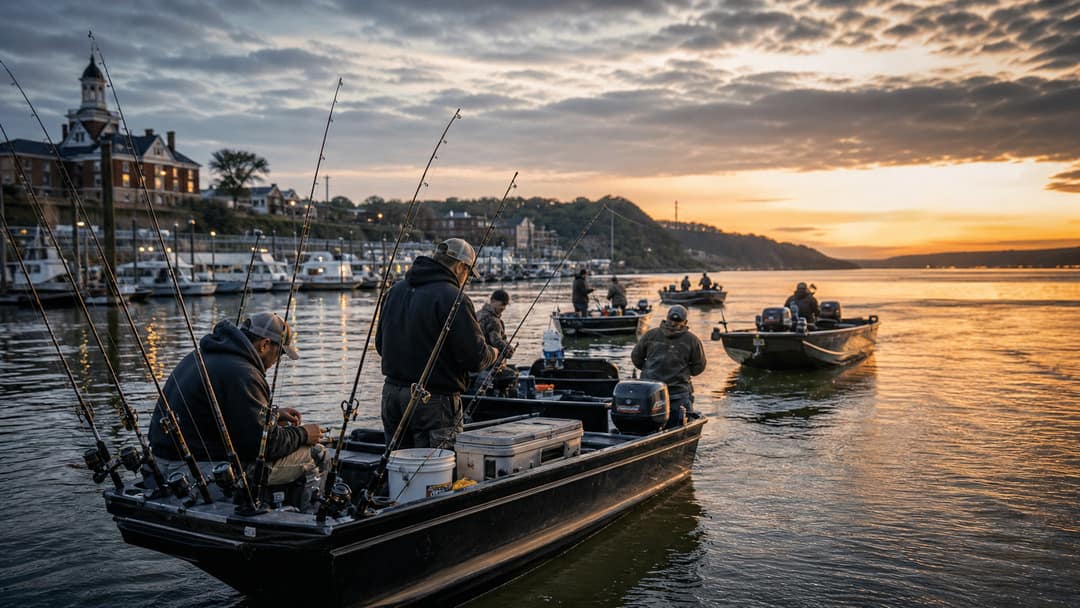
Fort Madison brings a distinctive backdrop to the tournament. It is a Mississippi River community with a working river identity, and that matters. Riverfront tournaments feel different from lake events because the water has a stronger sense of motion and consequence. Current is not scenery. It is structure.
A catfish tournament on the Mississippi asks anglers to solve a dynamic problem. Fish location can be influenced by flow, channel edges, outside bends, scour holes, wing dams, tributary influence, barge traffic, bait movement, and subtle changes in water level. Even when teams have experience on the river, the exact conditions on tournament day can force them to revise their assumptions.
This is why I pay attention to events like Fort Madison. They expose whether a team is merely confident or genuinely adaptable. Confidence can be built on memory. Adaptability is built on observation.
A team may have a favorite stretch, a trusted bait pattern, or a historical waypoint that has produced fish before. That helps, but it does not finish the work. Tournament day asks a sharper question: what is the river telling you now?
The answer may be different by midmorning. It may change again by afternoon. The best catfish teams are not just patient; they are selectively impatient. They know when to let a set develop, and they know when staying too long becomes stubbornness.
That judgment is hard to teach, but tournaments reveal it quickly.
The Rules Reflect A More Mature Sport
One of the most interesting parts of modern catfish tournaments is how rulebooks have evolved. The sport has moved far beyond the old stereotype of casual bank fishing and heavy rods leaning against coolers. Competitive catfishing now has organized trails, sponsor ecosystems, live results, media production, points races, conservation standards, and technology debates that mirror larger tensions across tournament fishing.
The Fort Madison rules show that maturity. They define entry procedures, late fees, refund windows, pre-fishing limits, livewell checks, team size, rod limits, fish eligibility, and weigh-in standards. They also make clear that dead fish are not accepted at weigh-in. That single rule matters because it turns fish care from a courtesy into a competitive obligation.
The real issue is accountability.
A five-fish limit can create temptation. Teams want weight. They want options. They want to upgrade. But a fish that cannot be kept alive cannot be treated as a mere scoring object. Tournament formats that emphasize live fish handling create a better standard for the sport and a better public argument for its future.
Catfish tournaments occupy an increasingly visible place in recreational fishing culture. Visibility brings scrutiny. If the sport wants to grow, it must prove that competition and conservation can coexist. Rules around dead fish, livewell checks, culling, legal bait, rod limits, and eligible species are not paperwork. They are part of the sport’s license to expand.
The Live Sonar Restriction Is More Than A Technical Rule
The prohibition on forward-facing and real-time live sonar is one of the most consequential rules in the Fort Madison event. It is not a minor equipment detail. It shapes the competitive philosophy of the tournament.
Across fishing disciplines, forward-facing sonar has changed how anglers locate and target fish. It can turn invisible water into visible opportunity. Supporters see it as innovation. Critics see it as an advantage that risks shifting competition away from traditional reading of water, seasonal patterning, and instinctive boat control. Both sides understand the same fact: live sonar matters because it works.
In this event, the rule draws a firm boundary. Teams cannot use forward-facing or real-time live sonar technology on tournament day. That brings the contest closer to a test of conventional river knowledge, pre-event preparation, bait strategy, anchoring decisions, drift control, and the ability to interpret current without watching fish react in real time.
I do not view that as anti-technology. I view it as a choice about competitive identity. Every tournament format has to decide what kind of skill it wants to reward most. This one places more weight on river craft than live-screen targeting.
That creates a more level field for teams without expensive electronics, but it also increases the value of experience. Anglers who know how catfish use current breaks, depth transitions, cover, and feeding corridors will not feel disadvantaged by the absence of live sonar. They may even welcome it.
The broader lesson is that tournament rules are not neutral. They define what excellence looks like.
What Anglers Should Be Listening For At The Captain’s Meeting
A good captain’s meeting is not just a roll call. It is a chance to identify operational details that may affect decisions later. I would listen for anything that clarifies launch sequence, marina boundaries, weigh-in timing, fish handling expectations, and how officials will interpret unusual situations.
The most useful questions are rarely dramatic. They are practical.
- Where exactly must boats be by the 4:00 PM deadline?
- How will boat numbers be called and staged?
- What happens if weather, river traffic, or mechanical trouble affects return timing?
- What is the expected flow of the weigh-in line?
- How will culling rules be interpreted once a boat is inside the marina?
- What should teams do if a fish appears stressed before weigh-in?
- How will tournament officials handle any rules protest or disputed interpretation?
Those questions matter because tournament pressure has a way of turning vague assumptions into conflict. The best meetings prevent that before it happens.
I also pay attention to the informal part of a captain’s meeting. Anglers talk. They watch who arrives early, who seems organized, who is scrambling, who has local confidence, and who looks uneasy. None of that determines the winner, but it is part of the competitive atmosphere. Tournament fishing has always included a psychological layer. The river is one opponent; the field is another.

The Five-Fish Limit Changes Strategy
A maximum of five fish per boat creates a specific kind of strategic puzzle. It is not enough to catch fish. Teams have to catch the right fish, protect them, and decide when to trade time for upgrades.
Catfish tournaments often hinge on one or two major bites. A team can have a respectable box and still fall behind if another boat brings in a true heavyweight. The Big Fish element adds another layer because a single exceptional fish can change the financial and competitive story of the day.
With a five-fish limit, teams have to balance consistency and ceiling. Should they begin in an area likely to produce steady fish and build a base weight? Should they gamble early on a lower-percentage location with trophy potential? Should they move after one good fish, or stay because one big fish may indicate more? These decisions are not abstract. They are made under time pressure, often with imperfect information and changing conditions.
The culling allowance adds nuance. Teams may possess one additional fish for culling during tournament hours, but that does not mean they can be careless. Livewell space, fish stress, water quality, and handling time all become part of the competitive equation. A team that mishandles fish may lose not only weight but eligibility.
That is where experience shows. A disciplined team treats the livewell as part of the tournament system, not as storage.
Fort Madison Rewards Local Knowledge But Does Not Guarantee It
Local knowledge matters on the Mississippi, but it can also become a trap. Anglers who know a stretch well may carry confidence that newer teams lack. They may understand historical fish locations, safe navigation routes, productive seams, and how certain areas react to river levels. That is valuable.
Still, local knowledge can harden into expectation. The river punishes anglers who fish memories instead of conditions.
This is where visiting teams sometimes surprise people. A team without deep local history may approach the water more openly. They may make decisions based on what they see rather than what worked last year. They may be less attached to a famous hole or a comfortable run. In tournament fishing, unfamiliarity can become an advantage when it forces sharper observation.
The best local teams avoid that trap by treating home water as a living system rather than a fixed map. They use memory, but they do not worship it. They know the river well enough to question themselves.
For readers who do not fish tournaments, this is one of the sport’s overlooked intellectual qualities. Competitive catfishing is not random waiting. It is field analysis conducted from a boat, under time constraints, with weather, water, equipment, biology, and human judgment all interacting at once.
The Event Also Matters For Fort Madison
Tournament stops create value beyond the weigh-in stage. Anglers travel. Families attend. Teams buy fuel, food, lodging, bait, tackle, ice, and supplies. Restaurants, gas stations, marinas, hotels, and local businesses all participate in the event economy, even if indirectly.
Fort Madison’s riverfront identity makes that especially important. Communities along the Mississippi have always had a practical relationship with the river, but recreational events add another dimension. They turn the river into a gathering place, a competitive venue, and a source of civic attention.
A successful tournament does not simply crown winners. It strengthens the case for bringing future events back. Good turnout, smooth operations, strong local hospitality, and visible community support all help. That is why details such as the pre-event meeting location, marina coordination, and weigh-in structure matter beyond the anglers themselves.
The opportunity is visibility.
Catfish tournaments can introduce visitors to a community in a way that feels authentic. This is not a convention center experience. It is a working river experience. People arrive before dawn, launch under pressure, fish hard, return with stories, and gather around a weigh-in that blends competition with community theater.
That kind of event has texture. Towns should recognize its value.
What Serious Teams Should Have Settled Before Sunday Morning
By the time Saturday night ends, the best-prepared teams should not be debating basics. They should have the tournament logistics handled and their Sunday plan narrowed to clear decision points.
A serious team should already know:
- Where to check in and how early to arrive.
- How boat staging and launch order will affect first-water access.
- Which areas remain realistic within the tournament window.
- What bait will be used first and what backup bait is available.
- How livewell performance will be monitored throughout the day.
- Who handles navigation, anchoring, fish care, and timing.
- What threshold triggers a move from one area to another.
- How much time must be protected for the return to the marina.
That list may sound basic, but the basics win more tournaments than many anglers admit. A missed deadline, a poor launch decision, a bait problem, a livewell issue, or a late return can erase great fishing.
I have always believed tournament preparation should reduce the number of decisions made under stress. Not eliminate them; that is impossible. But reduce them. The fewer preventable decisions a team has to make on Sunday morning, the more mental bandwidth remains for the river.
Why This Stop Reflects The Direction Of Tournament Catfishing
The Fort Madison stop reflects where organized catfishing is heading. The sport is becoming more professional without losing its grassroots character. That balance is difficult but necessary.
On one side, there are entry fees, sponsors, official rules, media production, payout structures, registration systems, and formal weigh-ins. On the other, there is still the culture that made catfishing durable in the first place: practical knowledge, family participation, river stories, local pride, and anglers willing to spend long hours chasing fish that do not care about reputations.
The challenge is protecting both.
If the sport becomes too polished, it risks losing the approachable quality that brings new anglers in. If it remains too informal, it limits growth, credibility, and sponsor confidence. Events like Fort Madison show the middle path: organized enough to be credible, still close enough to the water and community to feel real.
The Grass Roots concept associated with the broader trail also points in the right direction. Competitive fishing needs entry points. Not every angler is ready for a full main-series commitment. Lower-barrier formats help new competitors understand tournament rhythm without being overwhelmed by cost or pressure. That matters for the future of the sport.
A tournament trail that wants longevity cannot only serve the best teams. It has to develop the next ones.
The Saturday Meeting Is The First Test
By Sunday afternoon, the story will be told in pounds, fish care, decisions, and maybe one unforgettable bite. But Saturday evening is the first test of seriousness. Who shows up prepared? Who asks the right questions? Who understands the rules before they become consequences? Who treats logistics as part of competition rather than an inconvenience?
That is why I see the pre-event meeting as part of the tournament itself. It is not the dramatic part, but it is the foundation. The anglers who treat it casually may still catch fish. The anglers who treat it professionally give themselves fewer ways to lose.
For anyone needing the event page, registration details, or rules, the official listing for Twisted Cat Outdoors Fort Madison is the logical place to begin.
The larger point is simple: tournament catfishing has become a sport where preparation, ethics, technology rules, river knowledge, and community presence all matter at once. Fort Madison will reward the teams that understand that complexity. It may also expose the teams that do not.
What I’ll Be Watching As Tournament Day Arrives
I will be watching three things closely as this event moves from meeting room to river.
First, I want to see how teams respond to the live sonar restriction. Some anglers will shrug it off because their methods were never built around it. Others may feel a meaningful adjustment. Either way, the restriction places emphasis back on interpretation, patience, and location strategy.
Second, I will be watching fish care. A no-dead-fish weigh-in standard raises the stakes in the right way. Heavy fish matter, but healthy fish matter too. The teams that manage oxygen, water quality, handling time, and culling discipline are respecting both the tournament and the resource.
Third, I will be watching how the river distributes opportunity. Some tournaments are won from obvious community holes. Others are won by teams that see something subtle: a current seam, a depth change, a bait concentration, a less pressured stretch, or a timing window that opens only briefly. Fort Madison has the potential to produce that kind of story.
The risk for anglers is overconfidence. The opportunity is precision.
The Twisted Cat Outdoors Fort Madison event matters now because it captures a sport in motion: more organized, more visible, more strategically demanding, and more accountable than casual observers may realize. Saturday’s pre-event meeting will not produce the winning weight, but it will shape the conditions under which that weight is pursued. For serious teams, that is enough reason to treat it as the true beginning of tournament weekend.


