
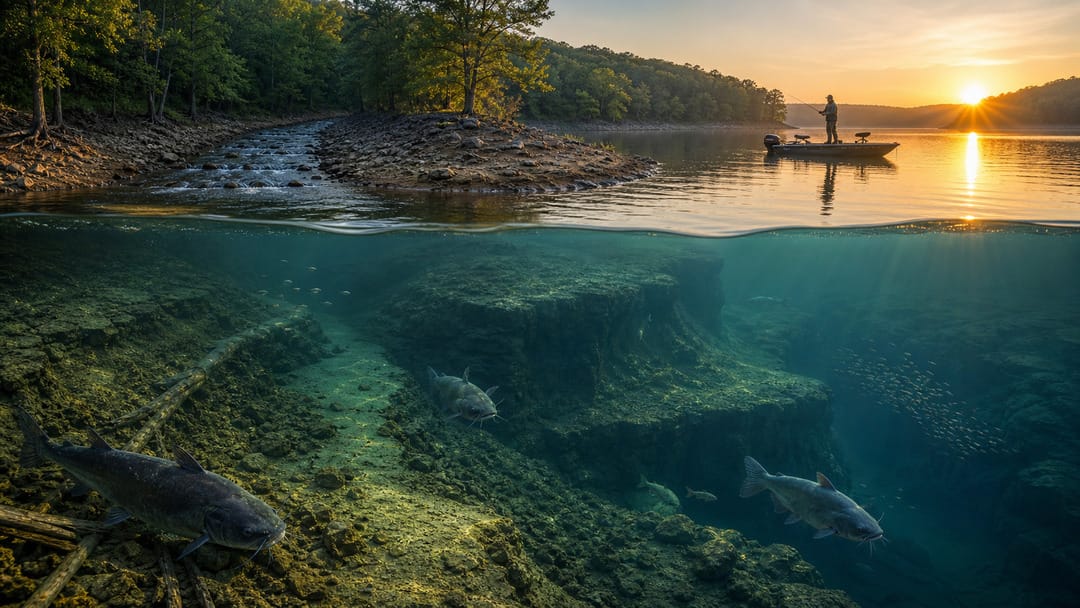

Lake Catfish Structure Fishing matters because most slow catfish days are not caused by bad luck; they are caused by fishing water that gives the fish no strong reason to be there. When I break down a lake, I am looking for structure, timing, and the hidden routes that turn open water into a feeding system.
Why Lake Catfish Structure Fishing Works
A lake can look simple from the surface, but the bottom is usually a map of highways, intersections, shelves, and resting rooms. Catfish use that map with more purpose than many anglers give them credit for. They may roam, especially channel cats and blue cats, but they rarely roam without incentives.
The core idea behind Lake Catfish Structure Fishing is narrowing the lake until every cast has a reason. A creek mouth concentrates food and movement. A point gives fish a travel lane. A ledge creates an edge where shallow feeding water meets deeper safety. A deep hole can hold fish during stress periods, but only when it connects to something useful.
This is where catfishing becomes more analytical and more enjoyable. I am not interested in turning a relaxed sport into a laboratory exercise, but I do want clarity. A bait soaking on a random flat is hope. A bait placed on the lip of a channel edge near a wind-blown point is a decision.
Structure also helps anglers avoid chasing every rumor about bait, color, scent, or secret rigging. Those details matter, but they matter less when the bait is in the wrong place. Location creates leverage. Bait placement refines it.
For anglers who want a broader reservoir framework, Lake Catfish Structure Fishing makes the most sense when structure is treated as a system of routes rather than a collection of isolated spots. The best water usually gives catfish food, comfort, and quick access to depth.
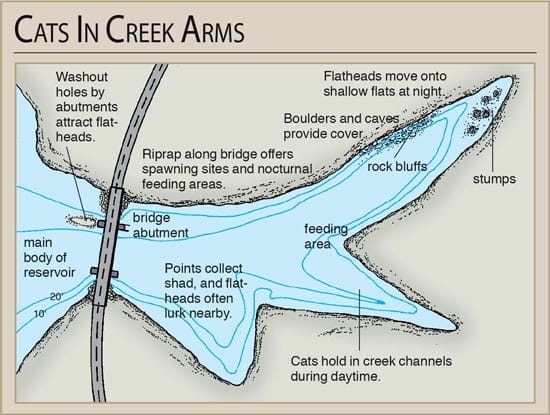
Creek Mouths Are Natural Feeding Intersections
A creek mouth is often the first place I check because it joins movement, current influence, and food. Even a small inflow can change water color, temperature, oxygen, and forage concentration. That combination creates opportunity.
The mistake is casting into the middle of the mouth and waiting as if the whole area is equal. I prefer the edges: the first drop, the outside bend of the creek channel, the shallow flat beside the mouth, or the seam where stained water meets clearer water. Catfish are efficient. They use edges because edges collect food.
After rain, creek mouths can become especially attractive. Worms, insects, small baitfish, and organic matter may wash through the system. In spring and early summer, those places can also connect pre-spawn and feeding movement. In hot weather, I become more selective and focus on creek mouths with nearby depth, because shallow inflows can warm too much during the day, making temperature part of the decision.
The creek mouth is not always an all-day answer. It is a timing location. Low light, incoming weather, fresh runoff, wind, and bait presence can turn it on quickly. When those signs are missing, I treat it as one test, not a commitment. That restraint protects patience from becoming stubbornness.
Points Reveal How Fish Are Moving
A point is useful because it extends shallow structure into deeper water. That shape gives catfish options. They can travel along the side, feed on top, hold near the base, or move around the tip as conditions change. Those options are the point.
When I fish a point, I want depth coverage. One bait goes shallow enough to test active fish. One sits on the slope. One reaches the base where the point falls toward deeper water. That simple spread tells me whether the fish are feeding up or holding down. It also gives me a cleaner signal than throwing every bait into the same zone.
The best points have something extra. Wind contact matters. Hard bottom matters. Nearby creek channels matter. Rock, shell, cover, timber, or baitfish activity can turn a plain point into productive water. A long tapering point near a channel is different from a short, featureless point ending in soft bottom.
Points also expose fishing pressure. Obvious main-lake points are easy to find, so they often get hit first. Secondary points inside creek arms may receive less attention and produce better under certain conditions. The angler’s advantage is judgment under pressure, not simply knowing that points exist.
Ledges Turn Guessing Into A Pattern
A ledge is one of the most important catfish features because it compresses depth change into a fishable line. Catfish can rest low, slide up to feed, and move parallel to the break without wasting energy. That economy is the reason ledges are so consistently relevant.
I define a good ledge by function, not just by depth. A drop from five feet into ten can matter if it sits beside a feeding flat. A drop from fifteen into thirty can matter if baitfish are using the channel. What matters is whether the ledge connects food, travel, and comfort. Without those ingredients, depth is just geography.
Ledges also create repeatable patterns. If a bite comes from the upper edge of a creek-channel ledge in twelve feet, I immediately look for similar places. If fish are holding at the base, I adjust. If bites come only where the ledge meets a point or bend, that intersection becomes the priority.
The presentation should match the contour. When anchored, I stagger baits from top to bottom. When drifting, I want the bait to crawl along the break rather than race across it. From the bank, I cast at angles until I can feel where the sinker drops. precision creates confidence.
Regional pages such as Texas Parks and Wildlife reservoir guidance keep the bait discussion practical by tying catfish targets to common lake presentations. I take that same practical view on ledges: freshness, clean placement, and enough time for the fish to find it.
Deep Holes Need More Scrutiny
Deep holes attract anglers because they look important on a map. Sometimes they are. During cold snaps, high heat, bright sun, or heavy pressure, deeper water may offer comfort. But the deepest spot in the lake is not automatically the best fishing spot. That is the risk.
The first question I ask is whether the hole is connected. Does a creek channel enter it? That connection matters. Does a ledge lead into it? Is there a point nearby? Is there timber, rock, or a flat within easy reach? A deep hole with access to feeding water is much more interesting than an isolated basin.
I rarely drop all my baits into the center. The lip, entrance, tail-out, and side slope often matter more. Catfish may hold in the deepest water, but active fish frequently use the doors into and out of the hole. That is where the best evidence often appears.
Deep holes also create a trap for anglers. They feel safe because they are obvious. Yet obvious is not the same as productive. If there is no bait, no life, no connection, and no reason for fish to feed, I move.
Daily Change Is The Hidden Variable
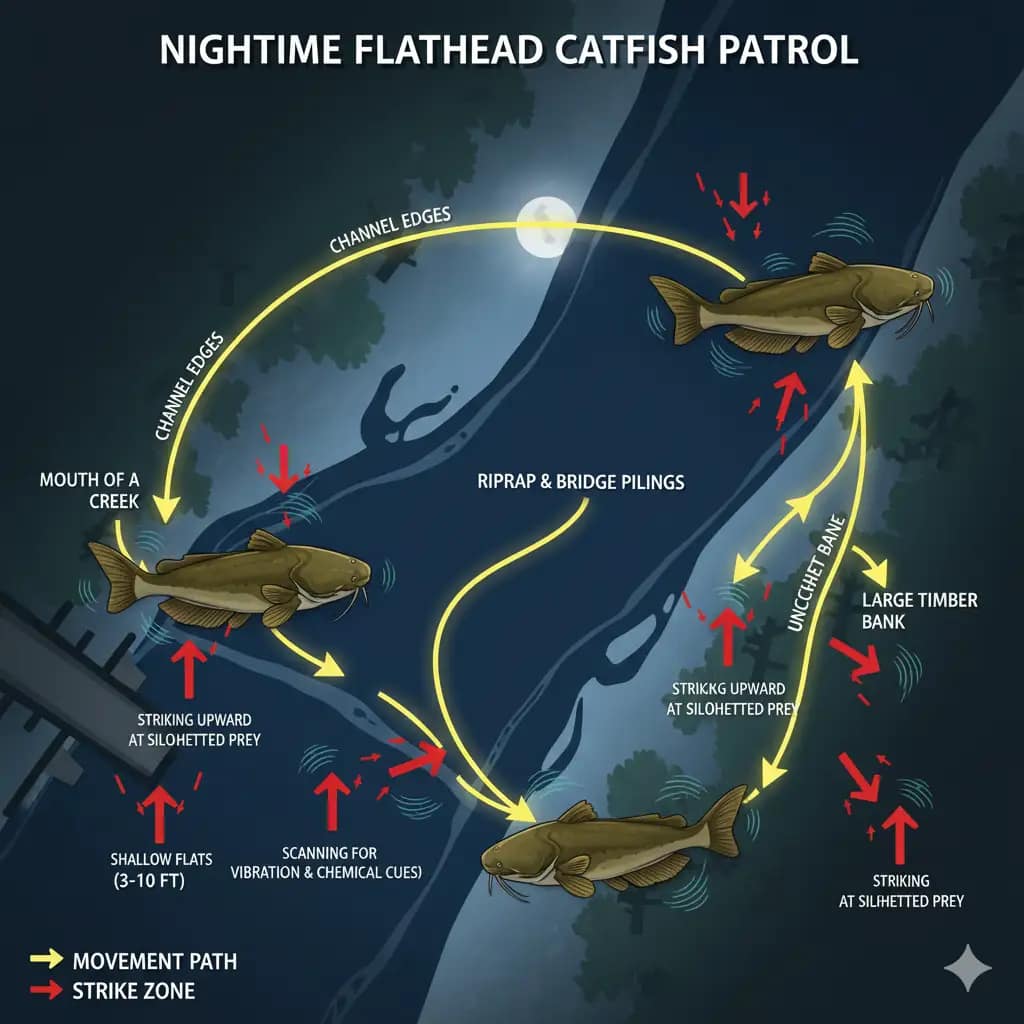
Structure matters, but structure does not operate in a vacuum. The same point that produced at sunset may look empty at noon. The same creek mouth that was alive after rain may fade once the inflow clears. That is why daily change is not background noise; it is part of the pattern.
I watch wind more carefully than many anglers expect. Wind can push plankton, baitfish, and scent toward one bank or across a point. It can also create a subtle current line where none is visible from a distance. That influence can turn a normal-looking feature into a high-percentage target. The best structure often needs a trigger, and wind is one of the most common.
Temperature shifts also deserve attention. A few degrees can move bait shallow, push fish deeper, or make a creek arm more attractive than the main basin. I do not need perfect numbers to make a good decision. I need a practical sense of whether the lake is warming, cooling, stabilizing, or reacting. That awareness gives me context before the first cast.
The same logic applies to fishing pressure. A popular deep hole may hold fish but receive so much attention that the bite becomes cautious. A smaller nearby ledge may offer the same depth relationship with less disturbance. That is where restraint and mobility work together.
Bait And Rigging Should Serve The Structure
Good bait cannot rescue bad placement, but good placement deserves the right bait. The target matters. For channel cats, I like punch bait, prepared bait, worms, shrimp, and smaller cut bait when numbers are the goal. For blue cats, fresh cut bait is usually my first choice. For flatheads, live bait near cover remains a serious option, especially after dark.
The practical standard is freshness. Catfish respond to scent, but scent alone is not magic. Fresh cut bait creates a natural trail and a believable meal. Old bait may still catch fish, but it gives up quality when conditions demand a stronger presentation.
Rig choice should follow the structure. A slip-sinker rig is a versatile starting point for creek mouths, points, and moderate ledges. A three-way rig can control bait on steeper breaks or current-influenced water. A float rig can keep bait just above cover or shallow feeding lanes. A drifting rig can search flats and ledges efficiently.
Leader length, sinker weight, and hook size should change with conditions. Too much weight can pin bait unnaturally. Too little can let it wash out of the strike zone. A leader that works on a clean flat may tangle around brush. Details create discipline when the structure has already put the angler close.
For a broader regional lens, I would pair on-the-water observation with useful Midwest catfish context before deciding whether the bite is improving because of weather, water temperature, forage movement, or seasonal positioning. Local interpretation still matters most.
A Practical Structure Plan For Today
If I were planning a lake trip today, I would not start by asking which bait is trending. I would ask which structure gives catfish the best reason to feed. That question creates a sharper plan and reduces wasted motion.
Start with a creek mouth during low light, after rain, or when wind pushes into it. Place baits on the channel edge, the nearby flat, and the seam. If nothing happens, move to a point and cover shallow, mid-slope, and deep positions. From there, work a ledge carefully. Save the deep hole for stress conditions or when connected structure points toward it.
A simple plan might look like this:
| Structure | Best Use | First Cast |
|---|---|---|
| Creek mouth | Feeding movement and inflow | Channel edge or seam |
| Point | Travel and depth testing | Side slope and base |
| Ledge | Repeatable positioning | Top, face, and bottom |
| Deep hole | Stress refuge and staging | Lip or entrance |
The key is to let each spot answer a different question. The creek mouth tests feeding traffic. The point tests movement. The ledge tests depth position. The deep hole tests comfort and staging. That sequence creates efficiency.
I also set a time limit before emotion enters the decision. On a strong spot with bait present, I may wait longer. On weak water, I move faster. Mobility is not impatience when it is guided by context.
What Better Catfish Anglers Notice
Better catfish anglers notice small differences. They notice whether the first bite came from the top of the ledge or the bottom. They notice whether fish preferred fresh cut bait over prepared bait. They notice whether wind contact made one point better than another. That awareness builds consistency.
They also notice silence. No baitfish, no current influence, no bird activity, no marks, no strikes, and no bottom variation are all forms of feedback. A quiet spot is not an insult. It is information. The strongest anglers accept that information without forcing a story onto it.
There is a balance between simplicity and seriousness. Catfishing does not need to become complicated to become thoughtful. The rig can remain simple. The bait can remain familiar. The thinking, though, should become more precise. That is where execution separates casual soaking from intentional fishing.
The Risks And Opportunities Ahead
The opportunity in structure fishing is obvious: better decisions, less wasted time, and more repeatable success. It rewards precision. The risk is overcomplication. Anglers can stare at maps so long that they forget to fish the water in front of them. A map is a guide, not a verdict.
Pressure is another factor. Popular creek mouths, obvious points, and famous holes may still produce, but they are rarely secrets. The next level is finding the overlooked version of the same feature: the secondary point, the subtle ledge, the smaller creek mouth, the hole with a better entrance. That is where adaptation matters.
Lake Catfish Structure Fishing matters now because anglers have more tools than ever, yet many still lose the plot by fishing without a clear reason. The future belongs to those who combine simple bait work with sharper water reading, who see creek mouths, points, ledges, and deep holes not as isolated spots but as connected parts of a living lake. That perspective creates better choices, better days, and a more durable kind of success.


