
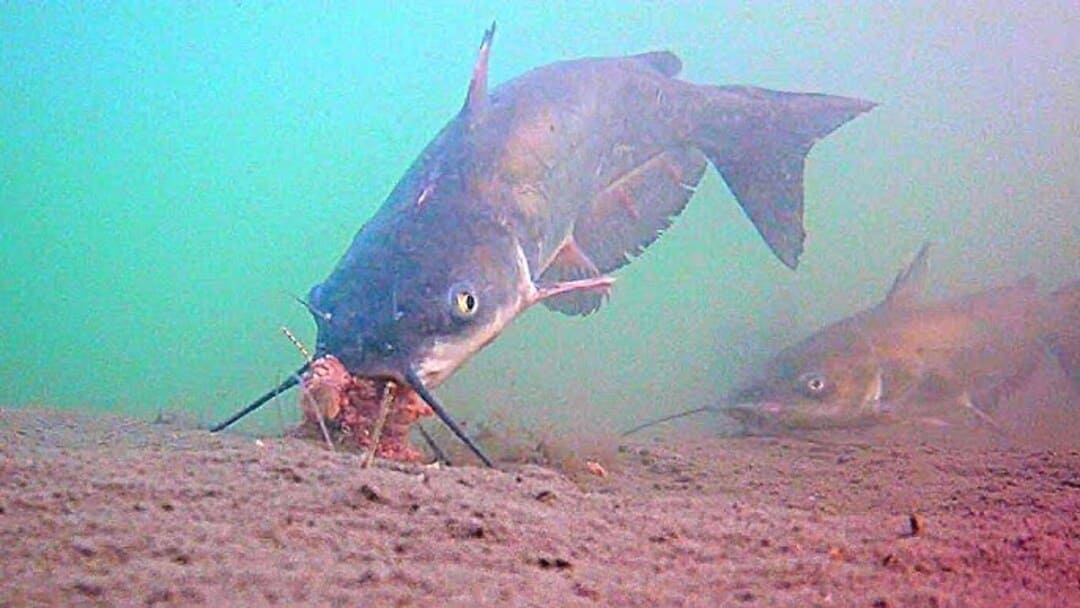

Catfish don’t need clear water, or even daylight, to feed with precision. Understanding how catfish find food is less about mystery and more about reading a system built on chemistry and movement, one that most anglers only partially use.
That gap matters. Many anglers pile on scent, noise, and gear without realizing those signals can cancel each other out. The better approach starts with how these fish actually interpret the water and how your presentation fits into that picture. It’s the same logic that separates random bites from consistent results in real-world Florida catfish fishing.
How Catfish Find Food: One Meal, Three Signals
Catfish locate food by combining three distinct sensory inputs: smell, taste, and vibration. None of them works in isolation for long. Together, they form a layered system that moves from broad detection to close-range confirmation.
Smell acts as the long-range cue, carried by current. Taste takes over at close range, verifying what the fish is about to eat. Vibration helps pinpoint location and movement, especially when visibility is low.
The important detail is sequence. A bait that smells strong but sits motionless in the wrong lane may never be found. A bait that moves but lacks chemical signal may be ignored. Success comes from aligning all three signals into something believable.
Smell Starts the Search, but Water Moves the Message
Smell is the first invitation. Catfish detect dissolved compounds in the water, especially amino acids and other organic signals that indicate food is present. Research into amino-acid sensitivity in catfish shows just how finely tuned this system is.
But scent alone doesn’t travel on its own. Water movement determines everything.
In rivers, scent forms a plume that drifts downstream. Fish position themselves where that plume is predictable, current seams, eddies, and transitions. If your bait isn’t in that path, it might as well not exist.
In still water, scent disperses slowly and unevenly. Placement becomes more important than distance. A strong-smelling bait dropped outside a feeding lane can go untouched while a subtle presentation in the right spot gets hit.
The takeaway is simple: smell works through current, not through sheer intensity.
Taste Is the Close-Range Test
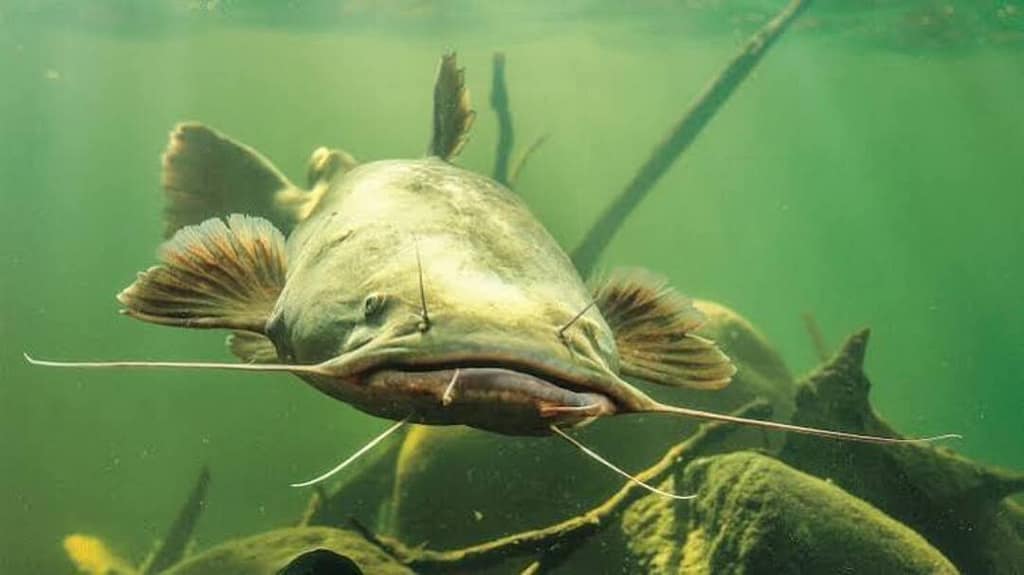
Once a catfish closes the distance, taste takes over and it’s not limited to the mouth. These fish are covered in taste receptors, especially around the barbels and head, allowing them to “sample” a bait before committing.
This is where many presentations fall apart.
If a bait is overly tough, poorly rigged, or cluttered with hardware, the fish may investigate and reject it. The signal is there, but the final check fails. That’s why compact, natural-feeling baits often outperform oversized or heavily treated options.
Think of taste as a final quality control step. It doesn’t attract the fish from afar, but it decides whether the fish stays.
Vibration Makes Bait Feel Alive
Vibration is often misunderstood. It’s not just about noise, it’s about how water moves around an object.
Catfish use a lateral line system to detect pressure changes and movement in the water. This system excels at interpreting nearby disturbances, helping fish locate prey even in complete darkness. Studies on lateral-line sensing in fish show how sensitive this detection can be.
For anglers, that means your bait needs some form of life-like presence.
A bait that drifts slightly, lifts off the bottom, or pulses in current creates a signal the fish can track. A bait buried in silt or pinned flat offers almost nothing for the fish to “feel.”
More isn’t always better, though. Excessive rattles or chaotic movement can create confusing signals, especially in turbulent water. The goal is controlled, readable movement, not noise for its own sake.
Matching the Signal to the Water
Every environment changes how these three signals behave. The best anglers adjust accordingly.
Here’s how each sense translates into practical decisions:
| Signal | What the Fish Detects | Best Angler Move | Common Failure |
|---|---|---|---|
| Smell | Dissolved food compounds in water | Place bait in current lanes or travel paths | Strong bait in dead water |
| Taste | Chemical contact at close range | Use compact, natural-feeling bait | Oversized or rigid presentation |
| Vibration | Water movement and pressure changes | Allow subtle movement or lift | Bait buried or completely static |
The table reveals a pattern: each sense depends on the others. A mistake in one area weakens the entire chain.
The Signals That Reveal a Weak Presentation
Missed bites and slow days often trace back to a broken signal chain.
If fish are present but not biting, the issue is rarely “not enough scent.” More often, it’s misalignment.
A few signs to watch:
- Bait returns untouched in active water: likely out of the scent lane
- Light taps without hookups: taste phase failing
- No response in low visibility: lack of movement or vibration
These are not random outcomes. They’re feedback.
Adjusting position, refining bait size, or introducing subtle movement often fixes the problem faster than changing bait types entirely. The key is recognizing which signal is missing or distorted.
The Edge Comes From Believable Signals
The difference between average and consistent results isn’t a secret bait, it’s understanding how catfish find food and building a presentation that matches that reality.
Smell gets attention, but only when current carries it correctly. Taste confirms the opportunity, but only when the bait feels right. Vibration guides the final approach, but only when movement makes sense in the water.
When those three elements line up, the result is something every angler recognizes: a confident, committed bite.


