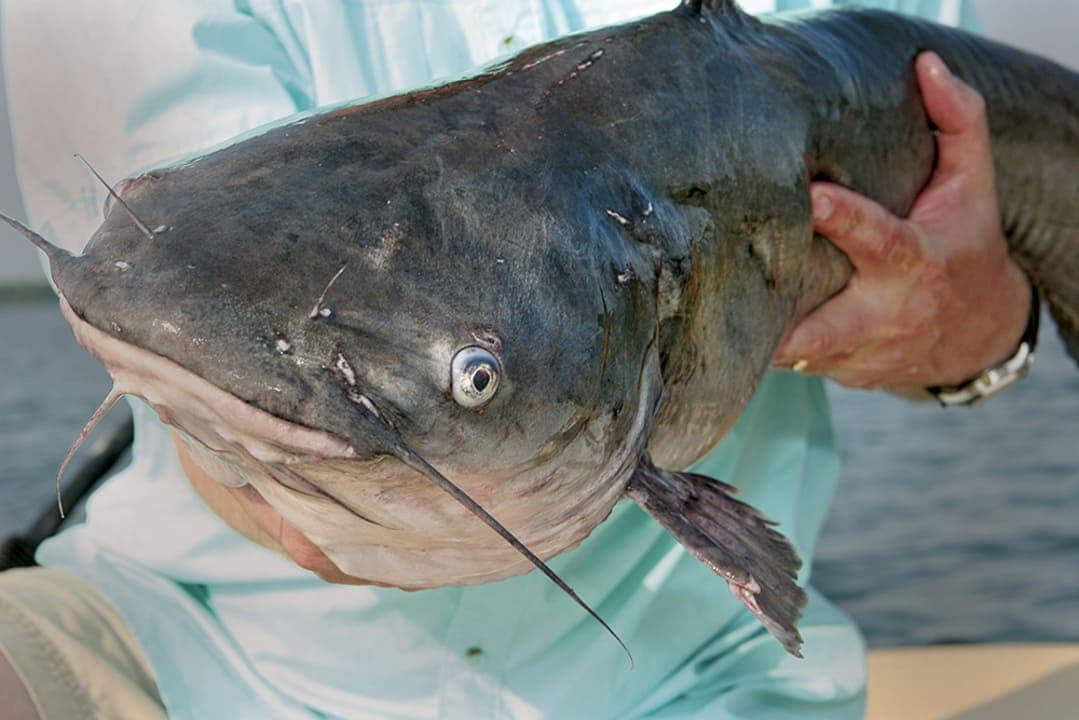

A big flathead catfish is exactly the kind of fish that makes an angler forget everything else living in the river for a few minutes. But recent North Florida flathead catfish sampling is raising a harder question: what happens when the trophy predator fishermen prize also becomes one of the dominant catfish in the system?
Florida fisheries biologists now have enough sampling from the Ochlockonee, Choctawhatchee and Chipola rivers to see a striking pattern. Nonnative catfish represented the largest share of catfish composition in all three rivers studied, while several native catfish showed lower representation where historical comparisons were available. The numbers deserve attention but not the simplistic conclusion that flatheads alone explain every change.
For anglers studying where those opportunities fit into a broader season, the site’s 2026 catfish scouting guide already shows how heavily Florida’s Panhandle rivers figure into big-fish planning.
The Ochlockonee Number Is Hard to Ignore
The Ochlockonee provides the headline.
In FWC’s North Florida catfish sampling, flathead catfish represented 20% of the catfish composition in the older comparison and 80% in the newer one. Channel catfish moved from 23% to 14%, spotted bullheads from 43% to 6%, and white catfish from 17% to about 0.3%.
That is a dramatic redistribution within the sample.
It is also where careful language matters. Species-composition percentages describe the fish collected during standardized sampling. They do not mean biologists counted every catfish in the Ochlockonee and found four out of five were flatheads.
Still, an 80% sample share is difficult to dismiss, particularly when flathead catch rates also rose while several native species fell in the same comparison.
The river anglers know for large flatheads is also becoming an important ecological monitoring site.
North Florida Flathead Catfish Are Nonnative Predators
Flatheads belong naturally in parts of the Mississippi River basin and other central U.S. drainages, but they are nonnative in Florida waters.
FWC says Florida’s flatheads most likely moved south from Georgia’s Flint River after introductions outside their native range. The species subsequently established in multiple Panhandle systems.
Their appeal to anglers is obvious. They grow large, fight hard and favor the sort of woody river habitat that rewards deliberate trophy fishing. Florida’s state-record flathead stands at 69.9 pounds, and agency sampling has encountered fish well into trophy territory.
Ecologically, however, flatheads are formidable predators.
The federal flathead risk assessment identifies predation and competition as documented impacts where the species has been introduced outside its native range. Fish and invertebrate populations have declined in some invaded systems.
Great sportfish and nonnative predator can both be true at once.
Three Rivers Are Showing Different Versions of the Same Shift
The river comparisons make more sense side by side.
| River | Flathead Share | Other Notable Catfish Signal |
|---|---|---|
| Ochlockonee | 20% historically to 80% newer | Spotted bullhead fell from 43% to 6% |
| Choctawhatchee | 55% historically to 61% newer | Blue catfish rose from 0% to 10% |
| Chipola | 48% in 2023 sample | Channel catfish represented 29% |
The Chipola is particularly useful because it shows that the flathead story is not confined to one river. In its 2023 sampling, flatheads represented 48% of catfish composition and were the most abundant ictalurid collected.
The Choctawhatchee presents a different picture. Flatheads were already prominent in the historical data, increasing from 55% to 61%, while blue catfish appeared at 10% in the newer comparison. Channel catfish actually increased from 15% to 29%.
So this is not a single neat story where every native species falls at the same rate.
Each river is responding differently.
Trophy Fishing and Conservation Are Colliding
This is where the issue becomes more interesting than a standard invasive-fish warning.
Flatheads are not unwanted by everyone.
FWC actively recognizes the angling opportunity these fish create. The agency’s current Panhandle catfish guidance points trophy anglers toward the Choctawhatchee and Ochlockonee and notes that biologists collected a 58-pound flathead from the Choctawhatchee and a 48-pounder from the Ochlockonee during 2024 sampling.
That creates a genuine management tension.
A species can support memorable recreational fishing while simultaneously changing the community around it. Fisheries managers are not dealing with a cartoon villain. They are dealing with a successful predator that anglers deliberately target and native species must live beside.
Falling Native Shares Do Not Prove One Simple Cause
The most tempting mistake is to look at declining bullhead percentages, look at rising flatheads and declare the case closed.
The data do not justify that certainty yet.
Predation is biologically plausible and has been documented in introduced flathead populations elsewhere. Florida’s own research also recognizes potential impacts on native species. But river communities change for many reasons, including habitat conditions, floods, sampling variability, recruitment and other ecological pressures.
The distinction between correlation and demonstrated cause matters.
FWC itself says information on North Florida catfish populations remains limited and that continued sampling is needed. That restraint should shape how anglers read these percentages.
The trend deserves investigation, not exaggeration.
More Sampling Will Decide How Big This Story Becomes
The next useful numbers will not come from another giant flathead photograph.
They will come from repeated sampling.
Biologists want to continue monitoring the rivers already studied and expand work into North Florida systems that have gone years without comparable catfish sampling. That should help determine whether current composition changes persist, stabilize or continue moving toward nonnative species.
Anglers should pay particular attention to future spotted bullhead and white catfish results in the Ochlockonee, flathead abundance in the Chipola, and the growing blue-catfish component of the Choctawhatchee.
For North Florida flathead catfish, the story has become larger than trophy weights. These fish have established valuable recreational fisheries, but the newest samples suggest their ecological footprint may be expanding alongside their angling reputation.
Catching a fifty-pound flathead will always make a good photograph.
Understanding what is happening to the rest of the river after that fish swims into the picture may turn out to matter considerably more.


