
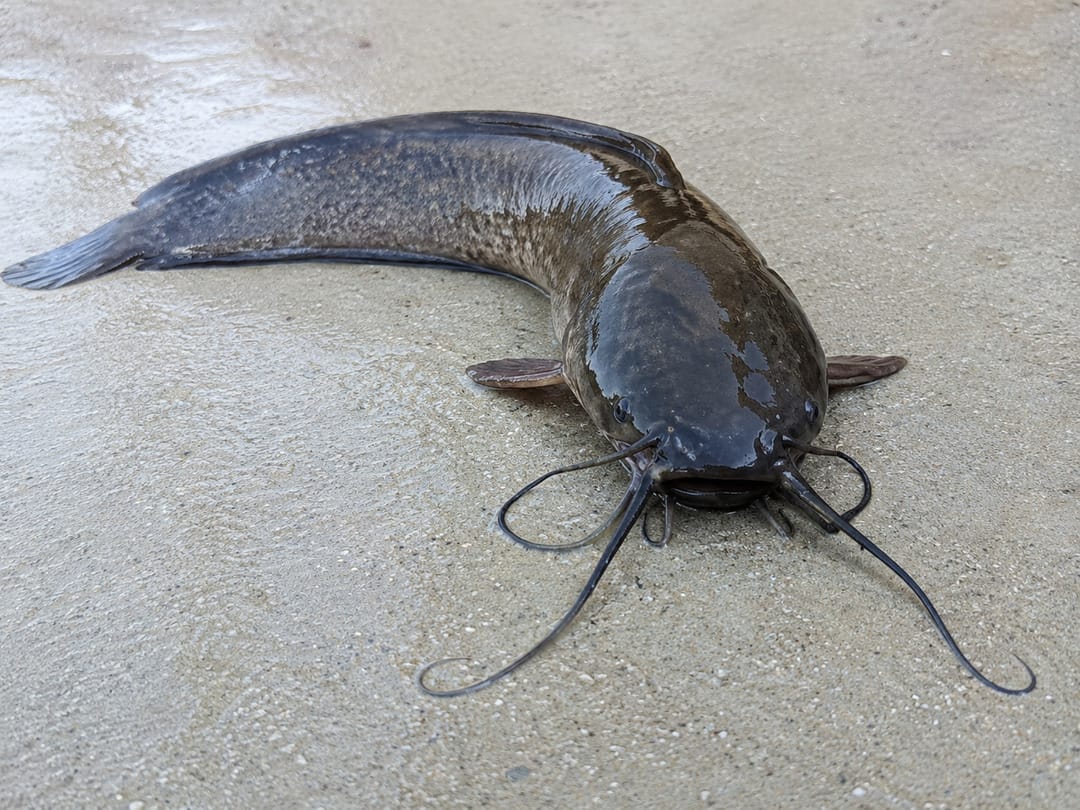

Walking catfish in Florida are not a new invader, but they remain easy to misidentify and even easier to handle incorrectly. The issue for anglers is not panic over a fish that has been here for decades; it is recognizing an established nonnative species whose biology and legal status differ sharply from native catfish.
Federal records still show the species in Florida waters, including observations as recent as 2025. That makes identification practical knowledge for anyone fishing canals, shallow ponds, flood-prone ditches and vegetated backwaters in central and South Florida.
Why Walking Catfish Still Deserve an Angler’s Attention
A walking catfish on the end of a line can look like little more than an unusual catch, especially in waters where nonnative fish are already common. The problem is that this species comes with a different set of identification, handling and legal considerations than many of Florida’s native catfish.
Its ability to tolerate low-oxygen water makes it particularly well suited to canals, shallow ponds, marsh edges and drainage systems. During wet conditions, walking catfish can also move short distances over damp ground, allowing them to reach waters that would be inaccessible to most freshwater fish.
That unusual biology can make encounters seem more dramatic than they really are. A fish appearing in a ditch, flooded roadside area or isolated pond does not necessarily mean a brand-new invasion is underway. Location and verified identification matter before drawing conclusions about where the species is spreading.
For anglers, the practical lesson is to know what is on the hook before deciding what to do next. Walking catfish have been part of Florida’s freshwater landscape for decades, and understanding that history helps separate genuine changes in distribution from ordinary encounters within an established range.
Walking Catfish in Florida Are Established, Not Newly Arrived
Walking catfish reached Florida during the 1960s through the aquarium and fish-farm trade. Early escapes occurred in southeast Florida, while another population appeared around Hillsborough County. The populations later connected as the species expanded through the peninsula.
The current story is persistence. Federal walking catfish distribution records list Florida observations from 1965 through 2025 across 31 hydrologic units. That shows a broad, established footprint, not proof that the fish is advancing into a new county every season.
State wildlife officials say walking catfish are most common in the Everglades and associated canals but occur throughout central and South Florida. Cold weather appears to constrain northward movement. Established does not mean everywhere, and a single sighting should not be treated as evidence of a new population without confirmation.
Florida’s Wet-Dry Cycle Gives This Catfish an Advantage
Walking catfish are unusually suited to shallow habitats that periodically lose oxygen or partly dry out. They can breathe atmospheric oxygen and survive in muddy, temporary waters that would stress many other fish.
That ability explains the “walking” reputation. During wet conditions, especially rainy nights and flooding, they can use their bodies and pectoral fins to make short overland movements. Florida’s canals, drainage systems and seasonal wetlands create plenty of connections between habitats.
Anglers are more likely to encounter them around shallow vegetated water, small ponds, marsh edges and drainage features than in the open middle of a large lake. Familiar approaches such as natural baits for catfish may still catch them, but the handling decision changes once the fish is identified.
How to Identify a Walking Catfish Before You Handle It
At first glance, a walking catfish looks familiar: barbels, a broad mouth and a scaleless body. The details matter because several native Florida catfish are also dark, bottom-oriented fish with sharp spines.
Use overall shape and behavior instead of color alone.
| Identification clue | Walking catfish | Angler takeaway |
|---|---|---|
| Body | Elongated, scaleless, usually gray to dark gray | More stretched-looking than many common native cats |
| Barbels | Four pairs around the mouth | Useful clue, but not enough by itself |
| Pectoral area | Sharp pectoral spines | Control the fish carefully before unhooking |
| Air breathing | Tolerates very low-oxygen water | Remaining active out of water does not make live transport legal |
| Movement | Can make short overland movements | Fish found near flooded drains deserve a closer look |
| Size | Often around 12 inches; can reach about 20 inches | Identification should not depend on size |
Albino individuals can occur, so color is a weak shortcut. Shape, barbels, spines and unusual behavior together provide a much better identification picture.
The Biggest Mistake Happens After the Catch
Walking catfish are a Conditional species in Florida. The state’s walking catfish rules and identification guidance says possession and transportation of live walking catfish is illegal without special state and federal permits. They may be possessed dead, and there is no bag or size limit.
That matters at the boat ramp. Do not place a live fish in a bucket, livewell or cooler planning to identify it later at home. Florida also advises that most nonnative freshwater fish should be harvested rather than released.
If the fish will be kept, state guidance says anglers who want to eat it should put it on ice immediately. The practical rule is simple: identify first, then avoid live transport or release once you know what you have.
The Ecological Story Is More Complicated Than the Nickname
Walking catfish sound like a textbook invasive threat: they breathe air, cross wet ground, feed opportunistically and can enter aquaculture ponds. Federal records document predation on farmed fish, and Florida still considers the species undesirable.
Yet the ecological record is more nuanced than claims that walking catfish have devastated every water body they occupy. Florida’s species profile says early predictions that they would eliminate native fishes proved wrong and that major statewide detrimental effects have not materialized.
A 2026 federal risk assessment still classified the species as high risk because of its invasion history and favorable climate match in Florida and parts of the Southeast. Federal fisheries records also describe its overall impacts as incompletely understood. Control without exaggeration is the more useful position for anglers.
Flooding and Fresh Records Are the Signals to Watch
The most meaningful future evidence will be verified records outside the species’ established footprint, especially after flooding or movement through connected drainage systems. Recent 2025 observations confirm continued presence, but a new database point does not automatically mark a new invasion front.
Anglers can help by photographing unusual catches, recording the exact water body and checking identification before moving a fish. Repeated confirmed records farther beyond central and South Florida would be more significant than another sighting in a canal where the species has existed for decades.
Know the Fish Before You Move It
Walking catfish in Florida show why species identification can carry legal and conservation consequences. The fish is established, adaptable and still being documented, but its presence is more complicated than the image of an unstoppable invader spreading everywhere.
For anglers, the pressure point is immediate: recognize the fish, respect the sharp spines, do not move it alive and do not mistake continued sightings for proof of uncontrolled expansion. Correct handling starts with correct identification, and that is where anglers can make the clearest difference.
Frequently asked questions
Are walking catfish dangerous to handle?
Walking catfish have sharp pectoral spines that can cause painful punctures. Control the fish carefully during hook removal, keep your hands away from the spines, and use pliers when needed.
Can you release a walking catfish in Florida?
Florida generally advises anglers not to release most nonnative freshwater fish. Walking catfish also cannot legally be possessed or transported alive without the required permits, making correct identification at the catch site important.
Can you eat walking catfish caught in Florida?
Yes. Florida allows anglers to possess walking catfish once they are dead, with no species-specific bag or size limit. State guidance recommends immediately putting a retained fish on ice.
Where are walking catfish found in Florida?
Walking catfish are most common in central and South Florida, including canals, wetlands, ponds and drainage systems. They are especially well adapted to shallow, low-oxygen water and seasonally flooded habitats.
How can you tell a walking catfish from a native catfish?
Walking catfish have elongated scaleless bodies, four pairs of barbels and strong pectoral spines. Their ability to breathe air and occasionally move across wet ground also helps distinguish them from native species.


