
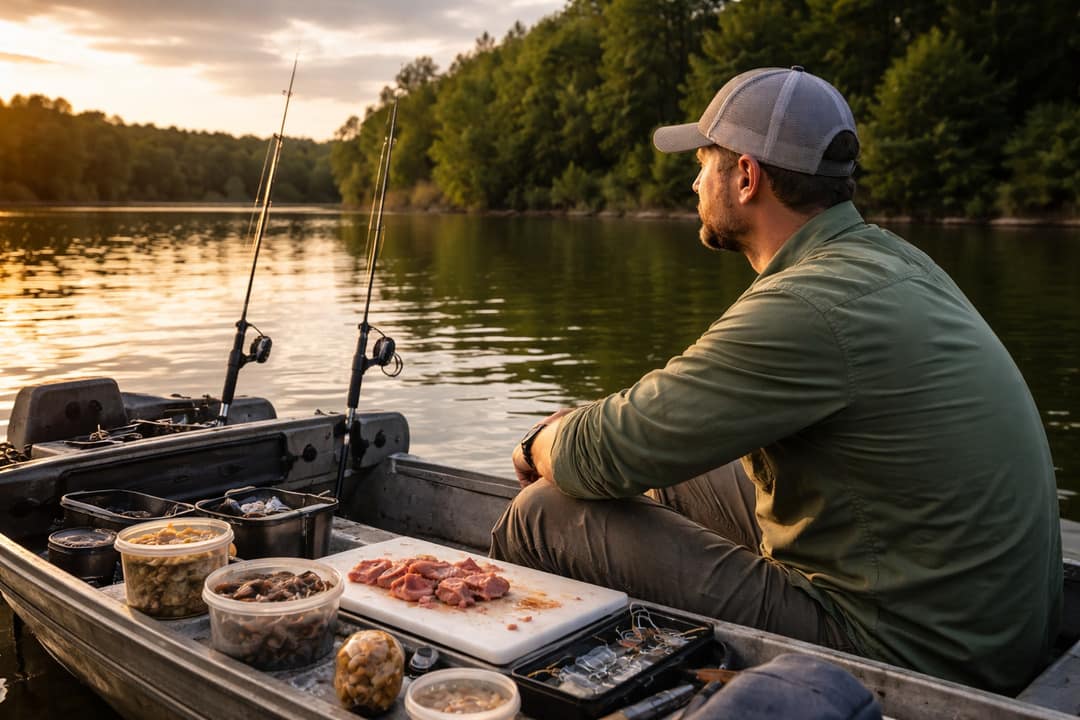

The difference between a slow day and a memorable one often comes down to a detail many anglers overlook: change. Right now, as more fishermen chase efficiency instead of luck, understanding where catfish position themselves has become less of a tip and more of a tactical advantage.
I have spent enough time around rivers, reservoirs, and muddy banks to know that catfish rarely behave as randomly as people assume. They are opportunists, but they are not wanderers. More often than not, they relate to edges, seams, and bottom shifts the places where one condition gives way to another. That simple truth explains why anglers who learn to read transitions tend to outperform everyone else on the water.
Why Change Attracts Catfish
Catfish are built to exploit environments that offer both security and feeding opportunity. A transition gives them exactly that. Where deep water slides into a shallow flat, they gain quick access to two worlds: a safe holding area and a feeding shelf. Where heavy current relaxes into slower water, they can conserve energy while staying close to food drifting by. Where mud turns to rock, the underwater landscape becomes more complex, often concentrating bait, scent, and movement.
That is why catfish are often less attached to a single spot than to a shift in conditions. They do not need uniform water. They prefer contrast.
This matters because many anglers still think in overly broad terms. They fish “the cove,” “the hole,” or “the bank” without narrowing their target any further. Catfish, however, are usually not spread evenly across those larger zones. They tend to favor the line where one feature becomes another. In practical terms, the fish may not be all over the deep hole; they may be sitting on the lip where it rises toward shallower water. They may not be in the strongest push of the river; they may be just off it, on the inside edge where the flow softens.
Deep-To-Shallow Edges Are Feeding Highways
Among the most reliable catfish holding areas is the drop or rise between deep and shallow water. These edges function like underwater travel routes. During low light, catfish can move up onto flats to feed, then slide back toward deeper water when conditions brighten or pressure changes. The edge becomes the staging point between rest and activity.
I look at these areas as natural checkpoints. A flat may hold forage, but the adjoining depth gives catfish comfort and escape. That combination is powerful. It allows a fish to move efficiently without exposing itself for long. On many waters, especially heavily fished ones, that efficiency seems to matter more than ever.
For anglers, this means placement is everything. Casting blindly into the middle of a flat can waste time. Working the break line, the ledge, or the contour where the flat begins often puts bait in front of fish that are already positioned to feed. Even a subtle change in depth can be enough. Catfish do not need dramatic structure; they need a reason to stop.
Current Breaks Offer the Best Of Both Worlds
Current creates life in moving water, but catfish are not interested in fighting it unnecessarily. They want proximity to food without burning energy. That is why the seam between fast current and calmer water is so productive. It gives them an ambush lane and a resting zone at the same time.
I have seen anglers make the mistake of throwing directly into the fastest water because it feels active. Sometimes that works, but often the better move is to target the soft edge beside it. The current carries scent and food. The calm pocket provides comfort. The fish hold where the math makes sense.
This is especially true around bends, bridge pilings, laydowns, and current-deflecting structure. In those places, water creates invisible lanes. Catfish understand those lanes instinctively. They settle where the buffet keeps moving but the effort stays low.
That principle is central to catfish fishing transitions: the best water is often not one condition or the other, but the exact line where those conditions meet.
Bottom Changes Concentrate Fish More Than Anglers Realize
Not every productive transition is easy to see from the bank. Some of the most important changes happen on the bottom. A shift from mud to rock, silt to gravel, or soft bottom to firmer substrate can alter how bait moves, how scent settles, and where forage holds. Catfish respond to those differences.
Mud can hold food and smell, while rock can offer harder structure, irregularities, and small shelter zones. Where the two meet, the environment becomes more dynamic. That tends to attract life, and life attracts catfish.
This is where experience often separates casual fishing from intentional fishing. An angler who pays attention to how a sinker drags, how the rod transmits bottom composition, or where snags begin and end is gathering valuable information. The bottom is telling a story long before a fish bites. If it changes beneath you, there is a good chance the pattern above it changes too.
Why This Approach Works Right Now
Fishing pressure has made many species harder to pattern in obvious places. Catfish remain accessible, but the easy assumptions do not always hold. Simply soaking bait in a general area is no longer enough when better-informed anglers are dissecting water more precisely. The transition mindset offers an answer because it replaces guesswork with logic.
It also suits the way modern anglers fish. Whether someone is on a big river with electronics or on a local bank with simple tackle, transitions are readable. A contour change, a current seam, or a bottom shift can be identified with observation and patience. The concept scales up or down, which is part of its enduring value.
In my view, that is what makes this subject especially relevant now. It is not trendy advice. It is foundational water-reading that helps anglers become sharper in any season and on nearly any body of water.
Fish The Change, Not The Crowd
The real lesson is straightforward: stop treating catfish water as a single, uniform space. Look for contrast. Look for the point where deep becomes shallow, where fast becomes calm, where mud becomes rock. Those lines are not accidents in the landscape. They are magnets for movement, feeding, and opportunity.
That matters right now because successful fishing increasingly belongs to the angler who can interpret water rather than simply occupy it. Catfish still reward patience, but they reward precision even more. Find the change, and you are no longer hoping a fish passes by. You are fishing where catfish are most likely to live, feed, and hold.


