
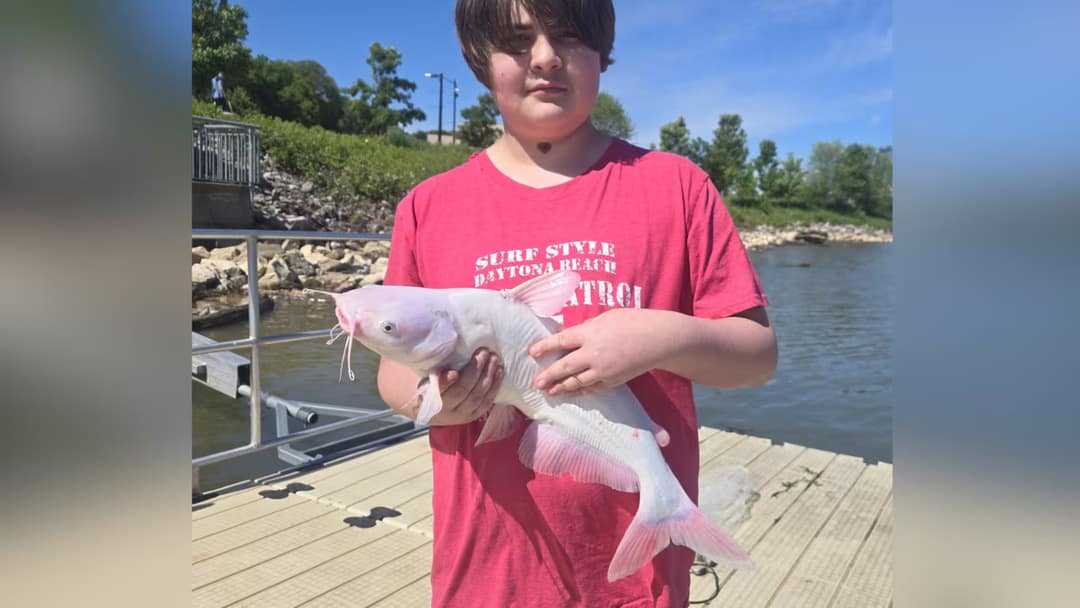

An 11-year-old boy catching a rare albino blue catfish on the Tennessee River is more than a sweet fishing story. It is the kind of moment that reminds anglers why rivers still feel unpredictable, why family fishing still matters, and why one unusual catch can turn an ordinary weekend into a memory that travels far beyond the boat ramp.
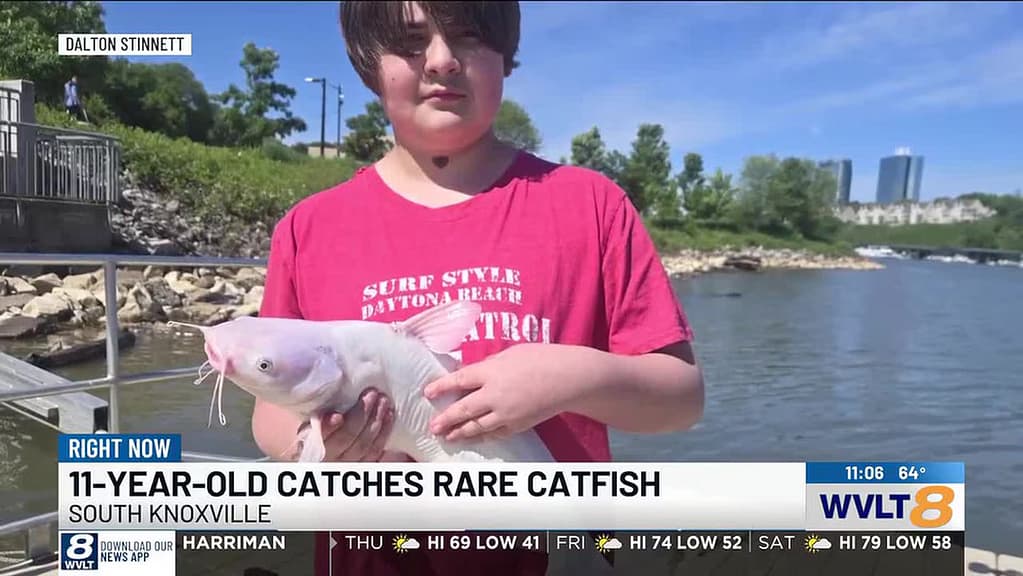
The story of the rare albino blue catfish centers on Oliver Stinnett, who was fishing with his father at Suttree Landing Park in South Knoxville when the pale, unmistakable catfish came to hand. The fish was photographed and released, which is exactly the detail that gives the story its larger value. It is not just about rarity. It is about judgment, restraint, and the kind of outdoor culture that treats a catch as something bigger than possession.
Why One Rare Catch Is Getting So Much Attention
A rare fish always has a natural pull on the public imagination. Anglers know that feeling immediately. Most trips produce the familiar rhythm: bait, cast, wait, miss, reset, repeat. Then, sometimes, the water gives up something strange enough to stop everyone nearby.
That is what makes this Tennessee River catch so easy to understand. The fish was not simply another catfish. Its unusual coloration turned a local family outing into a broader conversation about nature, genetics, youth fishing, and catch-and-release ethics. For readers who do not follow fishing closely, the word “albino” does most of the work. It signals rarity before anyone even asks about species, size, tackle, bait, or river conditions.
For catfish anglers, the story lands differently. Blue catfish already carry a reputation for size and power. They are one of the species that can make a casual outing feel suddenly serious. When a young angler connects with a fish that looks unlike almost anything most people have seen in person, the catch becomes a reminder that familiar waters can still hold surprises.
There is also a timing element. Late spring is when many anglers are already thinking hard about catfish movement, warming water, feeding windows, and pre-spawn behavior. That makes the story feel current, not just cute. It fits into the season’s larger momentum, when more families are near the water and more anglers are paying attention to what is biting.
The Human Side Of A Rare Albino Blue Catfish
The strongest part of this story is not the species label. It is the father-son setting. Fishing stories work best when they carry a human center, and this one has it: a young angler, a weekend trip, a public riverfront, a fish no one expected, and a release that kept the moment clean.
I have always believed fishing has a way of compressing lessons that adults often overcomplicate. Patience becomes visible. Preparation matters, but luck still has a say. Excitement has to be managed. The person holding the rod has to decide what happens next.
For a young angler, that sequence can be powerful. Catching an unusual fish creates confidence, but releasing it creates perspective. It teaches that the best outdoor stories do not always end with a cooler, a mount, or a record application. Sometimes the best ending is a photo, a careful release, and a river that gets its fish back.
That is why the catch resonated. It was not framed as domination over nature. It felt more like a brief encounter with something rare. The fish appeared, drew attention, gave a child a story, and returned to the system that produced it.
That distinction matters because recreational fishing is often misunderstood by people outside the sport. The best anglers are not simply chasing extraction. Many are practicing observation. They watch water levels, bait movement, pressure, temperature, current seams, and fish behavior. They develop respect because the river is never fully under their control.
What Makes Albino Catfish So Unusual
Albinism in fish is visually striking because it interrupts the coloration most people expect to see. In practical terms, a pale fish is more noticeable, and that can make survival harder in the wild. Predators, visibility, and environmental exposure all become part of the story.
That does not mean every unusually light fish is identical. Anglers often use “albino” casually when they see a white or pale fish, but biology can be more nuanced. Some fish are truly albino, while others may be leucistic or affected by different pigmentation conditions. The public conversation usually moves faster than the technical distinction, especially when a fish is caught, photographed, and released quickly.
Still, the core point holds: a pale blue catfish in a public river setting is not an everyday catch. That is why people reacted. It is also why the story traveled. A normal catfish might impress a child. A pale catfish can stop a walkway.
Blue catfish themselves are impressive even without unusual coloration. They are powerful river fish with broad heads, deep bodies, and the capacity to grow large in productive systems. The blue catfish has long carried a certain mythology among freshwater anglers because it combines accessibility with the possibility of genuine size.
That mix is part of the species’ appeal. A child can catch one. A trophy hunter can build an entire season around one. A family can fish from a public bank and still feel connected to the same river system that produces heavyweight fish for serious catfish specialists.
Why Catch And Release Changes The Story
The release is not a minor detail. It is the ethical hinge of the entire story.
Had the fish been kept, the public reaction would have been different. Some anglers would still have celebrated the catch, but the larger emotional charge would have shifted. By releasing it, Oliver and his father turned the moment into a conservation-friendly example rather than a possession story.
That choice creates credibility. It shows the fish was valued not only as a curiosity but as a living part of the river. It also lets the story carry a better lesson for young anglers. A rare catch does not have to be removed to be meaningful.
Catch and release is not automatically simple. Fish handling matters. Time out of water matters. Hooks, slime coat, water temperature, and release condition all matter. But the principle is clear: when an unusual fish comes to hand, especially one that may be rare in appearance, a careful release is often the strongest decision.
That is especially true when the fish has no obvious harvest purpose. A rare-looking catfish has more public and educational impact alive than it does as a one-time novelty. Its value becomes symbolic. It reminds people that rivers are not just channels of water. They are living systems that still produce surprises.
The release also softens the competitive instinct that can dominate fishing culture. Not every notable catch needs to become a measuring contest. Not every fish has to be translated into pounds, inches, or status. Sometimes the story works because it resists that impulse.
A Small Moment With A Bigger Conservation Message
The Tennessee catch also fits into a wider conversation about how anglers interact with catfish populations. In some waters, blue catfish are native or deeply established parts of the fishery. In others, they can become invasive predators that create serious management questions. That difference matters.
Anglers should not flatten every blue catfish story into the same category. Location, ecosystem, regulation, and management goals all shape the right response. A fish that is celebrated in one river system may be targeted for removal in another. That is not contradiction. It is fisheries management.
This is where public storytelling can help. A feel-good catch brings people in. Conservation context keeps the discussion honest. When readers understand that species, place, and management goals change the meaning of a catch, they become better outdoor citizens.
That is why conversations around conservation-minded catfish tournaments are increasingly relevant. They show how fishing can be framed not only as recreation but also as participation in ecosystem management, especially where invasive catfish pressure affects native species and local fisheries.
The larger lesson is not that every catfish should be released. It is that anglers should know the water they are fishing. They should understand local rules, species status, and the ecological role of the fish they catch. That kind of clarity turns a hobby into stewardship.
What The Tennessee River Setting Adds To The Story
The Tennessee River gives this catch a stronger sense of place. This was not a private pond story hidden away from public view. Suttree Landing Park sits in an urban riverfront environment, which means the catch happened in a setting where fishing, walking, family time, and city life overlap.
That matters. Urban and near-urban fishing access is one of the most underrated pieces of outdoor culture. Not every young angler grows up with a boat, a farm pond, or a remote cabin. Public riverfronts can become the entry point.
When a child catches a rare fish at a public park, it reinforces the access argument. People protect what they can experience. Families are more likely to care about rivers when rivers are visible, reachable, and capable of producing memorable encounters.
There is also a democratic quality to bank and park fishing. It does not require a tournament rig or a specialized guide trip. It requires time, curiosity, some tackle, and a willingness to be there. For many families, that is exactly the point.
Fishing needs those easy entry points. The sport cannot depend only on high-end boats, electronics, destination trips, or advanced techniques. Its future depends on ordinary places where a parent can take a child after work or on a weekend morning. A rare catch from a public riverfront reminds everyone that possibility is still out there.
What Anglers Can Learn From The Catch
This was not a technical fishing report in the usual sense. The lesson is not a secret bait recipe or a guaranteed pattern. Still, there are practical takeaways for anglers paying attention.
| Lesson | Why It Matters |
|---|---|
| Fish ordinary places consistently | Rare catches often happen during regular trips, not perfect ones |
| Keep a camera ready | A clean photo can preserve the moment without keeping the fish |
| Handle unusual fish carefully | Rare-looking catches deserve extra care and quick release decisions |
| Teach kids the full process | Landing, identifying, photographing, and releasing all matter |
| Know local species context | Catfish management depends heavily on the specific waterbody |
The first lesson may be the most useful: show up. Anglers often talk themselves out of fishing unless conditions are perfect. The wind is wrong. The moon is wrong. The river is too high. The schedule is tight. Yet many memorable catches happen because someone went anyway.
The second lesson is about readiness. A phone photo is now part of modern fishing culture, but there is a difference between documenting a fish and mishandling it for attention. Anglers should think ahead. Wet hands, support the fish properly, keep it low when possible, minimize air exposure, and release it with care.
The third lesson is about humility. Nobody can fully script a river. You can understand seasonal patterns, current, bait, and structure, but the fish still has the final vote. That uncertainty is not a flaw in fishing. It is the appeal.
Why Youth Fishing Stories Still Matter
Fishing media often leans toward extremes: giant fish, expensive gear, tournament drama, record claims, and high-pressure tactics. Those stories have their place, but they do not carry the same emotional reach as a child catching something remarkable with a parent nearby.
Youth fishing stories matter because they show the sport renewing itself. They remind older anglers that the next generation does not fall in love with fishing through lectures. Kids fall in love with fishing through moments.
Sometimes the moment is a bobber disappearing. Sometimes it is a first bluegill. Sometimes it is a catfish tugging hard enough to turn surprise into panic. And once in a while, it is a pale catfish that makes strangers stop and stare.
Those moments create memory. They become family shorthand. Years later, the exact size of the fish may be uncertain, but the scene stays sharp: where they stood, who was there, how the fish looked, how everyone reacted.
That is why parents and mentors should not underestimate small trips. A child does not need a professionally planned expedition to become an angler. A nearby river, a simple setup, and a patient adult can be enough. The Tennessee story proves that ordinary access can produce extraordinary meaning.
The Editorial Lesson: Why This Story Travels
From an editorial perspective, the story works because it has several clean elements: youth, rarity, family, public place, recognizable species, and a responsible ending. That combination is stronger than a generic big-fish headline.
The public is drawn to rare animals, but the story needed more than novelty. It needed emotional shape. The father-son detail gives it warmth. The public park gives it relatability. The release gives it moral closure. The fish gives it visual power.
That structure is why the story can appeal beyond the fishing community. Non-anglers may not know the difference between a blue catfish and a channel catfish, but they understand a child’s excitement. They understand a parent’s pride. They understand the instinct to protect something rare once it has been seen.
For publishers, that is the larger signal. Outdoor stories do not always need to be technical to be valuable. A well-framed fishing story can speak to family, ecology, access, conservation, and regional identity at once.
The risk is overinflating the catch into something it is not. Responsible coverage should avoid turning a rare fish into a miracle or making unsupported biological claims. The better approach is grounded enthusiasm: unusual fish, memorable moment, careful release, useful lesson.
The Balance Between Wonder And Accuracy
Rare catch stories can easily drift into exaggeration. That is part of the challenge. Anglers love a good story, and the public loves an unbelievable animal. But outdoor writing works best when wonder and accuracy stay in balance.
A fish can be rare without being mythic. A child’s catch can be impressive without turning into a record claim. A public reaction can be meaningful without pretending the entire fishery has changed overnight.
That balance protects trust. Readers can feel when a story is being stretched. They do not need inflated language when the facts are already compelling. An 11-year-old catching and releasing an unusually pale catfish on the Tennessee River is strong enough on its own.
The same discipline applies to conservation language. A single released fish does not solve river management. It does not prove a population trend. It does not tell us everything about genetics or survival rates. But it does provide a useful entry point into those discussions.
That is the best use of the story: not as proof of some sweeping change, but as a doorway. It invites readers to think about fish biology, public access, youth fishing, responsible handling, and the role anglers play in shaping how outdoor moments are remembered.
What This Means For Catfish Culture
Catfish culture has always been broader than many outsiders realize. It includes bank anglers, jugliners, tournament teams, conservation-minded harvest efforts, trophy hunters, family fishermen, night crews, river specialists, and weekend beginners. That variety creates tension, but it also gives the community depth.
A rare albino catch sits at the softer edge of that culture. It is not about who has the best electronics or who can drag the heaviest fish onto a scale. It is about the shared awe that still exists when something unusual comes out of the water.
That awe is healthy. Fishing can become overly transactional when every trip is judged by efficiency. How many fish? How many pounds? How many views? How quickly can the moment be monetized? Stories like this push back against that mindset.
They remind anglers that the sport is also about attention. It is about noticing color, movement, water, weather, and the small differences that make one catch stand apart from another. That kind of attention builds discipline over time.
It also builds better ambassadors. A young angler who learns to release a rare fish carefully may become an adult who respects regulations, understands species differences, and teaches the next child with patience. That is how outdoor ethics actually spread.
Why The Best Fishing Stories Are Not Always The Biggest
There is a reason this catch resonates even without a headline about record weight. Size is only one kind of fishing drama. Rarity is another. So is setting. So is age. So is the decision made after the fish is caught.
The biggest fish of a season may impress serious anglers, but the most memorable fish is often the one with the strongest story. In this case, the story is clean and durable. A boy went fishing with his father. He caught something rare. People noticed. He let it go.
That sequence has power because it is easy to retell. It does not require complex explanation. It does not depend on technical jargon. It has a beginning, surprise, reaction, and resolution.
For families, that matters. Parents looking for reasons to take kids fishing do not need a lecture about participation trends. They need reminders that a short trip can become a defining memory. They need to see that the barrier to entry can be lower than they think.
A rare fish is never promised. That is what makes the story work. The real invitation is not “go catch one like this.” The invitation is “go often enough that the water has a chance to surprise you.”
The Takeaway For Anglers, Parents, And River Communities
The rare albino catfish story should not be treated as a disposable curiosity. It is a small but useful reminder of what healthy outdoor culture can look like when access, family, excitement, and restraint meet in the same moment.
For anglers, the takeaway is to handle unusual catches with care and think beyond bragging rights. For parents, it is to make time for simple trips, even when conditions are not perfect. For river communities, it is to protect public access because those places create the stories that connect people to water.
For publishers and fishing organizations, the story is a lesson in storytelling. The most shareable outdoor moments are not always the loudest. They are often the most human.
The fish itself may never be seen again. That is part of the beauty. It returned to the Tennessee River, leaving behind a photograph, a family memory, and a public reminder that rare things still happen close to home.
What Readers Should Think About Next
The next step is not to chase an albino catfish as if rarity can be scheduled. The better question is how anglers can create the conditions for more meaningful days on the water.
That starts with access. Are local riverfronts safe, clean, and fishable? Are families encouraged to use them? Are young anglers learning not just how to catch fish, but how to identify, handle, and release them responsibly?
It also starts with local knowledge. Catfish are not the same management issue everywhere. In some regions, they are treasured sport fish. In others, they create ecological pressure that calls for targeted harvest. Responsible anglers understand the difference.
The Tennessee story matters now because it gives the fishing community a positive example at the right time of year. Families are getting outdoors. Catfish are active. Rivers are busy again. One unusual catch can help reset the conversation around what fishing is supposed to offer.
A rare albino blue catfish is not just a strange-looking fish. It is a reminder that wonder still belongs in fishing, that young anglers need real experiences more than perfect conditions, and that the best outdoor memories often come from treating the resource with care. That is why this rare albino blue catfish story deserves more than a quick smile before the news cycle moves on.


